 Add to Chrome
 Add to Firefox
 Add to Edge
Learning to Reason with Curriculum II: Compositional Generalization
Jun 26, 2026
Compositional generalization, the ability to solve complex problems by combining solutions to simpler sub-problems, is a fundamental capability of both natural and artificial intelligence, and a key mechanism underlying chain-of-thought reasoning. However, the theoretical underpinnings of compositional generalization remain poorly understood: when and why does decomposing a problem into parts yield more efficient learning than solving it directly? We study this question through the canonical problem of learning to simulate semiautomata (predicting the outcome of $T$ steps of sequential computation), a model that captures state tracking, regular language recognition, and modular arithmetic. We show that an autocurriculum-based approach building on Part I of this series, recursively decomposing longer sequences into shorter sub-problems, learning to solve them, and composing the solutions, achieves dramatically better statistical complexity than direct methods. (i) For a setting inspired by supervised fine-tuning (SFT) where the learner receives interactive feedback on intermediate states of the computation, curriculum facilitates learning from only $2^{\mathcal{O}(\sqrt{\log T})}$ tokens of supervision; i.e., subpolynomial in the sequence length $T$, overcoming the $Ω(T)$ token barrier required by direct simulation. (ii) For a setting inspired by reinforcement learning with verifiable rewards (RLVR), where the learner improves a pre-trained reference model using an outcome verifier, we show that curriculum reduces the requirement on the reference model from coverage at the full sequence length $T$ to coverage at a shorter block length $B \ll T$, an exponentially weaker condition.

Efficient Contextual Bandits with Knapsacks via Regression
Nov 14, 2022We consider contextual bandits with knapsacks (CBwK), a variant of the contextual bandit which places global constraints on budget consumption. We present a new algorithm that is simple, statistically optimal, and computationally efficient. Our algorithm combines LagrangeBwK (Immorlica et al., FOCS'19), a Lagrangian-based technique for CBwK, and SquareCB (Foster and Rakhlin, ICML'20), a regression-based technique for contextual bandits. Our analysis emphasizes the modularity of both techniques.
Guaranteed Discovery of Controllable Latent States with Multi-Step Inverse Models
Jul 17, 2022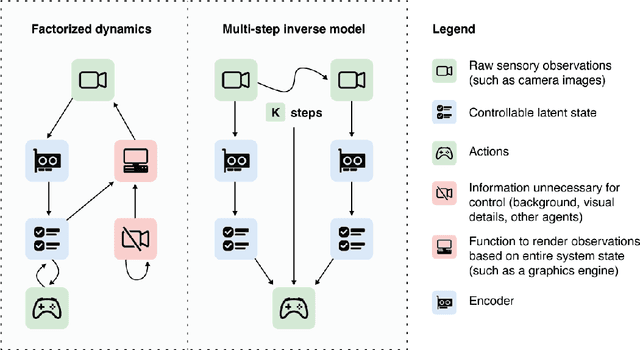
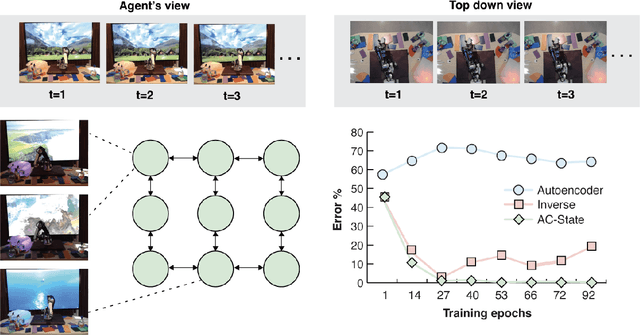
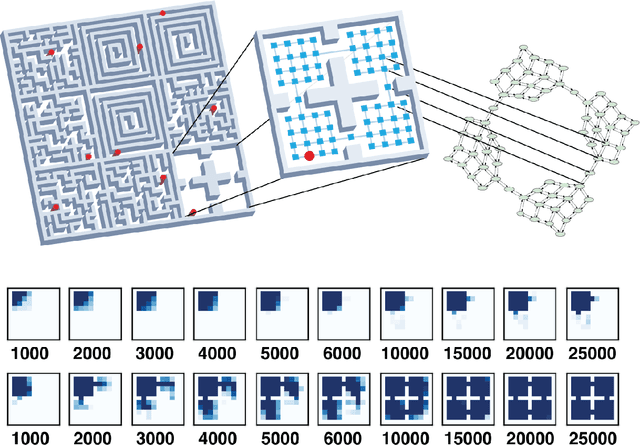
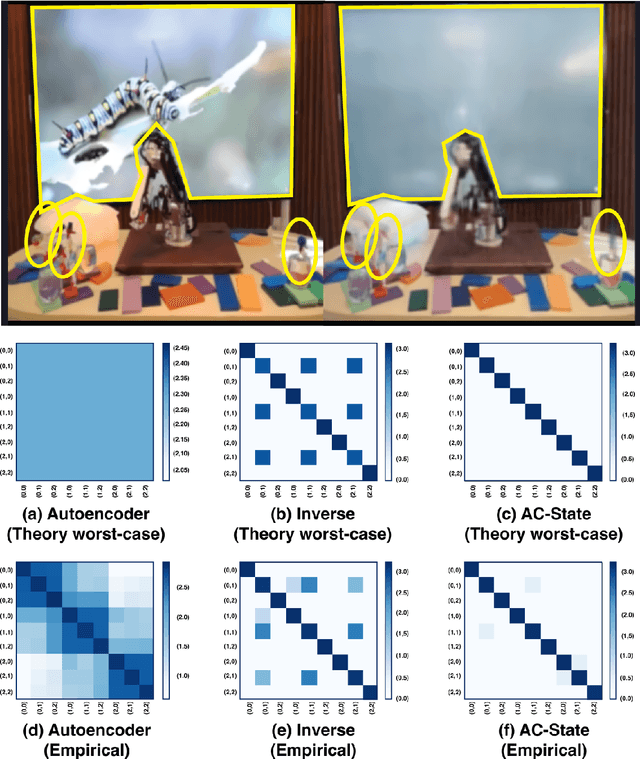
A person walking along a city street who tries to model all aspects of the world would quickly be overwhelmed by a multitude of shops, cars, and people moving in and out of view, following their own complex and inscrutable dynamics. Exploration and navigation in such an environment is an everyday task, requiring no vast exertion of mental resources. Is it possible to turn this fire hose of sensory information into a minimal latent state which is necessary and sufficient for an agent to successfully act in the world? We formulate this question concretely, and propose the Agent-Controllable State Discovery algorithm (AC-State), which has theoretical guarantees and is practically demonstrated to discover the \textit{minimal controllable latent state} which contains all of the information necessary for controlling the agent, while fully discarding all irrelevant information. This algorithm consists of a multi-step inverse model (predicting actions from distant observations) with an information bottleneck. AC-State enables localization, exploration, and navigation without reward or demonstrations. We demonstrate the discovery of controllable latent state in three domains: localizing a robot arm with distractions (e.g., changing lighting conditions and background), exploring in a maze alongside other agents, and navigating in the Matterport house simulator.