 Add to Chrome
 Add to Firefox
 Add to Edge
DeWorldSG: Depth-Aware 3D Semantic Scene Graph Generation via World-Model Priors
Jul 01, 2026
We present DeWorldSG, a novel framework that generates spatio-temporally robust 3D Semantic Scene Graphs from RGB-D sequences. Existing methods often struggle to construct reliable 3D scene graphs due to unstable 3D object representations and missing relations caused by frame-wise inference. DeWorldSG addresses these issues by estimating instance-level geometric 3D Gaussian distributions through depth-guided filtering and representing each object as a probabilistic 3D node rather than a single projected point. To mitigate relational sparsity from frame-wise inference, our framework further aggregates spatiotemporal evidence across object pairs and refines relations using contextual priors derived from a world model (V-JEPA 2). Experiments on the 3DSSG and ReplicaSSG datasets demonstrate state-of-the-art (SoTA) performance in both object and predicate prediction, while producing temporally consistent scene structures. In particular, our method improves triplet recall by 77.4% and predicate recall by 23.2% over prior SoTA approaches, making it suitable for robotic manipulation and AR applications. Our code and models are open-sourced.

Int3DNet: Scene-Motion Cross Attention Network for 3D Intention Prediction in Mixed Reality
Mar 09, 2026We propose Int3DNet, a scene-aware network that predicts 3D intention areas directly from scene geometry and head-hand motion cues, enabling robust human intention prediction without explicit object-level perception. In Mixed Reality (MR), intention prediction is critical as it enables the system to anticipate user actions and respond proactively, reducing interaction delays and ensuring seamless user experiences. Our method employs a cross attention fusion of sparse motion cues and scene point clouds, offering a novel approach that directly interprets the user's spatial intention within the scene. We evaluated Int3DNet on MoGaze and CIRCLE datasets, which are public datasets for full-body human-scene interactions, showing consistent performance across time horizons of up to 1500 ms and outperforming the baselines, even in diverse and unseen scenes. Moreover, we demonstrate the usability of proposed method through a demonstration of efficient visual question answering (VQA) based on intention areas. Int3DNet provides reliable 3D intention areas derived from head-hand motion and scene geometry, thus enabling seamless interaction between humans and MR systems through proactive processing of intention areas.
SceneLinker: Compositional 3D Scene Generation via Semantic Scene Graph from RGB Sequences
Feb 03, 2026We introduce SceneLinker, a novel framework that generates compositional 3D scenes via semantic scene graph from RGB sequences. To adaptively experience Mixed Reality (MR) content based on each user's space, it is essential to generate a 3D scene that reflects the real-world layout by compactly capturing the semantic cues of the surroundings. Prior works struggled to fully capture the contextual relationship between objects or mainly focused on synthesizing diverse shapes, making it challenging to generate 3D scenes aligned with object arrangements. We address these challenges by designing a graph network with cross-check feature attention for scene graph prediction and constructing a graph-variational autoencoder (graph-VAE), which consists of a joint shape and layout block for 3D scene generation. Experiments on the 3RScan/3DSSG and SG-FRONT datasets demonstrate that our approach outperforms state-of-the-art methods in both quantitative and qualitative evaluations, even in complex indoor environments and under challenging scene graph constraints. Our work enables users to generate consistent 3D spaces from their physical environments via scene graphs, allowing them to create spatial MR content. Project page is https://scenelinker2026.github.io.
DAPI: Domain Adaptive Toxicity Probe Vector Intervention for Fine-Grained Detoxification
Mar 17, 2025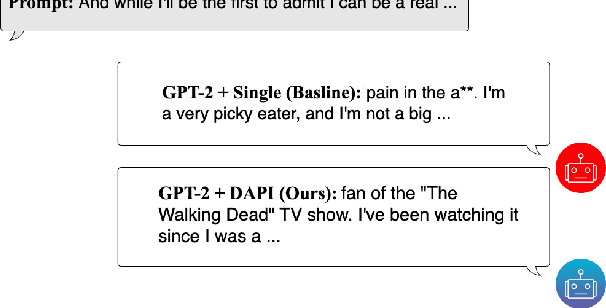
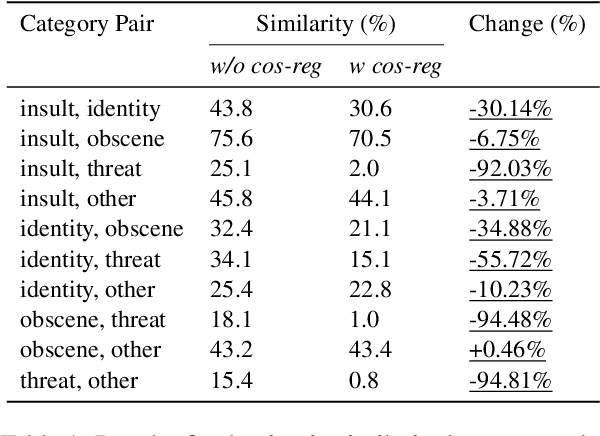
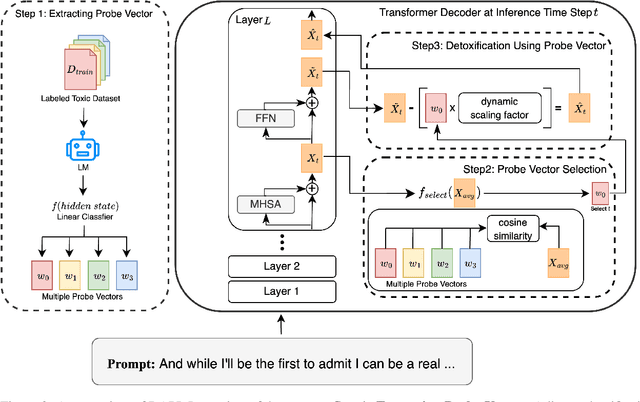
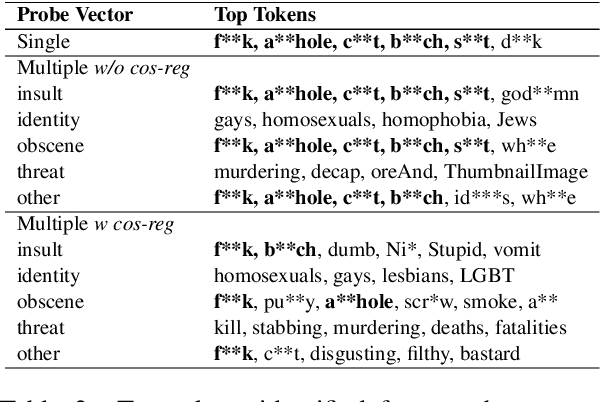
There have been attempts to utilize linear probe for detoxification, with existing studies relying on a single toxicity probe vector to reduce toxicity. However, toxicity can be fine-grained into various subcategories, making it difficult to remove certain types of toxicity by using a single toxicity probe vector. To address this limitation, we propose a category-specific toxicity probe vector approach. First, we train multiple toxicity probe vectors for different toxicity categories. During generation, we dynamically select the most relevant toxicity probe vector based on the current context. Finally, the selected vector is dynamically scaled and subtracted from model. Our method successfully mitigated toxicity from categories that the single probe vector approach failed to detoxify. Experiments demonstrate that our approach achieves up to a 78.52% reduction in toxicity on the evaluation dataset, while fluency remains nearly unchanged, with only a 0.052% drop compared to the unsteered model.
Efficient Monte Carlo Tree Search via On-the-Fly State-Conditioned Action Abstraction
Jun 02, 2024Monte Carlo Tree Search (MCTS) has showcased its efficacy across a broad spectrum of decision-making problems. However, its performance often degrades under vast combinatorial action space, especially where an action is composed of multiple sub-actions. In this work, we propose an action abstraction based on the compositional structure between a state and sub-actions for improving the efficiency of MCTS under a factored action space. Our method learns a latent dynamics model with an auxiliary network that captures sub-actions relevant to the transition on the current state, which we call state-conditioned action abstraction. Notably, it infers such compositional relationships from high-dimensional observations without the known environment model. During the tree traversal, our method constructs the state-conditioned action abstraction for each node on-the-fly, reducing the search space by discarding the exploration of redundant sub-actions. Experimental results demonstrate the superior sample efficiency of our method compared to vanilla MuZero, which suffers from expansive action space.