 Add to Chrome
 Add to Firefox
 Add to Edge
S-Avatar: Diffusion-Guided Gaussian Head Avatars from a Single Image
Jul 30, 2026
We propose S-Avatar, a novel method for generating photorealistic 3D head avatars from a single image using a diffusion-guided 3D model generation module and strategies for animating 3D Gaussian Splatting (3DGS). While single-image head avatar reconstruction is crucial for lifelike Virtual Reality (VR) applications, existing approaches often struggle to preserve 3D consistency under unseen viewpoints. S-Avatar addresses this limitation through a three-stage pipeline. First, a high-resolution 3DGS is synthesized directly from a single image using a diffusion-based Gaussian splat generation module. Next, the parametric head model FLAME is aligned with the generated 3DGS by optimizing its parameters and spatial transformations. Finally, to adapt the 3DGS to FLAME variations, we construct a binding template that encodes the spatial relationship between the initial splats and FLAME. The dynamic 3D head avatar can then be rendered in real time by deforming the 3DGS with the binding template. By combining diffusion-guided canonical 3DGS generation with FLAME-based control, our method achieves efficient and accurate reconstruction with enhanced 3D consistency. Evaluations on public datasets demonstrate that S-Avatar outperforms state-of-the-art methods in novel-view and expression generation, achieving superior realism and consistency. Consequently, our approach represents a significant advance in accessible avatar creation, applicable to a wide range of VR/AR applications. The project page is available at https://github.com/hailsong/savatar.

SceneLinker: Compositional 3D Scene Generation via Semantic Scene Graph from RGB Sequences
Feb 03, 2026We introduce SceneLinker, a novel framework that generates compositional 3D scenes via semantic scene graph from RGB sequences. To adaptively experience Mixed Reality (MR) content based on each user's space, it is essential to generate a 3D scene that reflects the real-world layout by compactly capturing the semantic cues of the surroundings. Prior works struggled to fully capture the contextual relationship between objects or mainly focused on synthesizing diverse shapes, making it challenging to generate 3D scenes aligned with object arrangements. We address these challenges by designing a graph network with cross-check feature attention for scene graph prediction and constructing a graph-variational autoencoder (graph-VAE), which consists of a joint shape and layout block for 3D scene generation. Experiments on the 3RScan/3DSSG and SG-FRONT datasets demonstrate that our approach outperforms state-of-the-art methods in both quantitative and qualitative evaluations, even in complex indoor environments and under challenging scene graph constraints. Our work enables users to generate consistent 3D spaces from their physical environments via scene graphs, allowing them to create spatial MR content. Project page is https://scenelinker2026.github.io.
VRGaussianAvatar: Integrating 3D Gaussian Avatars into VR
Feb 02, 2026We present VRGaussianAvatar, an integrated system that enables real-time full-body 3D Gaussian Splatting (3DGS) avatars in virtual reality using only head-mounted display (HMD) tracking signals. The system adopts a parallel pipeline with a VR Frontend and a GA Backend. The VR Frontend uses inverse kinematics to estimate full-body pose and streams the resulting pose along with stereo camera parameters to the backend. The GA Backend stereoscopically renders a 3DGS avatar reconstructed from a single image. To improve stereo rendering efficiency, we introduce Binocular Batching, which jointly processes left and right eye views in a single batched pass to reduce redundant computation and support high-resolution VR displays. We evaluate VRGaussianAvatar with quantitative performance tests and a within-subject user study against image- and video-based mesh avatar baselines. Results show that VRGaussianAvatar sustains interactive VR performance and yields higher perceived appearance similarity, embodiment, and plausibility. Project page and source code are available at https://vrgaussianavatar.github.io.
Fast Texture Transfer for XR Avatars via Barycentric UV Conversion
Aug 27, 2025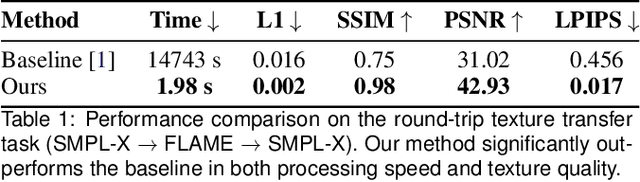
We present a fast and efficient method for transferring facial textures onto SMPL-X-based full-body avatars. Unlike conventional affine-transform methods that are slow and prone to visual artifacts, our method utilizes a barycentric UV conversion technique. Our approach precomputes the entire UV mapping into a single transformation matrix, enabling texture transfer in a single operation. This results in a speedup of over 7000x compared to the baseline, while also significantly improving the final texture quality by eliminating boundary artifacts. Through quantitative and qualitative evaluations, we demonstrate that our method offers a practical solution for personalization in immersive XR applications. The code is available online.
S3D: Sketch-Driven 3D Model Generation
May 07, 2025Generating high-quality 3D models from 2D sketches is a challenging task due to the inherent ambiguity and sparsity of sketch data. In this paper, we present S3D, a novel framework that converts simple hand-drawn sketches into detailed 3D models. Our method utilizes a U-Net-based encoder-decoder architecture to convert sketches into face segmentation masks, which are then used to generate a 3D representation that can be rendered from novel views. To ensure robust consistency between the sketch domain and the 3D output, we introduce a novel style-alignment loss that aligns the U-Net bottleneck features with the initial encoder outputs of the 3D generation module, significantly enhancing reconstruction fidelity. To further enhance the network's robustness, we apply augmentation techniques to the sketch dataset. This streamlined framework demonstrates the effectiveness of S3D in generating high-quality 3D models from sketch inputs. The source code for this project is publicly available at https://github.com/hailsong/S3D.