 Add to Chrome
 Add to Firefox
 Add to Edge
Learning to Theorize the World from Observation
May 05, 2026
What does it mean to understand the world? Contemporary world models often operationalize understanding as accurate future prediction in latent or observation space. Developmental cognitive science, however, suggests a different view: human understanding emerges through the construction of internal theories of how the world works, even before mature language is acquired. Inspired by this theory-building view of cognition, we introduce Learning-to-Theorize, a learning paradigm for inferring explicit explanatory theories of the world from raw, non-textual observations. We instantiate this paradigm with the Neural Theorizer (NEO), a probabilistic neural model that induces latent programs as a learned Language of Thought and executes them through a shared transition model. In NEO, a theory is represented as an executable, compositional program whose learned primitives can be systematically recombined to explain novel phenomena. Experiments show that this formulation enables explanation-driven generalization, allowing observations to be understood in terms of the programs that generate them.

Extendable Long-Horizon Planning via Hierarchical Multiscale Diffusion
Mar 25, 2025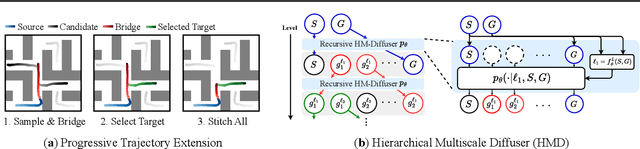
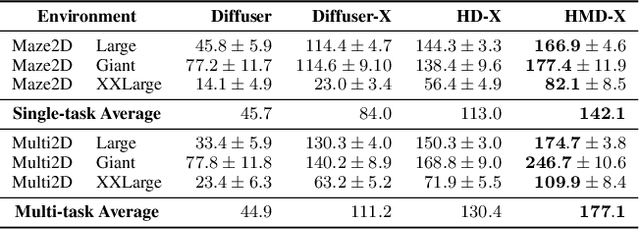
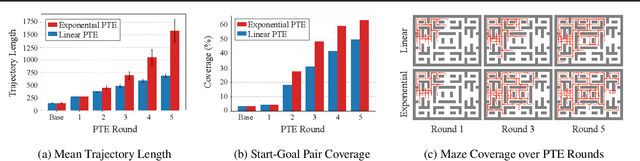

This paper tackles a novel problem, extendable long-horizon planning-enabling agents to plan trajectories longer than those in training data without compounding errors. To tackle this, we propose the Hierarchical Multiscale Diffuser (HM-Diffuser) and Progressive Trajectory Extension (PTE), an augmentation method that iteratively generates longer trajectories by stitching shorter ones. HM-Diffuser trains on these extended trajectories using a hierarchical structure, efficiently handling tasks across multiple temporal scales. Additionally, we introduce Adaptive Plan Pondering and the Recursive HM-Diffuser, which consolidate hierarchical layers into a single model to process temporal scales recursively. Experimental results demonstrate the effectiveness of our approach, advancing diffusion-based planners for scalable long-horizon planning.
Monte Carlo Tree Diffusion for System 2 Planning
Feb 11, 2025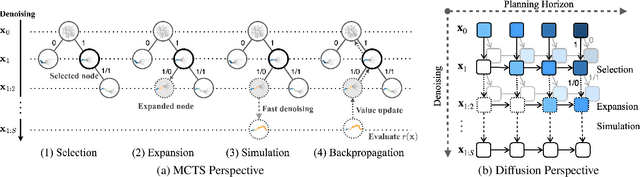
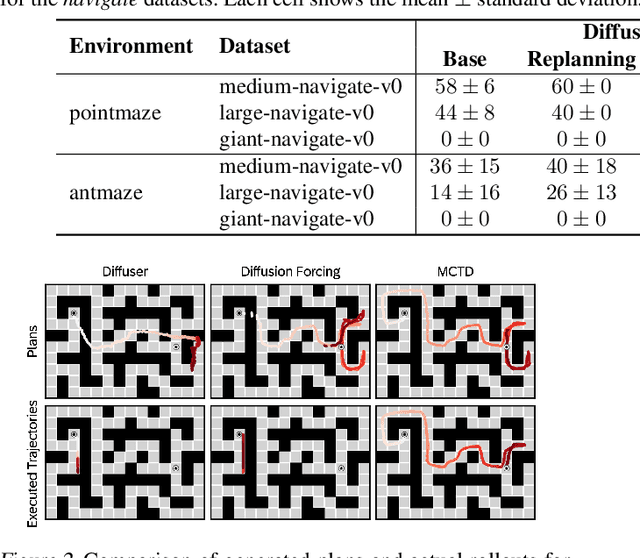

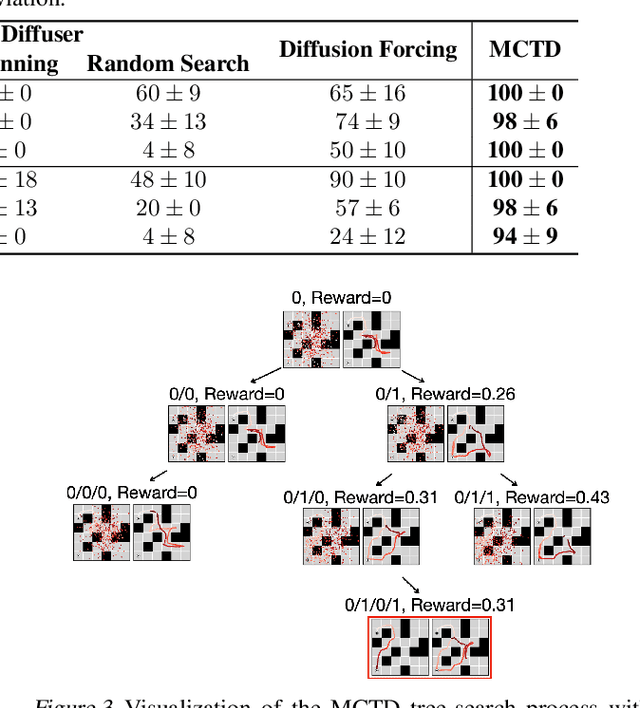
Diffusion models have recently emerged as a powerful tool for planning. However, unlike Monte Carlo Tree Search (MCTS)-whose performance naturally improves with additional test-time computation (TTC), standard diffusion-based planners offer only limited avenues for TTC scalability. In this paper, we introduce Monte Carlo Tree Diffusion (MCTD), a novel framework that integrates the generative strength of diffusion models with the adaptive search capabilities of MCTS. Our method reconceptualizes denoising as a tree-structured process, allowing partially denoised plans to be iteratively evaluated, pruned, and refined. By selectively expanding promising trajectories while retaining the flexibility to revisit and improve suboptimal branches, MCTD achieves the benefits of MCTS such as controlling exploration-exploitation trade-offs within the diffusion framework. Empirical results on challenging long-horizon tasks show that MCTD outperforms diffusion baselines, yielding higher-quality solutions as TTC increases.