 Add to Chrome
 Add to Firefox
 Add to Edge
Teacher Retains Full Tokens, Student Merges Efficiently: TM20K for E-Commerce Sequence Modeling in Ad Recommendation
Aug 07, 2026
Benefiting from ultra-long behavior sequence modeling, existing recommender systems bring users a better experience via simultaneously considering their long-term and short-term interests. Nevertheless, extended sequence lengths introduce substantial burdens on training efficiency and serving throughput. Prior approaches typically utilize search-based or cluster-based compression on ultra-long sequences at the cost of fine-grained information, or rely on various lightweight target attention structures incapable of sufficient sequential feature extraction. In this paper, we balance the effectiveness and efficiency for ultra-long sequence modeling via full transformer modeling accompanied with a two-stage knowledge distillation framework. First, both teacher and student models take the full attention mechanism rather than pure target-sequence attention for effective sequence scaling. For student models, we propose several simple yet well-motivated token merge approaches, significantly compressing the sequence length while maintaining an acceptable performance. Then, a one-time teacher is heavily trained with full sequence tokens, further boosting the performance of student models via knowledge distillation. The proposed paradigm named TM20K has been successfully deployed in ByteDance's e-commerce advertising recommender system that extends the e-commerce sequence length to 20K, delivering substantial improvements in key business metrics (e.g., ADSS +1.036\%) while keeping the training and serving cost nearly the same as the online state-of-the-art model (e.g., serving latency only +5.6\%).

MMRM: A Multiplex Multimodal Representation Model for Product Ranking in E-commerce Search
Jul 13, 2026Multimodal information is pivotal for e-commerce search ranking. Existing works leverage multimodal data typically by fine-tuning general Multimodal Large Language Models (MLLMs) via collaborative signals, subsequently integrating the derived representations into ranking models as item features. Despite their efficacy, these methods face two primary limitations: (1) they rely on a single collaborative signal for MLLM fine-tuning, failing to exploit the heterogeneous signals essential for multitask ranking; and (2) they treat multimodal representations as regular item features in ranking models, underutilizing their latent potential for user behavior modeling. To address these challenges, we propose the Multiplex Multimodal Representation Model (MMRM), a unified framework that aligns MLLMs with diverse collaborative signals. By employing a shared backbone with task-specific tokens and projection layers, MMRM simultaneously learns from multiple signals and generates comprehensive multiplex item representations in a single inference pass. Furthermore, we introduce a multiplex user representation strategy in ranking models, which derives task-specific user representations via search-based behavior sequence modeling leveraging multiplex item representations. Extensive experiments demonstrate MMRM's superior efficiency and effectiveness. Notably, MMRM has been successfully deployed in the JD e-commerce search engine, yielding significant performance gains for millions of daily users.
PPM : A Pre-trained Plug-in Model for Click-through Rate Prediction
Mar 15, 2024


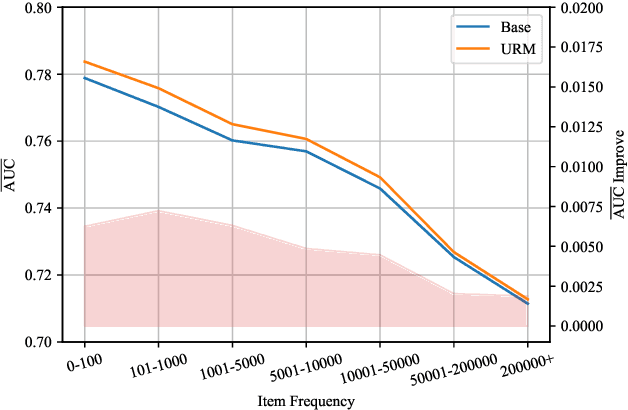
Click-through rate (CTR) prediction is a core task in recommender systems. Existing methods (IDRec for short) rely on unique identities to represent distinct users and items that have prevailed for decades. On one hand, IDRec often faces significant performance degradation on cold-start problem; on the other hand, IDRec cannot use longer training data due to constraints imposed by iteration efficiency. Most prior studies alleviate the above problems by introducing pre-trained knowledge(e.g. pre-trained user model or multi-modal embeddings). However, the explosive growth of online latency can be attributed to the huge parameters in the pre-trained model. Therefore, most of them cannot employ the unified model of end-to-end training with IDRec in industrial recommender systems, thus limiting the potential of the pre-trained model. To this end, we propose a $\textbf{P}$re-trained $\textbf{P}$lug-in CTR $\textbf{M}$odel, namely PPM. PPM employs multi-modal features as input and utilizes large-scale data for pre-training. Then, PPM is plugged in IDRec model to enhance unified model's performance and iteration efficiency. Upon incorporating IDRec model, certain intermediate results within the network are cached, with only a subset of the parameters participating in training and serving. Hence, our approach can successfully deploy an end-to-end model without causing huge latency increases. Comprehensive offline experiments and online A/B testing at JD E-commerce demonstrate the efficiency and effectiveness of PPM.