 Add to Chrome
 Add to Firefox
 Add to Edge
ADP: Adversarial Dynamics Priors for Physically Grounded Humanoid Locomotion
Jul 03, 2026
In this paper, we propose Adversarial Dynamics Priors (ADP) for perturbation-resilient humanoid locomotion control. Existing motion prior-based methods induce natural motion styles by imitating kinematic motion features, but they do not directly regularize dynamics features, such as CoM motion, centroidal momentum, contact forces, and contact states. To address this limitation, we replace kinematic motion-style feature with selected dynamics features extracted from locomotion trajectories as the target of adversarial regularization.To this end, we use trajectory optimization to construct a reference dataset and train a discriminator to evaluate whether policy-induced temporal windows are consistent with the resulting reference distribution.Without explicit motion tracking, ADP encourages policy rollouts to remain close to the reference support, even after perturbations. Experimental results show that, compared with AMP, the strongest baseline in our evaluation, ADP improves the $80\%$-success impulse threshold ($J_{80}$) by $16.7\%$, while reducing direction-averaged recovery time and velocity tracking error by $47.9\%$ and $35.4\%$, respectively.

WAY: Estimation of Vessel Destination in Worldwide AIS Trajectory
Dec 15, 2025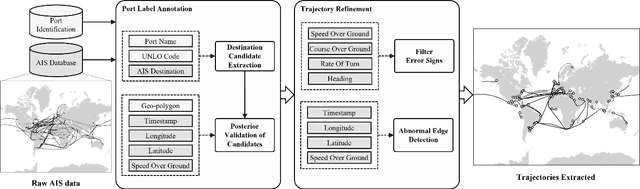
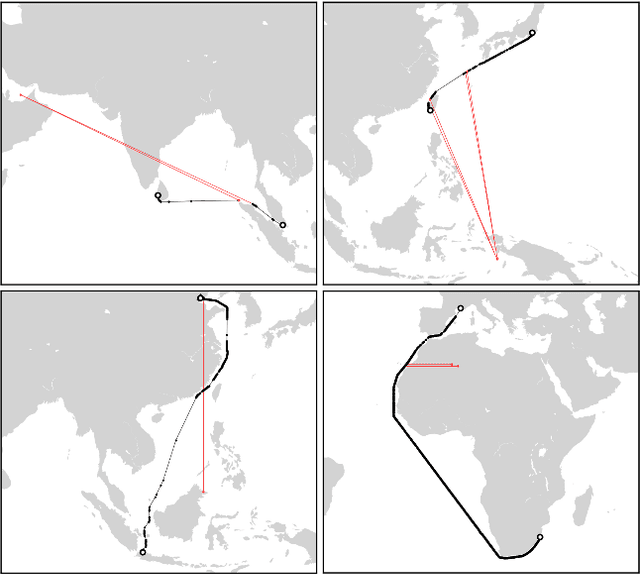
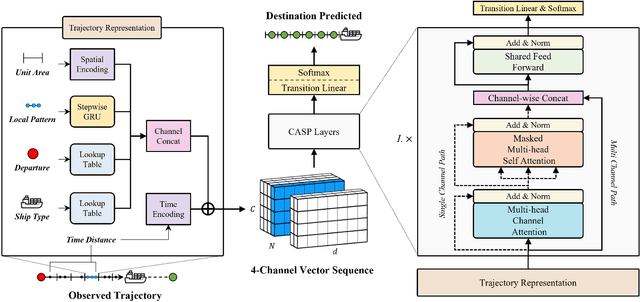
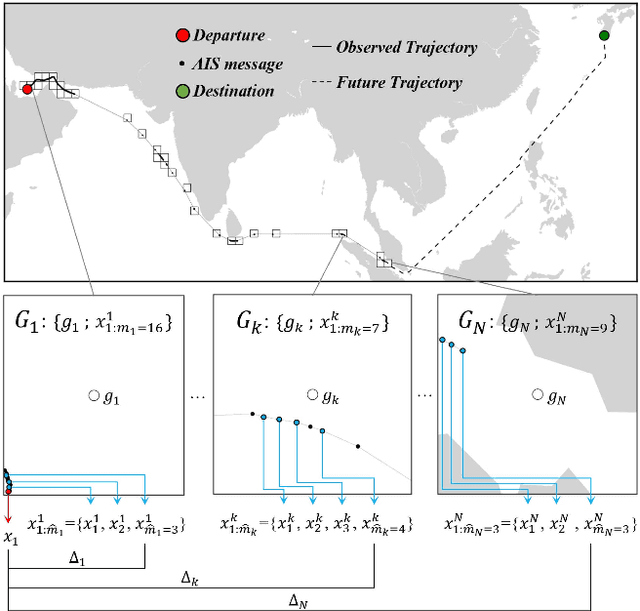
The Automatic Identification System (AIS) enables data-driven maritime surveillance but suffers from reliability issues and irregular intervals. We address vessel destination estimation using global-scope AIS data by proposing a differentiated approach that recasts long port-to-port trajectories as a nested sequence structure. Using spatial grids, this method mitigates spatio-temporal bias while preserving detailed resolution. We introduce a novel deep learning architecture, WAY, designed to process these reformulated trajectories for long-term destination estimation days to weeks in advance. WAY comprises a trajectory representation layer and Channel-Aggregative Sequential Processing (CASP) blocks. The representation layer generates multi-channel vector sequences from kinematic and non-kinematic features. CASP blocks utilize multi-headed channel- and self-attention for aggregation and sequential information delivery. Additionally, we propose a task-specialized Gradient Dropout (GD) technique to enable many-to-many training on single labels, preventing biased feedback surges by stochastically blocking gradient flow based on sample length. Experiments on 5-year AIS data demonstrate WAY's superiority over conventional spatial grid-based approaches regardless of trajectory progression. Results further confirm that adopting GD leads to performance gains. Finally, we explore WAY's potential for real-world application through multitask learning for ETA estimation.
* Accepted to IEEE Transactions on Aerospace and Electronic Systems (TAES)