 Add to Chrome
 Add to Firefox
 Add to Edge
SCI-Mamba: Unsupervised Learning based Low-Light Image Enhancement for Non-Cooperative Spacecraft
Jul 09, 2026
Low-light visual perception acts as the core visual foundation for on-orbit servicing missions targeting non-cooperative spacecraft, supporting autonomous rendezvous, pose estimation, component detection and robotic capture operations. Spaceborne imagery suffers from severe low-light degradation, while the extreme scarcity of paired normal/low-light space samples severely limits the generalization capacity of supervised enhancement algorithms. To address this practical bottleneck, this paper proposes SCI-Mamba, an unsupervised enhancement network for low-light orbital spacecraft observations. The proposed framework unites self-calibrated unsupervised learning, linear-complexity VMamba architecture and Retinex physical priors, delivering a lightweight enhancement pipeline adaptable to resource-limited spaceborne hardware. We construct Space Dark-1.0, a dedicated low-light spacecraft dataset integrating real orbital footage, darkroom hardware-in-the-loop measurements and physically constrained synthetic data covering diverse illumination, motion and attitude conditions. Comprehensive comparisons with CNN-, Transformer- and prevailing Mamba-based approaches verify the advantages of SCI-Mamba in visual authenticity, color fidelity and inference speed. The proposed framework provides a practical low-light enhancement solution for close-proximity non-cooperative space operations. The code is available at https://github.com/bitswh/SCI-Mamba

Development of Automated Neural Network Prediction for Echocardiographic Left ventricular Ejection Fraction
Mar 18, 2024

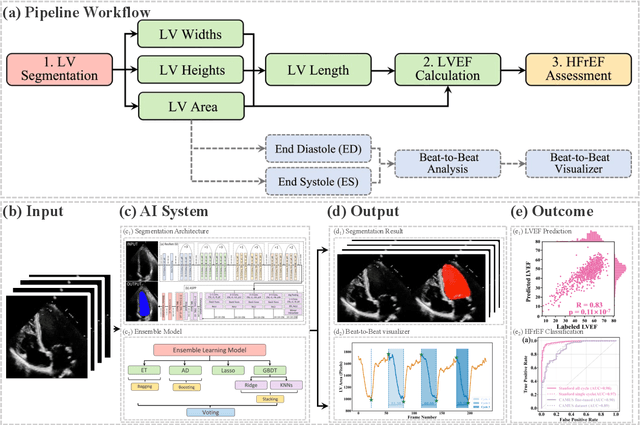

The echocardiographic measurement of left ventricular ejection fraction (LVEF) is fundamental to the diagnosis and classification of patients with heart failure (HF). In order to quantify LVEF automatically and accurately, this paper proposes a new pipeline method based on deep neural networks and ensemble learning. Within the pipeline, an Atrous Convolutional Neural Network (ACNN) was first trained to segment the left ventricle (LV), before employing the area-length formulation based on the ellipsoid single-plane model to calculate LVEF values. This formulation required inputs of LV area, derived from segmentation using an improved Jeffrey's method, as well as LV length, derived from a novel ensemble learning model. To further improve the pipeline's accuracy, an automated peak detection algorithm was used to identify end-diastolic and end-systolic frames, avoiding issues with human error. Subsequently, single-beat LVEF values were averaged across all cardiac cycles to obtain the final LVEF. This method was developed and internally validated in an open-source dataset containing 10,030 echocardiograms. The Pearson's correlation coefficient was 0.83 for LVEF prediction compared to expert human analysis (p<0.001), with a subsequent area under the receiver operator curve (AUROC) of 0.98 (95% confidence interval 0.97 to 0.99) for categorisation of HF with reduced ejection (HFrEF; LVEF<40%). In an external dataset with 200 echocardiograms, this method achieved an AUC of 0.90 (95% confidence interval 0.88 to 0.91) for HFrEF assessment. This study demonstrates that an automated neural network-based calculation of LVEF is comparable to expert clinicians performing time-consuming, frame-by-frame manual evaluation of cardiac systolic function.