 Add to Chrome
 Add to Firefox
 Add to Edge
CVPD at QIAS 2026: RAG-Guided LLM Reasoning for Al-Mawarith Share Computation and Heir Allocation
Mar 25, 2026
Islamic inheritance (Ilm al-Mawarith) is a multi-stage legal reasoning task requiring the identification of eligible heirs, resolution of blocking rules (hajb), assignment of fixed and residual shares, handling of adjustments such as awl and radd, and generation of a consistent final distribution. The task is further complicated by variations across legal schools and civil-law codifications, requiring models to operate under explicit legal configurations. We present a retrieval-augmented generation (RAG) pipeline for this setting, combining rule-grounded synthetic data generation, hybrid retrieval (dense and BM25) with cross-encoder reranking, and schema-constrained output validation. A symbolic inheritance calculator is used to generate a large high-quality synthetic corpus with full intermediate reasoning traces, ensuring legal and numerical consistency. The proposed system achieves a MIR-E score of 0.935 and ranks first on the official QIAS 2026 blind-test leaderboard. Results demonstrate that retrieval-grounded, schema-aware generation significantly improves reliability in high-precision Arabic legal reasoning tasks.

Versailles-FP dataset: Wall Detection in Ancient
Mar 14, 2021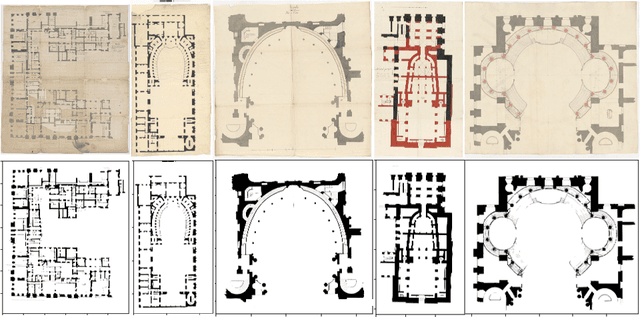
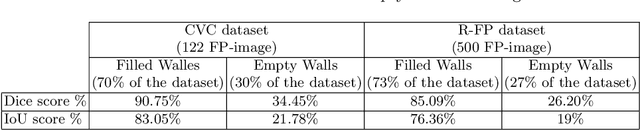
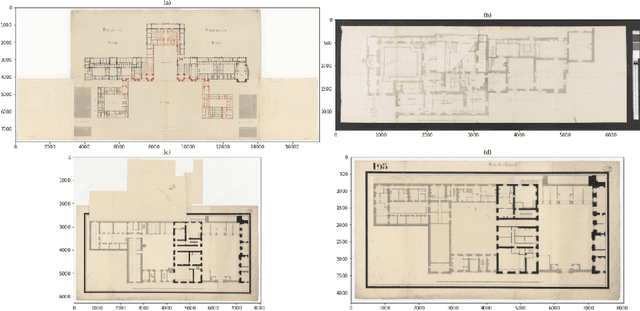
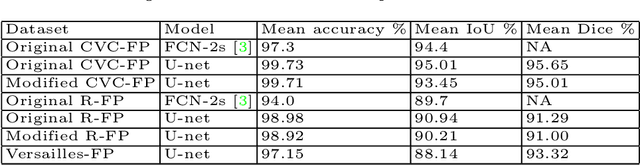
Access to historical monuments' floor plans over a time period is necessary to understand the architectural evolution and history. Such knowledge bases also helps to rebuild the history by establishing connection between different event, person and facts which are once part of the buildings. Since the two-dimensional plans do not capture the entire space, 3D modeling sheds new light on the reading of these unique archives and thus opens up great perspectives for understanding the ancient states of the monument. Since the first step in the building's or monument's 3D model is the wall detection in the floor plan, we introduce in this paper the new and unique Versailles FP dataset of wall groundtruthed images of the Versailles Palace dated between 17th and 18th century. The dataset's wall masks are generated using an automatic approach based on multi directional steerable filters. The generated wall masks are then validated and corrected manually. We validate our approach of wall mask generation in state-of-the-art modern datasets. Finally we propose a U net based convolutional framework for wall detection. Our method achieves state of the art result surpassing fully connected network based approach.