 Add to Chrome
 Add to Firefox
 Add to Edge
CoRe-DA: Contrastive Regression for Unsupervised Domain Adaptation in Surgical Skill Assessment
Mar 31, 2026
Vision-based surgical skill assessment (SSA) enables objective and scalable evaluation of operative performance. Progress in this field is constrained by the high cost and time demands for manual annotation of quantitative skill scores, as well as the poor generalization of existing regression models to new surgical tasks and environments. Meanwhile, appreciable volumes of unlabeled video data are now available, motivating the development of unsupervised domain adaptation (UDA) methods for SSA. We introduce the first benchmark for UDA in SSA regression, spanning four datasets across dry-lab and clinical settings as well as open and robotic surgery. We evaluate eight representative models under challenging domain shifts and propose CoRe-DA, a novel contrastive regression-based adaptation framework. Our method learns domain-invariant representations through relative-score supervision and target-domain self-training. Comprehensive experiments across two UDA settings show that CoRe-DA is superior to state-of-the-art methods, achieving Spearman Correlation Coefficients of 0.46 and 0.41 on dry-lab and clinical target datasets, respectively, without using any labeled target data for training. Overall, CoRe-DA enables scalable SSA with reliable cross-domain generalization, where existing methods underperform. Our code and datasets will be released at https://github.com/anastadimi/CoRe-DA.

Learning from Single Timestamps: Complexity Estimation in Laparoscopic Cholecystectomy
Nov 06, 2025Purpose: Accurate assessment of surgical complexity is essential in Laparoscopic Cholecystectomy (LC), where severe inflammation is associated with longer operative times and increased risk of postoperative complications. The Parkland Grading Scale (PGS) provides a clinically validated framework for stratifying inflammation severity; however, its automation in surgical videos remains largely unexplored, particularly in realistic scenarios where complete videos must be analyzed without prior manual curation. Methods: In this work, we introduce STC-Net, a novel framework for SingleTimestamp-based Complexity estimation in LC via the PGS, designed to operate under weak temporal supervision. Unlike prior methods limited to static images or manually trimmed clips, STC-Net operates directly on full videos. It jointly performs temporal localization and grading through a localization, window proposal, and grading module. We introduce a novel loss formulation combining hard and soft localization objectives and background-aware grading supervision. Results: Evaluated on a private dataset of 1,859 LC videos, STC-Net achieves an accuracy of 62.11% and an F1-score of 61.42%, outperforming non-localized baselines by over 10% in both metrics and highlighting the effectiveness of weak supervision for surgical complexity assessment. Conclusion: STC-Net demonstrates a scalable and effective approach for automated PGS-based surgical complexity estimation from full LC videos, making it promising for post-operative analysis and surgical training.
Exploring Pre-training Across Domains for Few-Shot Surgical Skill Assessment
Sep 11, 2025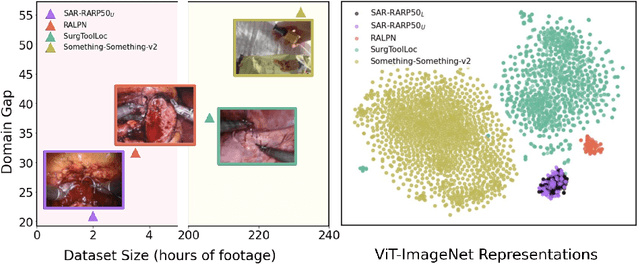

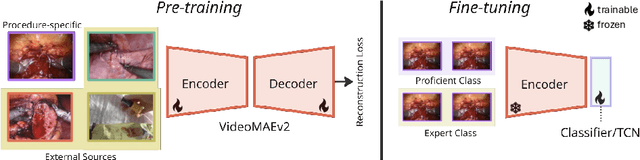
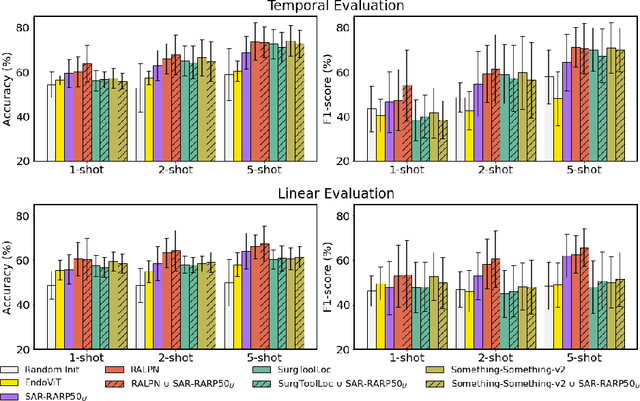
Automated surgical skill assessment (SSA) is a central task in surgical computer vision. Developing robust SSA models is challenging due to the scarcity of skill annotations, which are time-consuming to produce and require expert consensus. Few-shot learning (FSL) offers a scalable alternative enabling model development with minimal supervision, though its success critically depends on effective pre-training. While widely studied for several surgical downstream tasks, pre-training has remained largely unexplored in SSA. In this work, we formulate SSA as a few-shot task and investigate how self-supervised pre-training strategies affect downstream few-shot SSA performance. We annotate a publicly available robotic surgery dataset with Objective Structured Assessment of Technical Skill (OSATS) scores, and evaluate various pre-training sources across three few-shot settings. We quantify domain similarity and analyze how domain gap and the inclusion of procedure-specific data into pre-training influence transferability. Our results show that small but domain-relevant datasets can outperform large scale, less aligned ones, achieving accuracies of 60.16%, 66.03%, and 73.65% in the 1-, 2-, and 5-shot settings, respectively. Moreover, incorporating procedure-specific data into pre-training with a domain-relevant external dataset significantly boosts downstream performance, with an average gain of +1.22% in accuracy and +2.28% in F1-score; however, applying the same strategy with less similar but large-scale sources can instead lead to performance degradation. Code and models are available at https://github.com/anastadimi/ssa-fsl.