 Add to Chrome
 Add to Firefox
 Add to Edge
OpenReservoirComputing: GPU-Accelerated Reservoir Computing in JAX
Mar 16, 2026
OpenReservoirComputing (ORC) is a Python library for reservoir computing (RC) written in JAX (Bradbury et al. 2018) and Equinox (Kidger and Garcia 2021). JAX is a Python library for high-performance numerical computing that enables automatic differentiation, just-in-time (JIT) compilation, and GPU/TPU acceleration, while Equinox is a neural network framework for JAX. RC is a form of machine learning that functions by lifting a low-dimensional sequence or signal into a high-dimensional dynamical system and training a simple, linear readout layer from the high-dimensional dynamics back to a lower-dimensional quantity of interest. The most common application of RC is time-series forecasting, where the goal is to predict a signal's future evolution. RC has achieved state-of-the-art performance on this task, particularly when applied to chaotic dynamical systems. In addition, RC approaches can be adapted to perform classification and control tasks. ORC provides both modular components for building custom RC models and built-in models for forecasting, classification, and control. By building on JAX and Equinox, ORC offers GPU acceleration, JIT compilation, and automatic vectorization. These capabilities make prototyping new models faster and enable larger and more powerful reservoir architectures. End-to-end differentiability also enables seamless integration with other deep learning models built with Equinox.

Physics-Constrained Generative Adversarial Networks for 3D Turbulence
Dec 01, 2022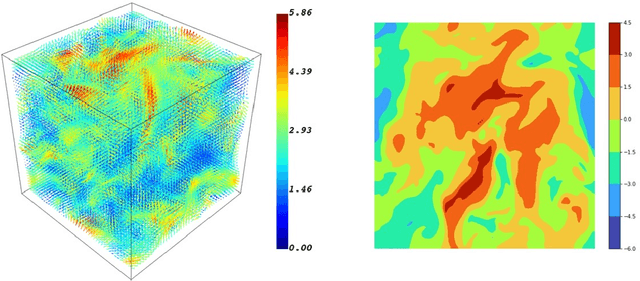
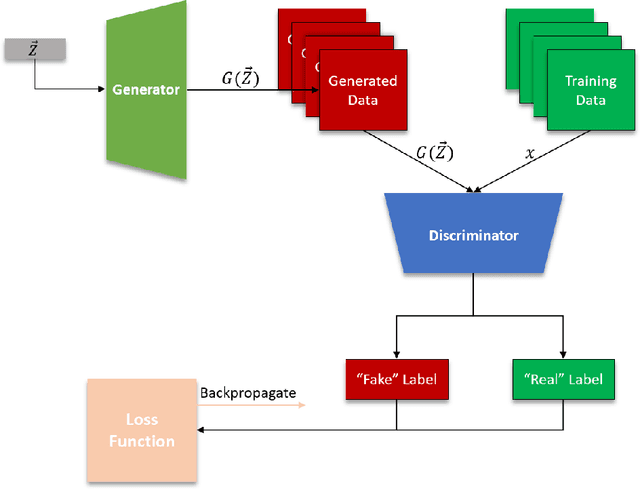
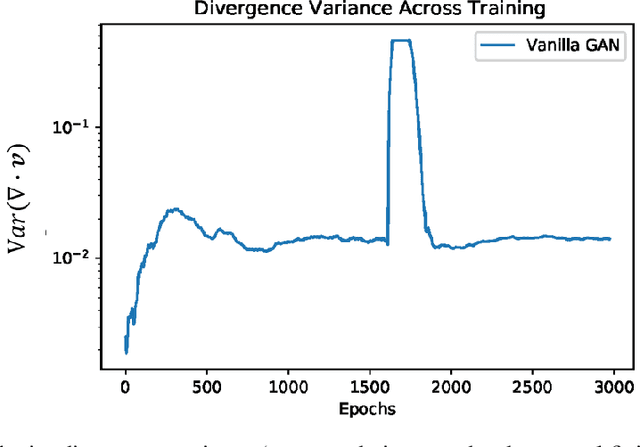
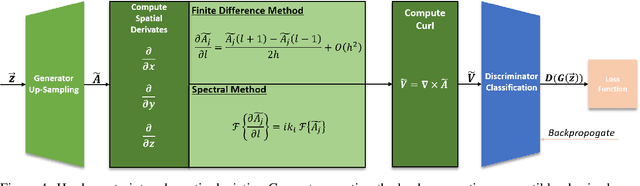
Generative Adversarial Networks (GANs) have received wide acclaim among the machine learning (ML) community for their ability to generate realistic 2D images. ML is being applied more often to complex problems beyond those of computer vision. However, current frameworks often serve as black boxes and lack physics embeddings, leading to poor ability in enforcing constraints and unreliable models. In this work, we develop physics embeddings that can be stringently imposed, referred to as hard constraints, in the neural network architecture. We demonstrate their capability for 3D turbulence by embedding them in GANs, particularly to enforce the mass conservation constraint in incompressible fluid turbulence. In doing so, we also explore and contrast the effects of other methods of imposing physics constraints within the GANs framework, especially penalty-based physics constraints popular in literature. By using physics-informed diagnostics and statistics, we evaluate the strengths and weaknesses of our approach and demonstrate its feasibility.
The ISTI Rapid Response on Exploring Cloud Computing 2018
Jan 04, 2019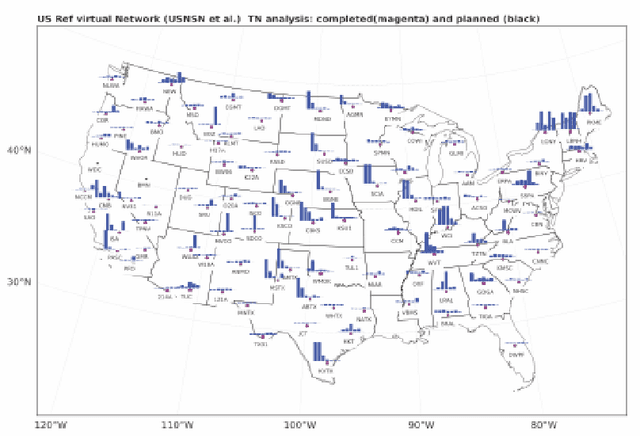
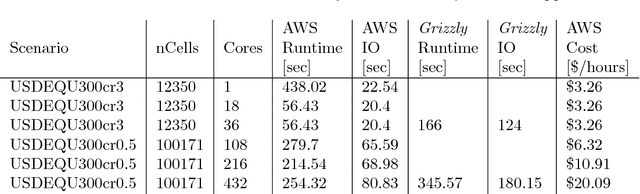
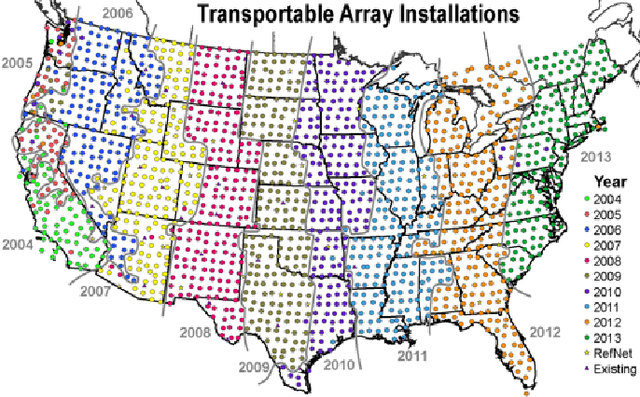
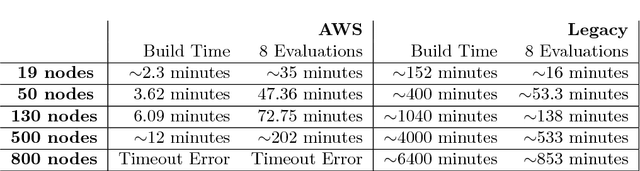
This report describes eighteen projects that explored how commercial cloud computing services can be utilized for scientific computation at national laboratories. These demonstrations ranged from deploying proprietary software in a cloud environment to leveraging established cloud-based analytics workflows for processing scientific datasets. By and large, the projects were successful and collectively they suggest that cloud computing can be a valuable computational resource for scientific computation at national laboratories.