 Add to Chrome
 Add to Firefox
 Add to Edge
Reduced Order Modeling for Tsunami Forecasting with Bayesian Hierarchical Pooling
Dec 22, 2025
Reduced order models (ROM) can represent spatiotemporal processes in significantly fewer dimensions and can be solved many orders faster than their governing partial differential equations (PDEs). For example, using a proper orthogonal decomposition produces a ROM that is a small linear combination of fixed features and weights, but that is constrained to the given process it models. In this work, we explore a new type of ROM that is not constrained to fixed weights, based on neural Galerkin-Projections, which is an initial value problem that encodes the physics of the governing PDEs, calibrated via neural networks to accurately model the trajectory of these weights. Then using a statistical hierarchical pooling technique to learn a distribution on the initial values of the temporal weights, we can create new, statistically interpretable and physically justified weights that are generalized to many similar problems. When recombined with the spatial features, we form a complete physics surrogate, called a randPROM, for generating simulations that are consistent in distribution to a neighborhood of initial conditions close to those used to construct the ROM. We apply the randPROM technique to the study of tsunamis, which are unpredictable, catastrophic, and highly-detailed non-linear problems, modeling both a synthetic case of tsunamis near Fiji and the real-world Tohoku 2011 disaster. We demonstrate that randPROMs may enable us to significantly reduce the number of simulations needed to generate a statistically calibrated and physically defensible prediction model for arrival time and height of tsunami waves.

Physics-Constrained Generative Adversarial Networks for 3D Turbulence
Dec 01, 2022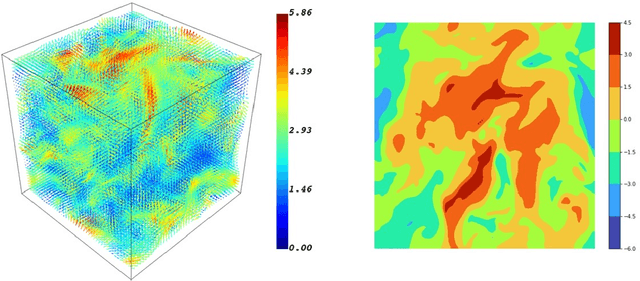
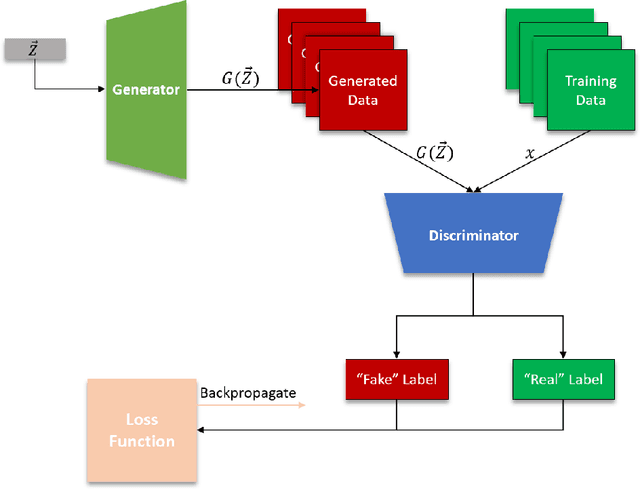
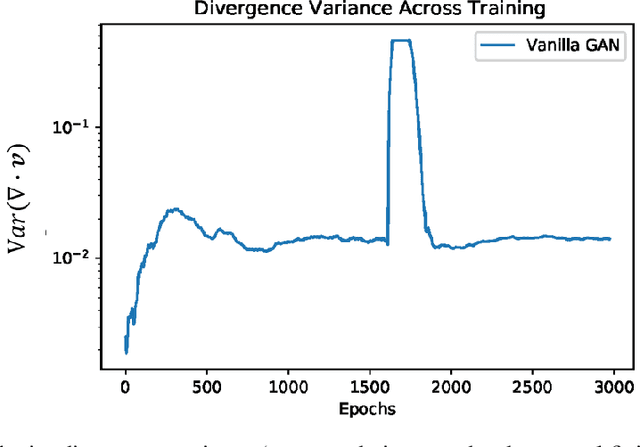
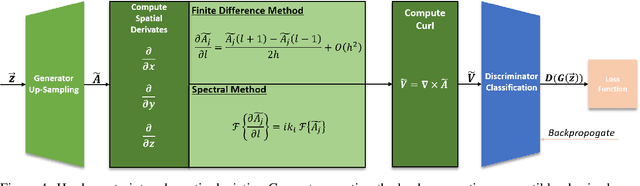
Generative Adversarial Networks (GANs) have received wide acclaim among the machine learning (ML) community for their ability to generate realistic 2D images. ML is being applied more often to complex problems beyond those of computer vision. However, current frameworks often serve as black boxes and lack physics embeddings, leading to poor ability in enforcing constraints and unreliable models. In this work, we develop physics embeddings that can be stringently imposed, referred to as hard constraints, in the neural network architecture. We demonstrate their capability for 3D turbulence by embedding them in GANs, particularly to enforce the mass conservation constraint in incompressible fluid turbulence. In doing so, we also explore and contrast the effects of other methods of imposing physics constraints within the GANs framework, especially penalty-based physics constraints popular in literature. By using physics-informed diagnostics and statistics, we evaluate the strengths and weaknesses of our approach and demonstrate its feasibility.