 Add to Chrome
 Add to Firefox
 Add to Edge
QueryAgent-R1: Bridging Query Generation and Product Retrieval for E-Commerce Query Recommendation
Jun 04, 2026
Query recommendation in e-commerce search aims to proactively suggest queries that match users' potential interests. However, existing methods mainly optimize query-level relevance, while neglecting whether the retrieved products align with users' downstream preferences. This mismatch often leads to high query click through rates (CTR) but low product conversion rates (CVR). To bridge this gap, we propose QueryAgent-R1, a memory-augmented agentic framework that improves end-to-end alignment via chain-of-retrieval optimization. Our QueryAgent-R1 grounds query generation in real inventory retrieval, allowing the agent to validate and refine queries based on retrieved products. We also design a consistency reward in the agentic reinforcement learning (RL) process to jointly optimize query relevance and downstream engagement. In addition, we construct a memory abstraction module for efficient user profiling. To support offline evaluation, we construct two datasets based on both proprietary industrial data and public datasets, on which QueryAgent-R1 consistently outperforms strong baselines. Moreover, on a large scale production platform, QueryAgent-R1 improves Query CTR by 2.9% and guided CVR by 3.1% in online A/B tests.

KAST: Knowledge Aware Adaptive Session Multi-Topic Network for Click-Through Rate Prediction
Oct 07, 2022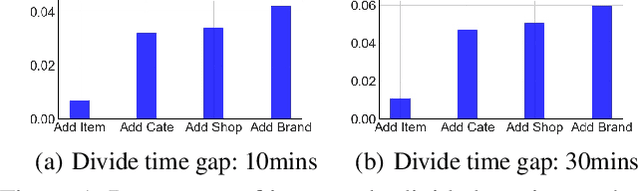
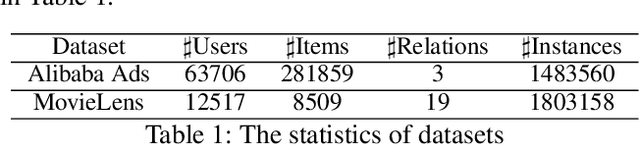
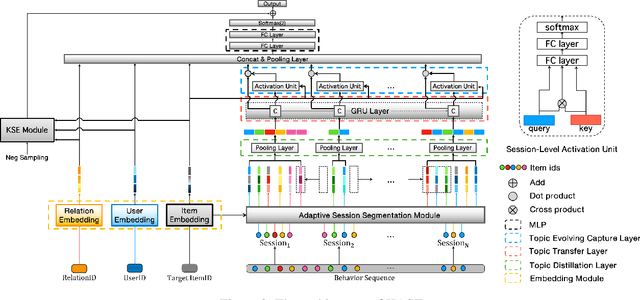
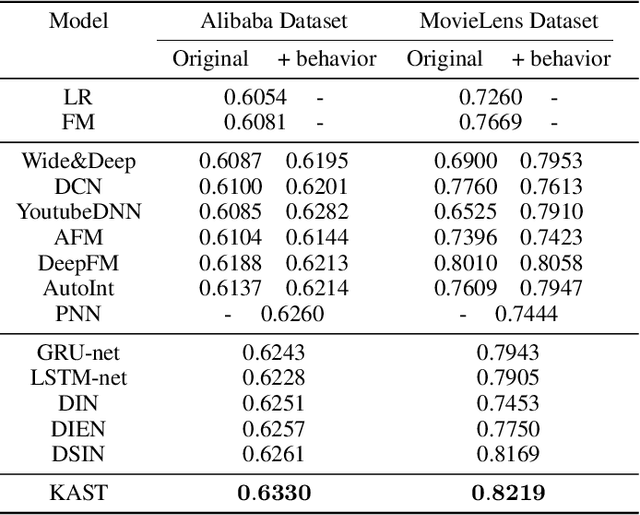
Capturing the evolving trends of user interest is important for both recommendation systems and advertising systems, and user behavior sequences have been successfully used in Click-Through-Rate(CTR) prediction problems. However, if the user interest is learned on the basis of item-level behaviors, the performance may be affected by the following two issues. Firstly, some casual outliers might be included in the behavior sequences as user behaviors are likely to be diverse. Secondly, the span of time intervals between user behaviors is random and irregular, for which a RNN-based module employed from NLP is not perfectly adaptive. To handle these two issues, we propose the Knowledge aware Adaptive Session multi-Topic network(KAST). It can adaptively segment user sessions from the whole user behavior sequence, and maintain similar intents in the same session. Furthermore, in order to improve the quality of session segmentation and representation, a knowledge-aware module is introduced so that the structural information from the user-item interaction can be extracted in an end-to-end manner, and a marginal based loss with these information is merged into the major loss. Through extensive experiments on public benchmarks, we demonstrate that KAST can achieve superior performance than state-of-the-art methods for CTR prediction, and key modules and hyper-parameters are also evaluated.