 Add to Chrome
 Add to Firefox
 Add to Edge
PRBench: Large-Scale Expert Rubrics for Evaluating High-Stakes Professional Reasoning
Nov 14, 2025
Frontier model progress is often measured by academic benchmarks, which offer a limited view of performance in real-world professional contexts. Existing evaluations often fail to assess open-ended, economically consequential tasks in high-stakes domains like Legal and Finance, where practical returns are paramount. To address this, we introduce Professional Reasoning Bench (PRBench), a realistic, open-ended, and difficult benchmark of real-world problems in Finance and Law. We open-source its 1,100 expert-authored tasks and 19,356 expert-curated criteria, making it, to our knowledge, the largest public, rubric-based benchmark for both legal and finance domains. We recruit 182 qualified professionals, holding JDs, CFAs, or 6+ years of experience, who contributed tasks inspired by their actual workflows. This process yields significant diversity, with tasks spanning 114 countries and 47 US jurisdictions. Our expert-curated rubrics are validated through a rigorous quality pipeline, including independent expert validation. Subsequent evaluation of 20 leading models reveals substantial room for improvement, with top scores of only 0.39 (Finance) and 0.37 (Legal) on our Hard subsets. We further catalog associated economic impacts of the prompts and analyze performance using human-annotated rubric categories. Our analysis shows that models with similar overall scores can diverge significantly on specific capabilities. Common failure modes include inaccurate judgments, a lack of process transparency and incomplete reasoning, highlighting critical gaps in their reliability for professional adoption.

MultiNRC: A Challenging and Native Multilingual Reasoning Evaluation Benchmark for LLMs
Jul 23, 2025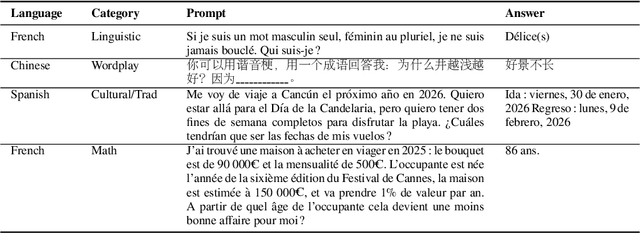

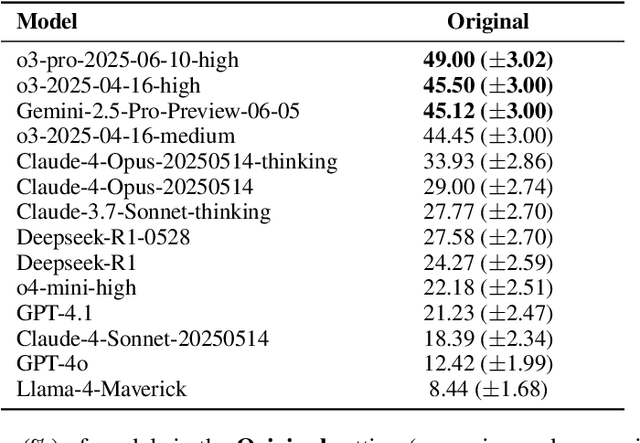
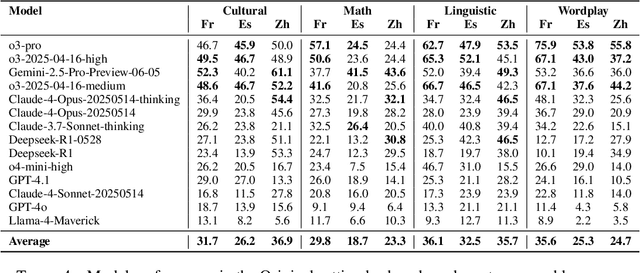
Although recent Large Language Models (LLMs) have shown rapid improvement on reasoning benchmarks in English, the evaluation of such LLMs' multilingual reasoning capability across diverse languages and cultural contexts remains limited. Existing multilingual reasoning benchmarks are typically constructed by translating existing English reasoning benchmarks, biasing these benchmarks towards reasoning problems with context in English language/cultures. In this work, we introduce the Multilingual Native Reasoning Challenge (MultiNRC), a benchmark designed to assess LLMs on more than 1,000 native, linguistic and culturally grounded reasoning questions written by native speakers in French, Spanish, and Chinese. MultiNRC covers four core reasoning categories: language-specific linguistic reasoning, wordplay & riddles, cultural/tradition reasoning, and math reasoning with cultural relevance. For cultural/tradition reasoning and math reasoning with cultural relevance, we also provide English equivalent translations of the multilingual questions by manual translation from native speakers fluent in English. This set of English equivalents can provide a direct comparison of LLM reasoning capacity in other languages vs. English on the same reasoning questions. We systematically evaluate current 14 leading LLMs covering most LLM families on MultiNRC and its English equivalent set. The results show that (1) current LLMs are still not good at native multilingual reasoning, with none scoring above 50% on MultiNRC; (2) LLMs exhibit distinct strengths and weaknesses in handling linguistic, cultural, and logical reasoning tasks; (3) Most models perform substantially better in math reasoning in English compared to in original languages (+10%), indicating persistent challenges with culturally grounded knowledge.