 Add to Chrome
 Add to Firefox
 Add to Edge
LeBenchmark: A Reproducible Framework for Assessing Self-Supervised Representation Learning from Speech
Apr 23, 2021
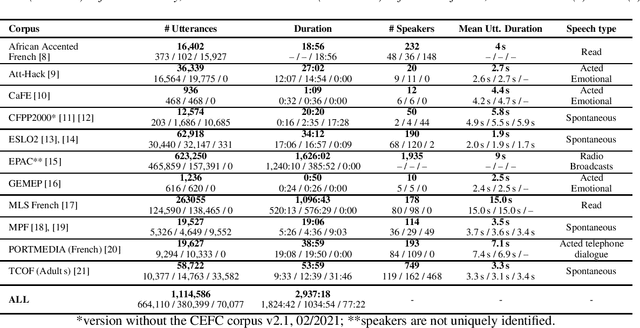
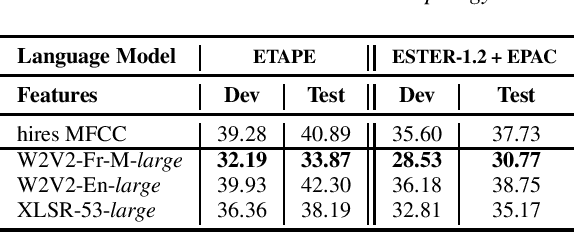
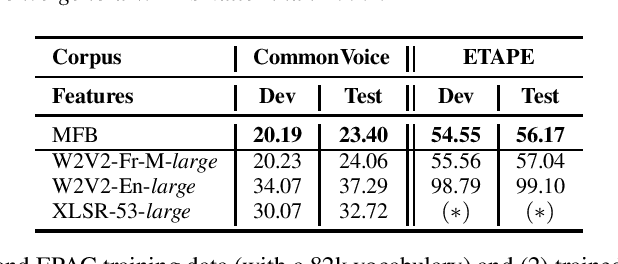
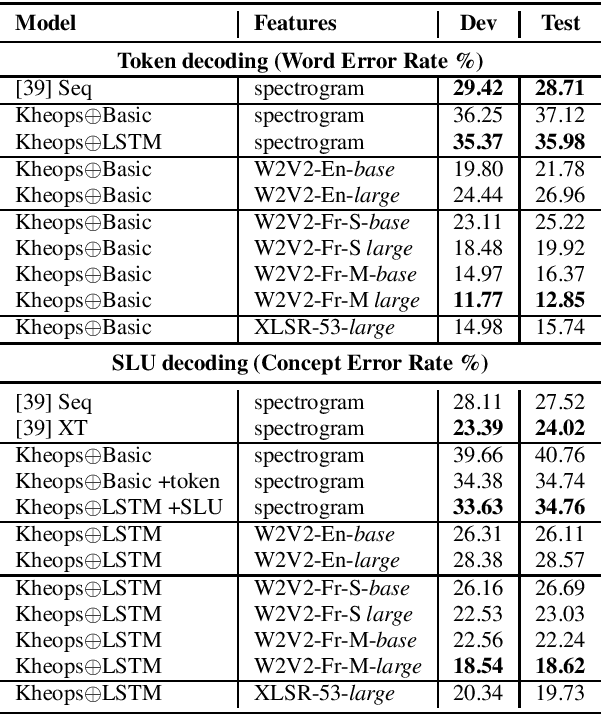
Self-Supervised Learning (SSL) using huge unlabeled data has been successfully explored for image and natural language processing. Recent works also investigated SSL from speech. They were notably successful to improve performance on downstream tasks such as automatic speech recognition (ASR). While these works suggest it is possible to reduce dependence on labeled data for building efficient speech systems, their evaluation was mostly made on ASR and using multiple and heterogeneous experimental settings (most of them for English). This renders difficult the objective comparison between SSL approaches and the evaluation of their impact on building speech systems. In this paper, we propose LeBenchmark: a reproducible framework for assessing SSL from speech. It not only includes ASR (high and low resource) tasks but also spoken language understanding, speech translation and emotion recognition. We also target speech technologies in a language different than English: French. SSL models of different sizes are trained from carefully sourced and documented datasets. Experiments show that SSL is beneficial for most but not all tasks which confirms the need for exhaustive and reliable benchmarks to evaluate its real impact. LeBenchmark is shared with the scientific community for reproducible research in SSL from speech.

Dual-decoder Transformer for Joint Automatic Speech Recognition and Multilingual Speech Translation
Nov 02, 2020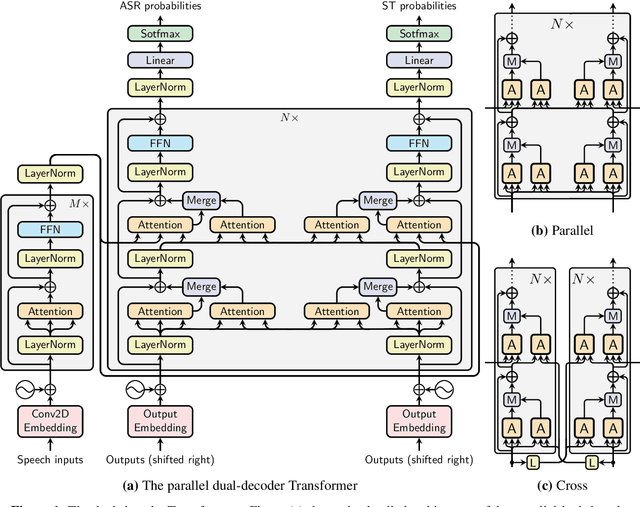
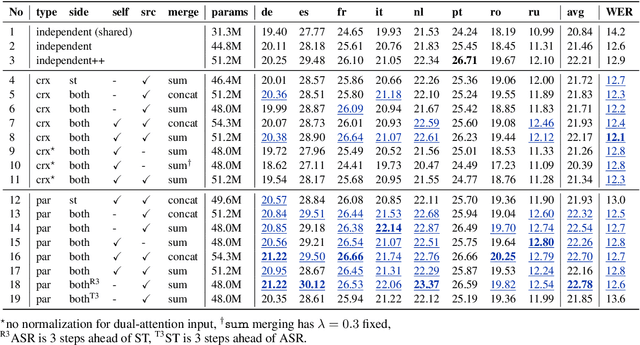
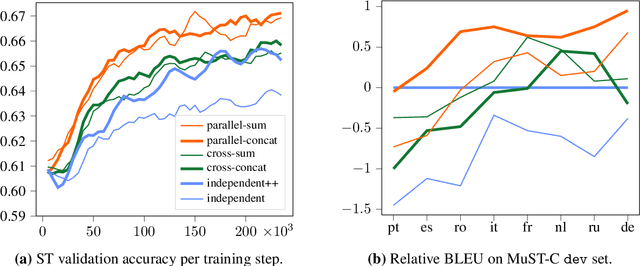
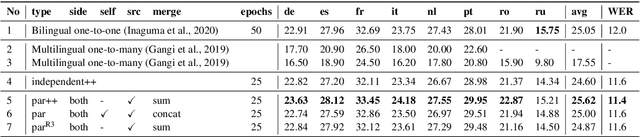
We introduce dual-decoder Transformer, a new model architecture that jointly performs automatic speech recognition (ASR) and multilingual speech translation (ST). Our models are based on the original Transformer architecture (Vaswani et al., 2017) but consist of two decoders, each responsible for one task (ASR or ST). Our major contribution lies in how these decoders interact with each other: one decoder can attend to different information sources from the other via a dual-attention mechanism. We propose two variants of these architectures corresponding to two different levels of dependencies between the decoders, called the parallel and cross dual-decoder Transformers, respectively. Extensive experiments on the MuST-C dataset show that our models outperform the previously-reported highest translation performance in the multilingual settings, and outperform as well bilingual one-to-one results. Furthermore, our parallel models demonstrate no trade-off between ASR and ST compared to the vanilla multi-task architecture. Our code and pre-trained models are available at https://github.com/formiel/speech-translation.
* Accepted at COLING 2020 (Oral)
FlauBERT: Unsupervised Language Model Pre-training for French
Jan 09, 2020
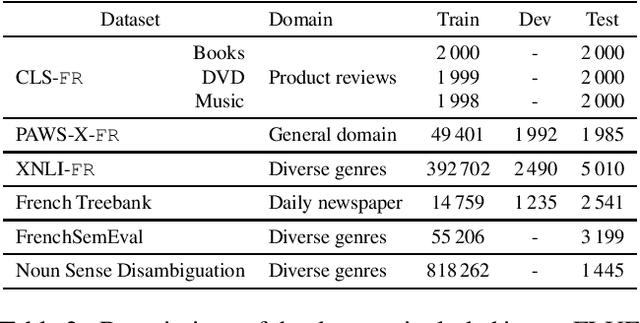
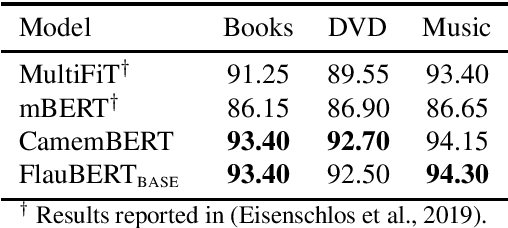
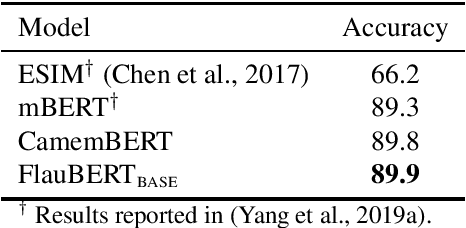
Language models have become a key step to achieve state-of-the art results in many different Natural Language Processing (NLP) tasks. Leveraging the huge amount of unlabeled texts nowadays available, they provide an efficient way to pre-train continuous word representations that can be fine-tuned for a downstream task, along with their contextualization at the sentence level. This has been widely demonstrated for English using contextualized representations (Dai and Le, 2015; Peters et al., 2018; Howard and Ruder, 2018; Radford et al., 2018; Devlin et al., 2019; Yang et al., 2019b). In this paper, we introduce and share FlauBERT, a model learned on a very large and heterogeneous French corpus. Models of different sizes are trained using the new CNRS (French National Centre for Scientific Research) Jean Zay supercomputer. We apply our French language models to diverse NLP tasks (text classification, paraphrasing, natural language inference, parsing, word sense disambiguation) and show that most of the time they outperform other pre-training approaches. Different versions of FlauBERT as well as a unified evaluation protocol for the downstream tasks, called FLUE (French Language Understanding Evaluation), are shared to the research community for further reproducible experiments in French NLP.
The LIG system for the English-Czech Text Translation Task of IWSLT 2019
Nov 07, 2019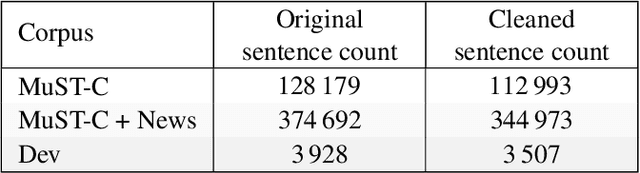
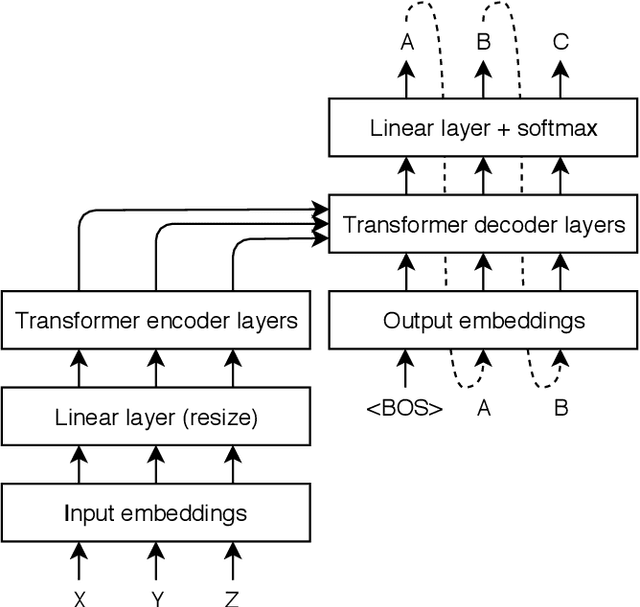
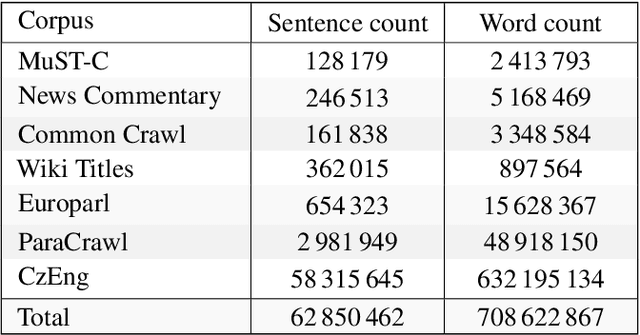
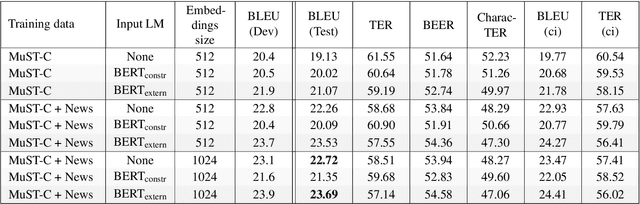
In this paper, we present our submission for the English to Czech Text Translation Task of IWSLT 2019. Our system aims to study how pre-trained language models, used as input embeddings, can improve a specialized machine translation system trained on few data. Therefore, we implemented a Transformer-based encoder-decoder neural system which is able to use the output of a pre-trained language model as input embeddings, and we compared its performance under three configurations: 1) without any pre-trained language model (constrained), 2) using a language model trained on the monolingual parts of the allowed English-Czech data (constrained), and 3) using a language model trained on a large quantity of external monolingual data (unconstrained). We used BERT as external pre-trained language model (configuration 3), and BERT architecture for training our own language model (configuration 2). Regarding the training data, we trained our MT system on a small quantity of parallel text: one set only consists of the provided MuST-C corpus, and the other set consists of the MuST-C corpus and the News Commentary corpus from WMT. We observed that using the external pre-trained BERT improves the scores of our system by +0.8 to +1.5 of BLEU on our development set, and +0.97 to +1.94 of BLEU on the test set. However, using our own language model trained only on the allowed parallel data seems to improve the machine translation performances only when the system is trained on the smallest dataset.
Sense Vocabulary Compression through the Semantic Knowledge of WordNet for Neural Word Sense Disambiguation
May 14, 2019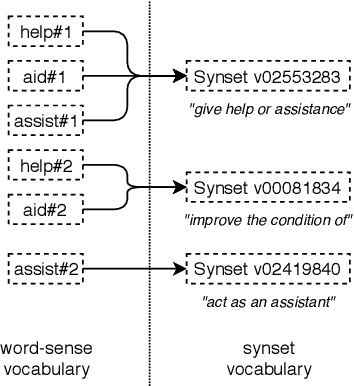
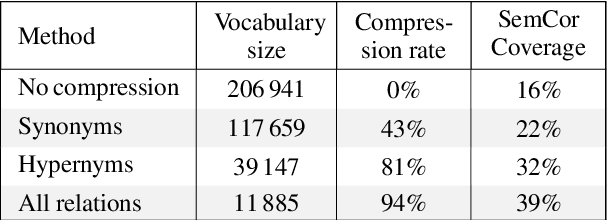
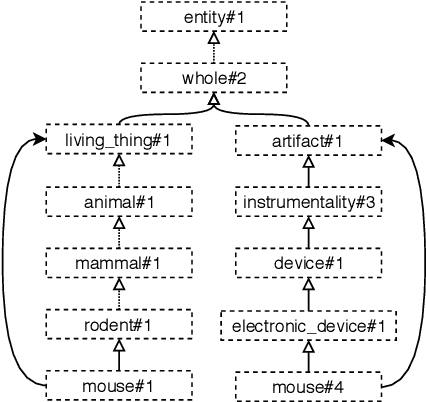
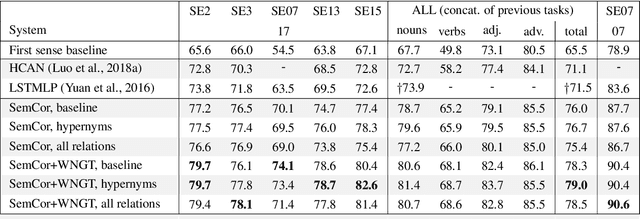
In this article, we tackle the issue of the limited quantity of manually sense annotated corpora for the task of word sense disambiguation, by exploiting the semantic relationships between senses such as synonymy, hypernymy and hyponymy, in order to compress the sense vocabulary of Princeton WordNet, and thus reduce the number of different sense tags that must be observed to disambiguate all words of the lexical database. We propose two different methods that greatly reduces the size of neural WSD models, with the benefit of improving their coverage without additional training data, and without impacting their precision. In addition to our method, we present a new WSD system which relies on pre-trained BERT word vectors in order to achieve results that significantly outperform the state of the art on all WSD evaluation tasks.
Improving the Coverage and the Generalization Ability of Neural Word Sense Disambiguation through Hypernymy and Hyponymy Relationships
Nov 02, 2018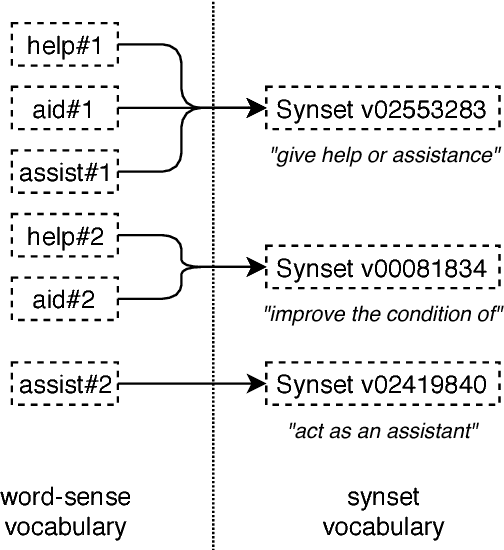

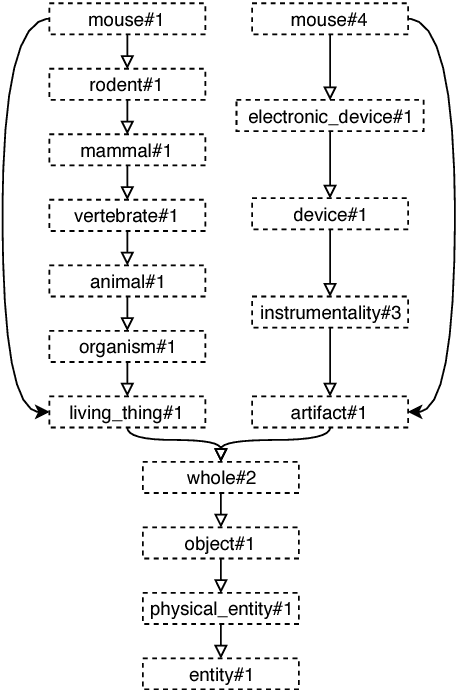
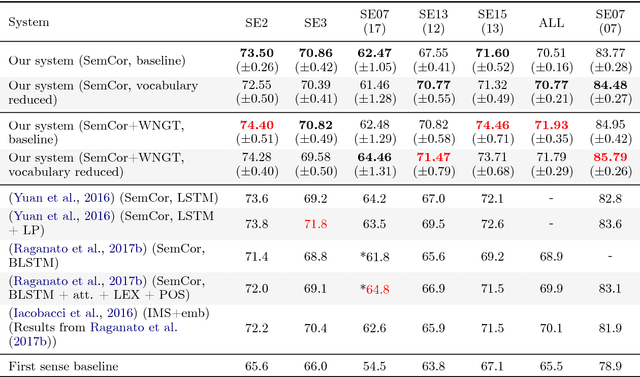
In Word Sense Disambiguation (WSD), the predominant approach generally involves a supervised system trained on sense annotated corpora. The limited quantity of such corpora however restricts the coverage and the performance of these systems. In this article, we propose a new method that solves these issues by taking advantage of the knowledge present in WordNet, and especially the hypernymy and hyponymy relationships between synsets, in order to reduce the number of different sense tags that are necessary to disambiguate all words of the lexical database. Our method leads to state of the art results on most WSD evaluation tasks, while improving the coverage of supervised systems, reducing the training time and the size of the models, without additional training data. In addition, we exhibit results that significantly outperform the state of the art when our method is combined with an ensembling technique and the addition of the WordNet Gloss Tagged as training corpus.
Système de traduction automatique statistique Anglais-Arabe
Feb 06, 2018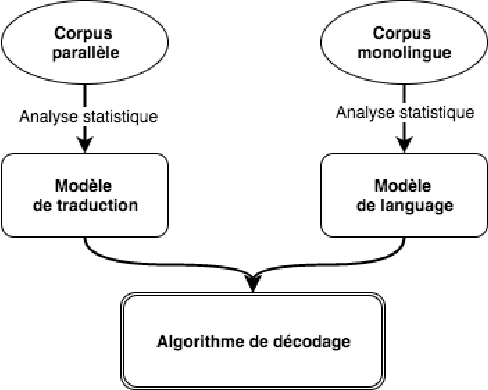



Machine translation (MT) is the process of translating text written in a source language into text in a target language. In this article, we present our English-Arabic statistical machine translation system. First, we present the general process for setting up a statistical machine translation system, then we describe the tools as well as the different corpora we used to build our MT system. Our system was evaluated in terms of the BLUE score (24.51%)
Deep Investigation of Cross-Language Plagiarism Detection Methods
May 24, 2017
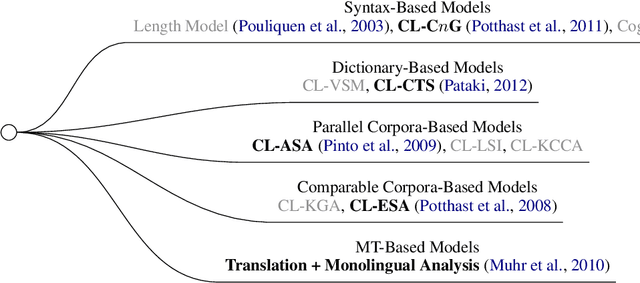
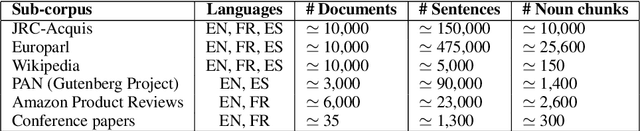
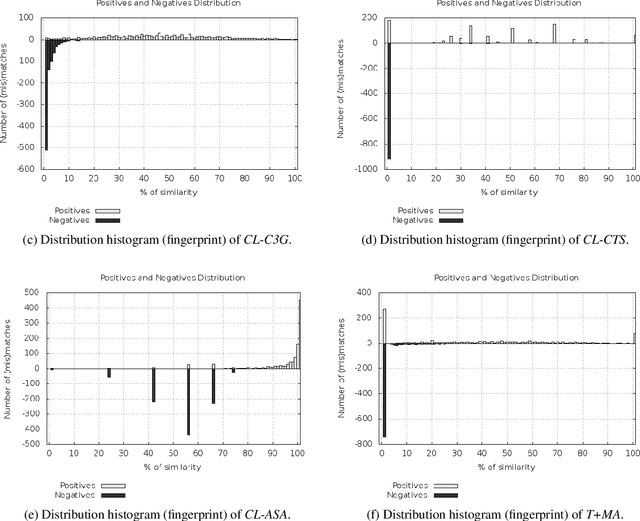
This paper is a deep investigation of cross-language plagiarism detection methods on a new recently introduced open dataset, which contains parallel and comparable collections of documents with multiple characteristics (different genres, languages and sizes of texts). We investigate cross-language plagiarism detection methods for 6 language pairs on 2 granularities of text units in order to draw robust conclusions on the best methods while deeply analyzing correlations across document styles and languages.
Comparison of Global Algorithms in Word Sense Disambiguation
Apr 07, 2017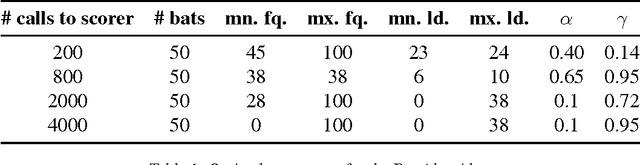
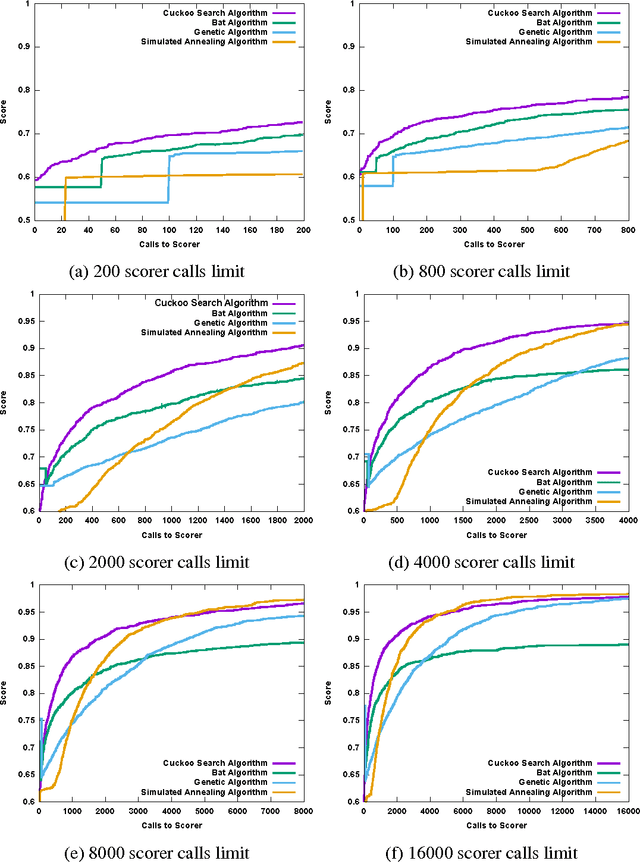
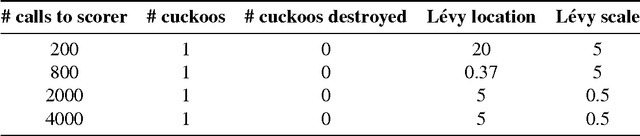
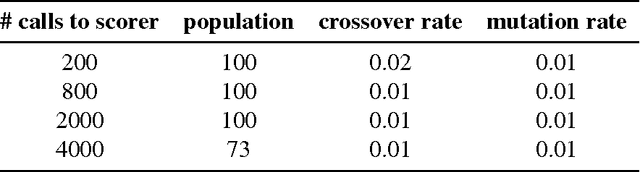
This article compares four probabilistic algorithms (global algorithms) for Word Sense Disambiguation (WSD) in terms of the number of scorer calls (local algo- rithm) and the F1 score as determined by a gold-standard scorer. Two algorithms come from the state of the art, a Simulated Annealing Algorithm (SAA) and a Genetic Algorithm (GA) as well as two algorithms that we first adapt from WSD that are state of the art probabilistic search algorithms, namely a Cuckoo search algorithm (CSA) and a Bat Search algorithm (BS). As WSD requires to evaluate exponentially many word sense combinations (with branching factors of up to 6 or more), probabilistic algorithms allow to find approximate solution in a tractable time by sampling the search space. We find that CSA, GA and SA all eventually converge to similar results (0.98 F1 score), but CSA gets there faster (in fewer scorer calls) and reaches up to 0.95 F1 before SA in fewer scorer calls. In BA a strict convergence criterion prevents it from reaching above 0.89 F1.
CompiLIG at SemEval-2017 Task 1: Cross-Language Plagiarism Detection Methods for Semantic Textual Similarity
Apr 05, 2017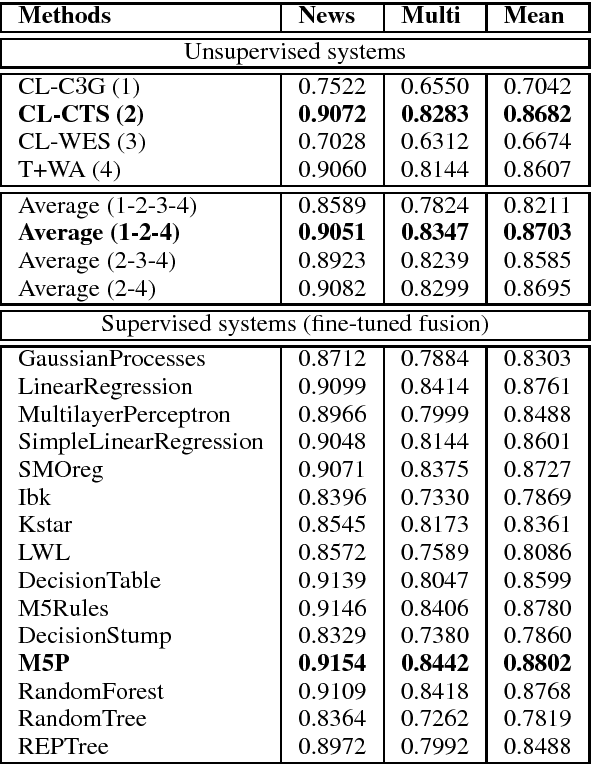
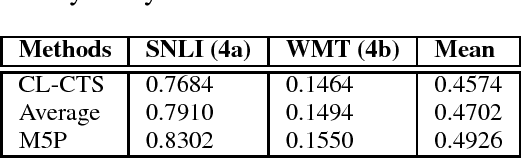
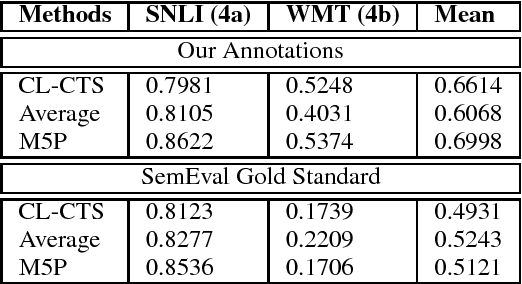
We present our submitted systems for Semantic Textual Similarity (STS) Track 4 at SemEval-2017. Given a pair of Spanish-English sentences, each system must estimate their semantic similarity by a score between 0 and 5. In our submission, we use syntax-based, dictionary-based, context-based, and MT-based methods. We also combine these methods in unsupervised and supervised way. Our best run ranked 1st on track 4a with a correlation of 83.02% with human annotations.