 Add to Chrome
 Add to Firefox
 Add to Edge
Conflict-Aware Retriever Editing for Knowledge Injection Attacks on LLM-Based RAG Systems
Jun 16, 2026
Injecting malicious knowledge into retrieval-augmented generation (RAG) systems can manipulate retrieved evidence and mislead downstream generation, posing a serious security threat for AI applications. Existing RAG injection attacks mainly rely on manipulating external knowledge bases, such as crafting malicious corpus. However, the synthetic text crafted by such data-centric methods could be detectable, leading to the failure of attacks. Beyond corpus manipulation, open-source retrievers are increasingly exposing RAG systems to model-centric attacks. In this paper, we propose conflict-aware retriever editing, i.e., CAREATTACK, a model-centric retriever attack framework for malicious knowledge injection in RAG. Specifically, CAREATTACK consists two stages of conflict-aware retriever editing and attack-preserving anchor repair. Conflict-aware retriever editing adapts efficient closed-form parameter editing to the dense retrieval model, promoting malicious knowledge above benign competing passages and resolving potential parameter conflicts through graph-based conflict detection and parameter editing projection. Then, attack-preserving anchor repair performs lightweight calibration on the edited retriever to further eliminate the impact on non-target prompts while preserving the attack effectiveness for target prompts. We instantiate CAREATTACK on Qwen3-Embedding-0.6B and BGE-M3, and conduct evaluation on three benchmark datasets. Experimental results demonstrate our method substantially promote malicious passages into the retrieved knowledge of RAG systems and can perform attacks for batches of target prompts and passages, given the access of retrieval model parameters. Since most RAG systems are built upon open-source retrieval models, this work reveals a practical attack surface in RAG systems. Codes are public accessible at https://anonymous.4open.science/r/CareAttack-3F1C.

The USTC-NERCSLIP Systems for the CHiME-8 NOTSOFAR-1 Challenge
Sep 03, 2024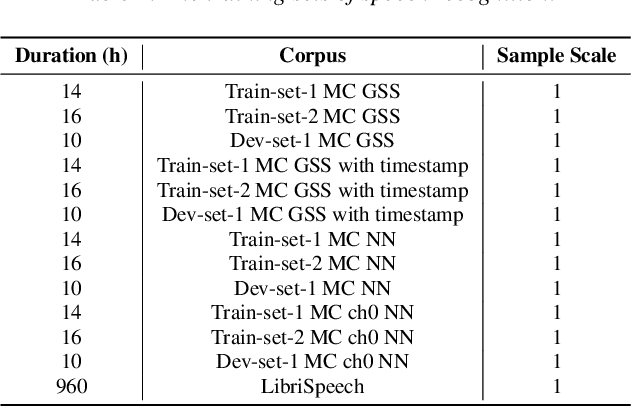
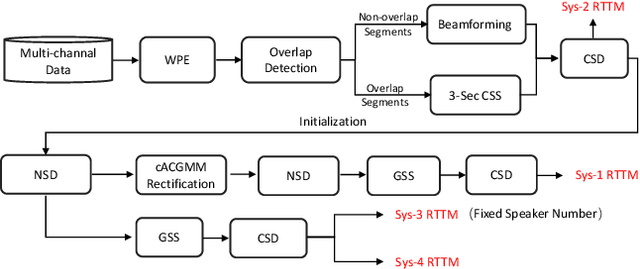
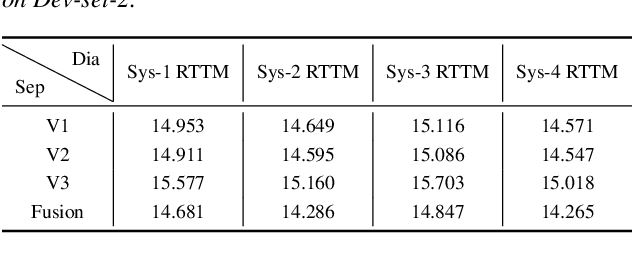
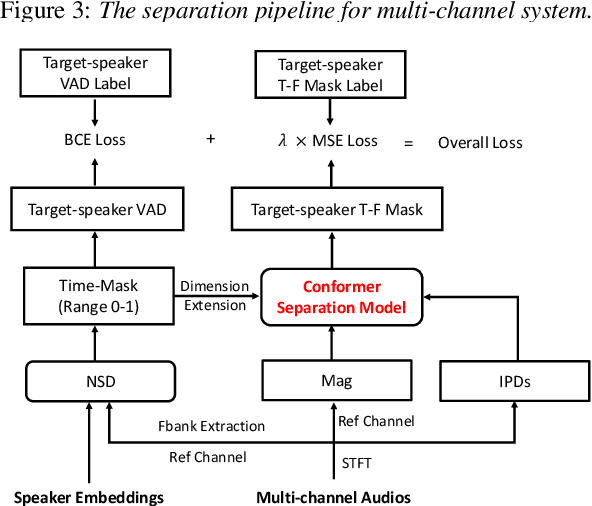
This technical report outlines our submission system for the CHiME-8 NOTSOFAR-1 Challenge. The primary difficulty of this challenge is the dataset recorded across various conference rooms, which captures real-world complexities such as high overlap rates, background noises, a variable number of speakers, and natural conversation styles. To address these issues, we optimized the system in several aspects: For front-end speech signal processing, we introduced a data-driven joint training method for diarization and separation (JDS) to enhance audio quality. Additionally, we also integrated traditional guided source separation (GSS) for multi-channel track to provide complementary information for the JDS. For back-end speech recognition, we enhanced Whisper with WavLM, ConvNeXt, and Transformer innovations, applying multi-task training and Noise KLD augmentation, to significantly advance ASR robustness and accuracy. Our system attained a Time-Constrained minimum Permutation Word Error Rate (tcpWER) of 14.265% and 22.989% on the CHiME-8 NOTSOFAR-1 Dev-set-2 multi-channel and single-channel tracks, respectively.