 Add to Chrome
 Add to Firefox
 Add to Edge
Generative Augmented Inference
Apr 16, 2026
Data-driven operations management often relies on parameters estimated from costly human-generated labels. Recent advances in large language models (LLMs) and other AI systems offer inexpensive auxiliary data, but introduce a new challenge: AI outputs are not direct observations of the target outcomes, but could involve high-dimensional representations with complex and unknown relationships to human labels. Conventional methods leverage AI predictions as direct proxies for true labels, which can be inefficient or unreliable when this relationship is weak or misspecified. We propose Generative Augmented Inference (GAI), a general framework that incorporates AI-generated outputs as informative features for estimating models of human-labeled outcomes. GAI uses an orthogonal moment construction that enables consistent estimation and valid inference with flexible, nonparametric relationship between LLM-generated outputs and human labels. We establish asymptotic normality and show a "safe default" property: relative to human-data-only estimators, GAI weakly improves estimation efficiency under arbitrary auxiliary signals and yields strict gains whenever the auxiliary information is predictive. Empirically, GAI outperforms benchmarks across diverse settings. In conjoint analysis with weak auxiliary signals, GAI reduces estimation error by about 50% and lowers human labeling requirements by over 75%. In retail pricing, where all methods access the same auxiliary inputs, GAI consistently outperforms alternative estimators, highlighting the value of its construction rather than differences in information. In health insurance choice, it cuts labeling requirements by over 90% while maintaining decision accuracy. Across applications, GAI improves confidence interval coverage without inflating width. Overall, GAI provides a principled and scalable approach to integrating AI-generated information.

Large Language Models for Market Research: A Data-augmentation Approach
Dec 26, 2024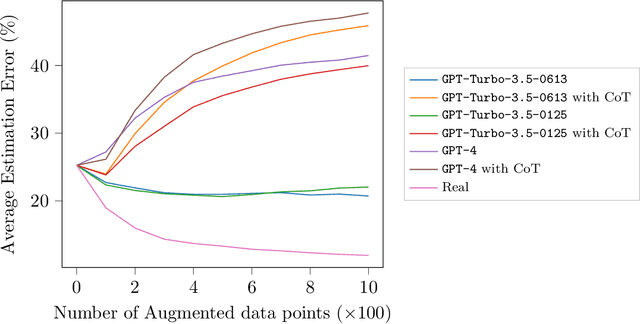


Large Language Models (LLMs) have transformed artificial intelligence by excelling in complex natural language processing tasks. Their ability to generate human-like text has opened new possibilities for market research, particularly in conjoint analysis, where understanding consumer preferences is essential but often resource-intensive. Traditional survey-based methods face limitations in scalability and cost, making LLM-generated data a promising alternative. However, while LLMs have the potential to simulate real consumer behavior, recent studies highlight a significant gap between LLM-generated and human data, with biases introduced when substituting between the two. In this paper, we address this gap by proposing a novel statistical data augmentation approach that efficiently integrates LLM-generated data with real data in conjoint analysis. Our method leverages transfer learning principles to debias the LLM-generated data using a small amount of human data. This results in statistically robust estimators with consistent and asymptotically normal properties, in contrast to naive approaches that simply substitute human data with LLM-generated data, which can exacerbate bias. We validate our framework through an empirical study on COVID-19 vaccine preferences, demonstrating its superior ability to reduce estimation error and save data and costs by 24.9\% to 79.8\%. In contrast, naive approaches fail to save data due to the inherent biases in LLM-generated data compared to human data. Another empirical study on sports car choices validates the robustness of our results. Our findings suggest that while LLM-generated data is not a direct substitute for human responses, it can serve as a valuable complement when used within a robust statistical framework.