 Add to Chrome
 Add to Firefox
 Add to Edge
An AI-Based Supervisory Measurement Integrity Validation Layer for Cyber-Resilient AC/DC Protection in Inverter-Based Microgrids
Apr 26, 2026
Line current differential relays (LCDRs) are measurement-driven relays that rely on time-synchronized multi-phase current waveforms to infer internal faults in AC and DC power networks. In inverter-based microgrids, however, the increasing reliance on digitally communicated measurements exposes LCDRs to false-data injection attacks (FDIAs), in which adversaries manipulate remote measurement streams to create protection-triggering yet physically inconsistent current trajectories. This paper addresses this emerging measurement integrity problem by introducing a measurement integrity validation scheme that operates as a supervisory instrumentation layer for modern LCDRs. The proposed scheme interprets short windows of synchronized instantaneous current measurements recorded during relay operation and assesses their physical consistency to distinguish genuine fault-induced trajectories from cyber-manipulated measurement streams. A recurrent neural network is trained offline using only relay-available current measurements and exploits the temporal structure of differential current waveforms, which remains informative in inverter-dominated systems where current magnitude is no longer a reliable observable. The method requires no additional sensors, auxiliary protection elements, or prior knowledge of network topology, and is applicable to both AC and DC LCDRs without structural modification. The proposed measurement validation scheme is evaluated on an islanded inverter-based microgrid under a comprehensive set of fault and FDIA scenarios, demonstrating high detection accuracy while preserving relay dependability. Hardware-in-the-loop validation using an OPAL-RT real-time simulator confirms that the scheme satisfies protection timing constraints and can operate in real time under realistic operating conditions.

Evaluating Jailbreaking Vulnerabilities in LLMs Deployed as Assistants for Smart Grid Operations: A Benchmark Against NERC Standards
Apr 25, 2026The deployment of Large Language Models (LLMs) as assistants in electric grid operations promises to streamline compliance and decision-making but exposes new vulnerabilities to prompt-based adversarial attacks. This paper evaluates the risk of jailbreaking LLMs, i.e., circumventing safety alignments to produce outputs violating regulatory standards, assuming threats from authorized users, such as operators, who craft malicious prompts to elicit non-compliant guidance. Three state-of-the-art LLMs (OpenAI's GPT-4o mini, Google's Gemini 2.0 Flash-Lite, and Anthropic's Claude 3.5 Haiku) were tested against Baseline, BitBypass, and DeepInception jailbreaking methods across scenarios derived from nine NERC Reliability Standards (EOP, TOP, and CIP). In the initial broad experiment, the overall Attack Success Rate (ASR) was 33.1%, with DeepInception proving most effective at 63.17% ASR. Claude 3.5 Haiku exhibited complete resistance (0% ASR), while Gemini 2.0 Flash-Lite was most vulnerable (55.04% ASR) and GPT-4o mini moderately susceptible (44.34% ASR). A follow-up experiment refining malicious wording in Baseline and BitBypass attacks yielded a 30.6% ASR, confirming that subtle prompt adjustments can enhance simpler methods' efficacy.
Dual-Stage LLM Framework for Scenario-Centric Semantic Interpretation in Driving Assistance
Mar 29, 2026Advanced Driver Assistance Systems (ADAS) increasingly rely on learning-based perception, yet safety-relevant failures often arise without component malfunction, driven instead by partial observability and semantic ambiguity in how risk is interpreted and communicated. This paper presents a scenario-centric framework for reproducible auditing of LLM-based risk reasoning in urban driving contexts. Deterministic, temporally bounded scenario windows are constructed from multimodal driving data and evaluated under fixed prompt constraints and a closed numeric risk schema, ensuring structured and comparable outputs across models. Experiments on a curated near-people scenario set compare two text-only models and one multimodal model under identical inputs and prompts. Results reveal systematic inter-model divergence in severity assignment, high-risk escalation, evidence use, and causal attribution. Disagreement extends to the interpretation of vulnerable road user presence, indicating that variability often reflects intrinsic semantic indeterminacy rather than isolated model failure. These findings highlight the importance of scenario-centric auditing and explicit ambiguity management when integrating LLM-based reasoning into safety-aligned driver assistance systems.
Large Language Models for Detecting Cyberattacks on Smart Grid Protective Relays
Jan 07, 2026This paper presents a large language model (LLM)-based framework for detecting cyberattacks on transformer current differential relays (TCDRs), which, if undetected, may trigger false tripping of critical transformers. The proposed approach adapts and fine-tunes compact LLMs such as DistilBERT to distinguish cyberattacks from actual faults using textualized multidimensional TCDR current measurements recorded before and after tripping. Our results demonstrate that DistilBERT detects 97.6% of cyberattacks without compromising TCDR dependability and achieves inference latency below 6 ms on a commercial workstation. Additional evaluations confirm the framework's robustness under combined time-synchronization and false-data-injection attacks, resilience to measurement noise, and stability across prompt formulation variants. Furthermore, GPT-2 and DistilBERT+LoRA achieve comparable performance, highlighting the potential of LLMs for enhancing smart grid cybersecurity. We provide the full dataset used in this study for reproducibility.
A Kolmogorov-Arnold Network for Interpretable Cyberattack Detection in AGC Systems
Sep 05, 2025Automatic Generation Control (AGC) is essential for power grid stability but remains vulnerable to stealthy cyberattacks, such as False Data Injection Attacks (FDIAs), which can disturb the system's stability while evading traditional detection methods. Unlike previous works that relied on blackbox approaches, this work proposes Kolmogorov-Arnold Networks (KAN) as an interpretable and accurate method for FDIA detection in AGC systems, considering the system nonlinearities. KAN models include a method for extracting symbolic equations, and are thus able to provide more interpretability than the majority of machine learning models. The proposed KAN is trained offline to learn the complex nonlinear relationships between the AGC measurements under different operating scenarios. After training, symbolic formulas that describe the trained model's behavior can be extracted and leveraged, greatly enhancing interpretability. Our findings confirm that the proposed KAN model achieves FDIA detection rates of up to 95.97% and 95.9% for the initial model and the symbolic formula, respectively, with a low false alarm rate, offering a reliable approach to enhancing AGC cybersecurity.
Large Language Model-Based Framework for Explainable Cyberattack Detection in Automatic Generation Control Systems
Jul 29, 2025The increasing digitization of smart grids has improved operational efficiency but also introduced new cybersecurity vulnerabilities, such as False Data Injection Attacks (FDIAs) targeting Automatic Generation Control (AGC) systems. While machine learning (ML) and deep learning (DL) models have shown promise in detecting such attacks, their opaque decision-making limits operator trust and real-world applicability. This paper proposes a hybrid framework that integrates lightweight ML-based attack detection with natural language explanations generated by Large Language Models (LLMs). Classifiers such as LightGBM achieve up to 95.13% attack detection accuracy with only 0.004 s inference latency. Upon detecting a cyberattack, the system invokes LLMs, including GPT-3.5 Turbo, GPT-4 Turbo, and GPT-4o mini, to generate human-readable explanation of the event. Evaluated on 100 test samples, GPT-4o mini with 20-shot prompting achieved 93% accuracy in identifying the attack target, a mean absolute error of 0.075 pu in estimating attack magnitude, and 2.19 seconds mean absolute error (MAE) in estimating attack onset. These results demonstrate that the proposed framework effectively balances real-time detection with interpretable, high-fidelity explanations, addressing a critical need for actionable AI in smart grid cybersecurity.
Speech as a Multimodal Digital Phenotype for Multi-Task LLM-based Mental Health Prediction
May 28, 2025Speech is a noninvasive digital phenotype that can offer valuable insights into mental health conditions, but it is often treated as a single modality. In contrast, we propose the treatment of patient speech data as a trimodal multimedia data source for depression detection. This study explores the potential of large language model-based architectures for speech-based depression prediction in a multimodal regime that integrates speech-derived text, acoustic landmarks, and vocal biomarkers. Adolescent depression presents a significant challenge and is often comorbid with multiple disorders, such as suicidal ideation and sleep disturbances. This presents an additional opportunity to integrate multi-task learning (MTL) into our study by simultaneously predicting depression, suicidal ideation, and sleep disturbances using the multimodal formulation. We also propose a longitudinal analysis strategy that models temporal changes across multiple clinical interactions, allowing for a comprehensive understanding of the conditions' progression. Our proposed approach, featuring trimodal, longitudinal MTL is evaluated on the Depression Early Warning dataset. It achieves a balanced accuracy of 70.8%, which is higher than each of the unimodal, single-task, and non-longitudinal methods.
Machine Learning-Based Cyberattack Detection and Identification for Automatic Generation Control Systems Considering Nonlinearities
Apr 12, 2025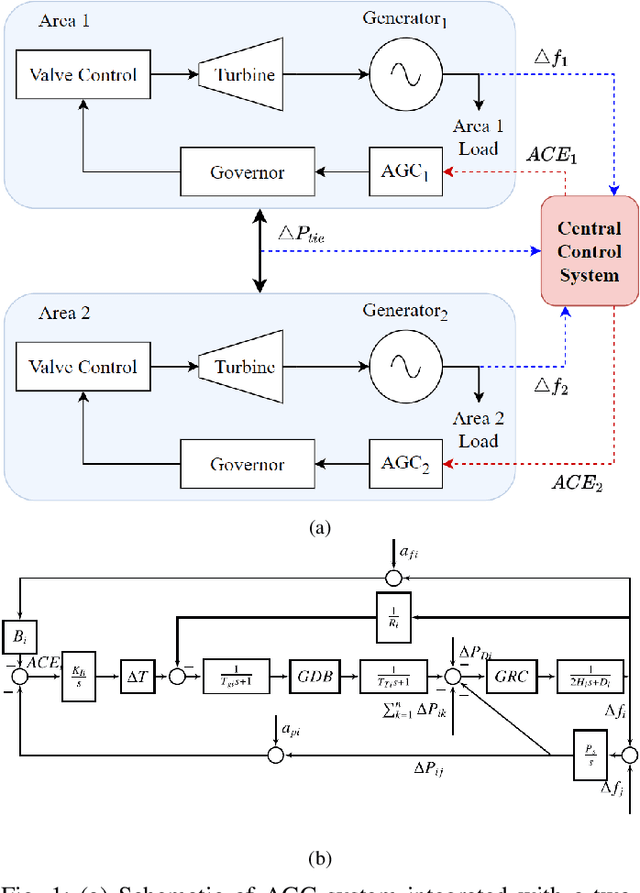
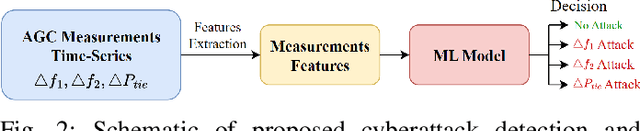
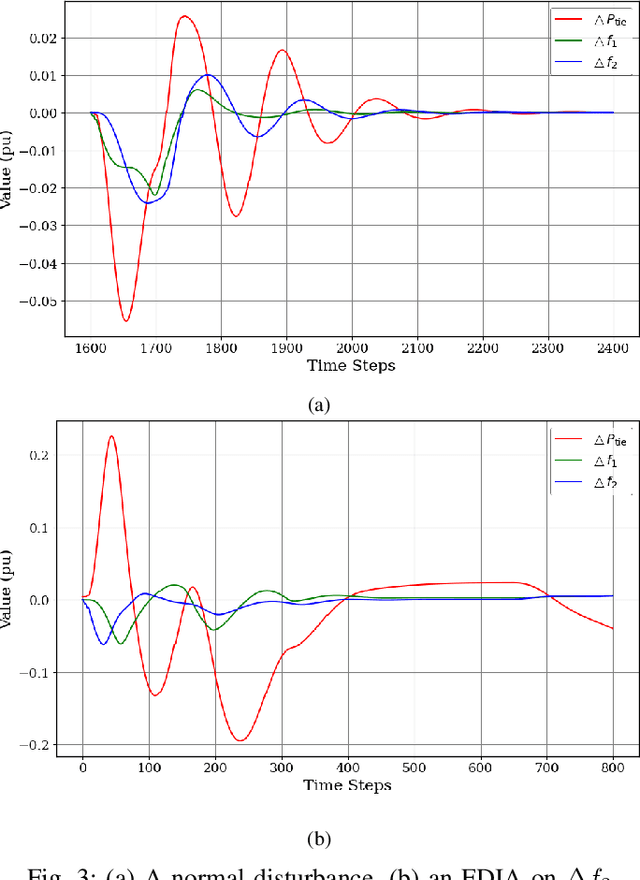
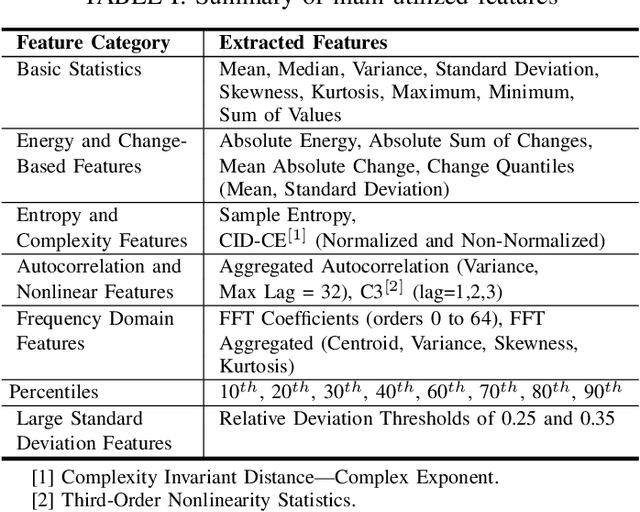
Automatic generation control (AGC) systems play a crucial role in maintaining system frequency across power grids. However, AGC systems' reliance on communicated measurements exposes them to false data injection attacks (FDIAs), which can compromise the overall system stability. This paper proposes a machine learning (ML)-based detection framework that identifies FDIAs and determines the compromised measurements. The approach utilizes an ML model trained offline to accurately detect attacks and classify the manipulated signals based on a comprehensive set of statistical and time-series features extracted from AGC measurements before and after disturbances. For the proposed approach, we compare the performance of several powerful ML algorithms. Our results demonstrate the efficacy of the proposed method in detecting FDIAs while maintaining a low false alarm rate, with an F1-score of up to 99.98%, outperforming existing approaches.
A Kolmogorov-Arnold Network for Explainable Detection of Cyberattacks on EV Chargers
Mar 04, 2025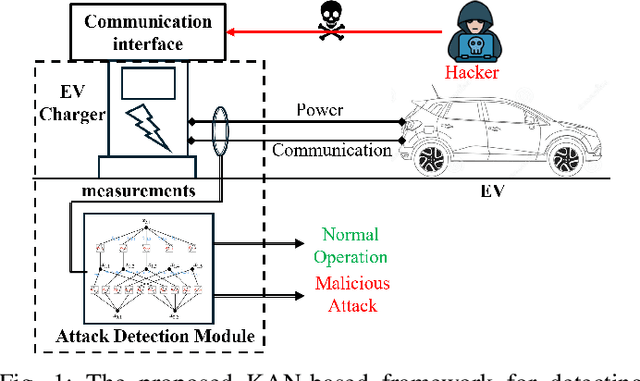
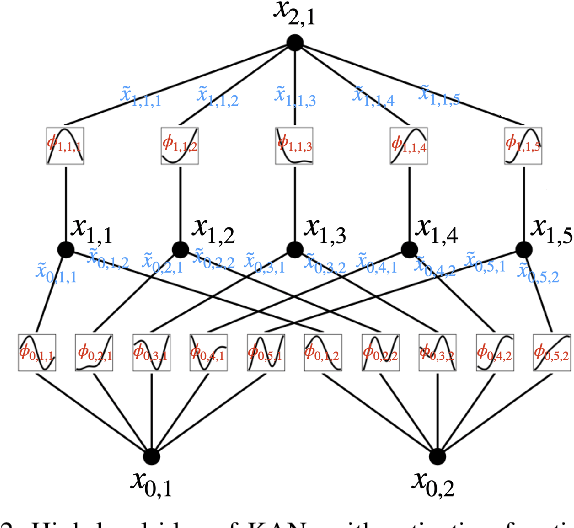


The increasing adoption of Electric Vehicles (EVs) and the expansion of charging infrastructure and their reliance on communication expose Electric Vehicle Supply Equipment (EVSE) to cyberattacks. This paper presents a novel Kolmogorov-Arnold Network (KAN)-based framework for detecting cyberattacks on EV chargers using only power consumption measurements. Leveraging the KAN's capability to model nonlinear, high-dimensional functions and its inherently interpretable architecture, the framework effectively differentiates between normal and malicious charging scenarios. The model is trained offline on a comprehensive dataset containing over 100,000 cyberattack cases generated through an experimental setup. Once trained, the KAN model can be deployed within individual chargers for real-time detection of abnormal charging behaviors indicative of cyberattacks. Our results demonstrate that the proposed KAN-based approach can accurately detect cyberattacks on EV chargers with Precision and F1-score of 99% and 92%, respectively, outperforming existing detection methods. Additionally, the proposed KANs's enable the extraction of mathematical formulas representing KAN's detection decisions, addressing interpretability, a key challenge in deep learning-based cybersecurity frameworks. This work marks a significant step toward building secure and explainable EV charging infrastructure.
Enhancing Power Quality Event Classification with AI Transformer Models
Feb 22, 2024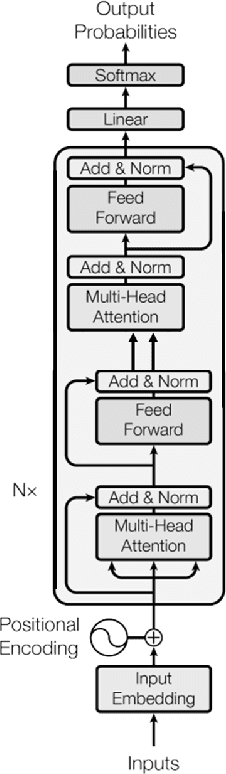

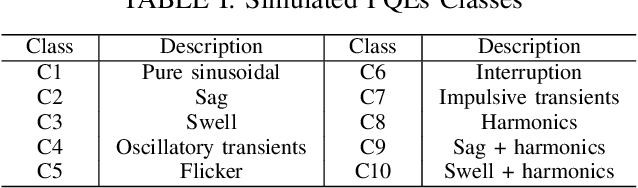
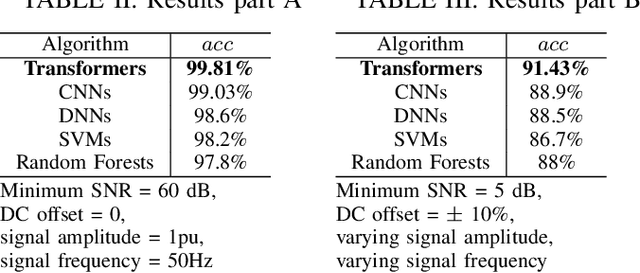
Recently, there has been a growing interest in utilizing machine learning for accurate classification of power quality events (PQEs). However, most of these studies are performed assuming an ideal situation, while in reality, we can have measurement noise, DC offset, and variations in the voltage signal's amplitude and frequency. Building on the prior PQE classification works using deep learning, this paper proposes a deep-learning framework that leverages attention-enabled Transformers as a tool to accurately classify PQEs under the aforementioned considerations. The proposed framework can operate directly on the voltage signals with no need for a separate feature extraction or calculation phase. Our results show that the proposed framework outperforms recently proposed learning-based techniques. It can accurately classify PQEs under the aforementioned conditions with an accuracy varying between 99.81%$-$91.43% depending on the signal-to-noise ratio, DC offsets, and variations in the signal amplitude and frequency.