 Add to Chrome
 Add to Firefox
 Add to Edge
An AI-Based Supervisory Measurement Integrity Validation Layer for Cyber-Resilient AC/DC Protection in Inverter-Based Microgrids
Apr 26, 2026
Line current differential relays (LCDRs) are measurement-driven relays that rely on time-synchronized multi-phase current waveforms to infer internal faults in AC and DC power networks. In inverter-based microgrids, however, the increasing reliance on digitally communicated measurements exposes LCDRs to false-data injection attacks (FDIAs), in which adversaries manipulate remote measurement streams to create protection-triggering yet physically inconsistent current trajectories. This paper addresses this emerging measurement integrity problem by introducing a measurement integrity validation scheme that operates as a supervisory instrumentation layer for modern LCDRs. The proposed scheme interprets short windows of synchronized instantaneous current measurements recorded during relay operation and assesses their physical consistency to distinguish genuine fault-induced trajectories from cyber-manipulated measurement streams. A recurrent neural network is trained offline using only relay-available current measurements and exploits the temporal structure of differential current waveforms, which remains informative in inverter-dominated systems where current magnitude is no longer a reliable observable. The method requires no additional sensors, auxiliary protection elements, or prior knowledge of network topology, and is applicable to both AC and DC LCDRs without structural modification. The proposed measurement validation scheme is evaluated on an islanded inverter-based microgrid under a comprehensive set of fault and FDIA scenarios, demonstrating high detection accuracy while preserving relay dependability. Hardware-in-the-loop validation using an OPAL-RT real-time simulator confirms that the scheme satisfies protection timing constraints and can operate in real time under realistic operating conditions.

Unmasking Covert Intrusions: Detection of Fault-Masking Cyberattacks on Differential Protection Systems
Sep 06, 2024

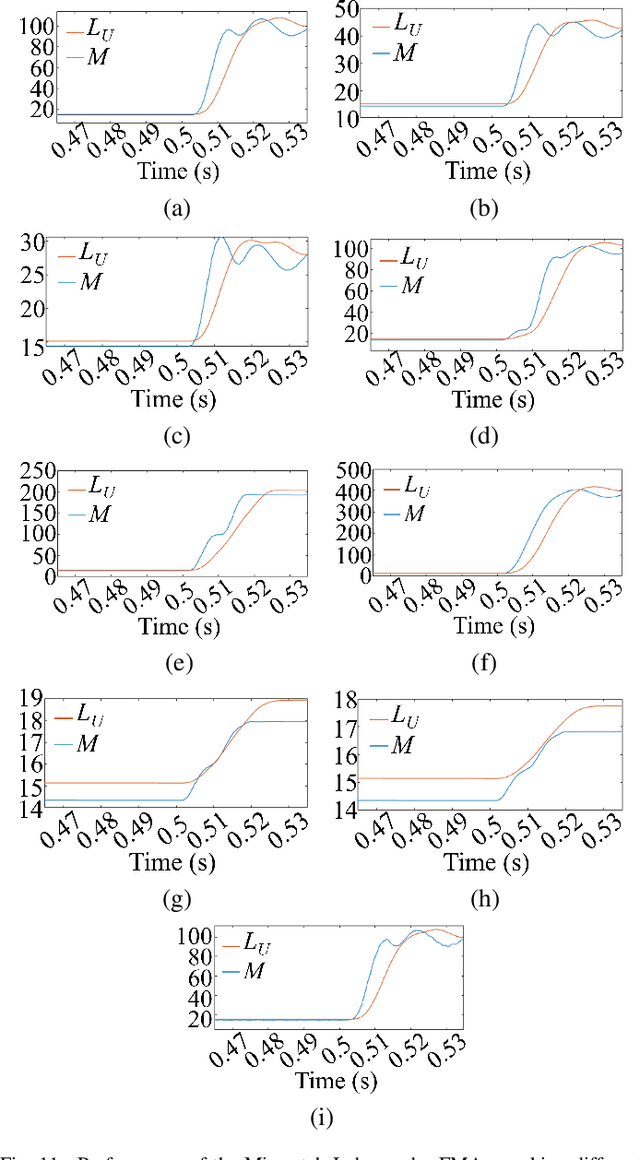

Line Current Differential Relays (LCDRs) are high-speed relays progressively used to protect critical transmission lines. However, LCDRs are vulnerable to cyberattacks. Fault-Masking Attacks (FMAs) are stealthy cyberattacks performed by manipulating the remote measurements of the targeted LCDR to disguise faults on the protected line. Hence, they remain undetected by this LCDR. In this paper, we propose a two-module framework to detect FMAs. The first module is a Mismatch Index (MI) developed from the protected transmission line's equivalent physical model. The MI is triggered only if there is a significant mismatch in the LCDR's local and remote measurements while the LCDR itself is untriggered, which indicates an FMA. After the MI is triggered, the second module, a neural network-based classifier, promptly confirms that the triggering event is a physical fault that lies on the line protected by the LCDR before declaring the occurrence of an FMA. The proposed framework is tested using the IEEE 39-bus benchmark system. Our simulation results confirm that the proposed framework can accurately detect FMAs on LCDRs and is not affected by normal system disturbances, variations, or measurement noise. Our experimental results using OPAL-RT's real-time simulator confirm the proposed solution's real-time performance capability.
Enhancing Power Quality Event Classification with AI Transformer Models
Feb 22, 2024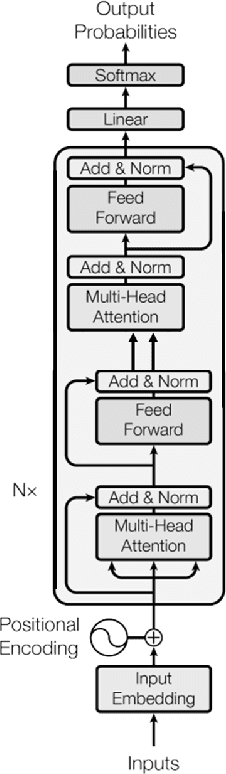

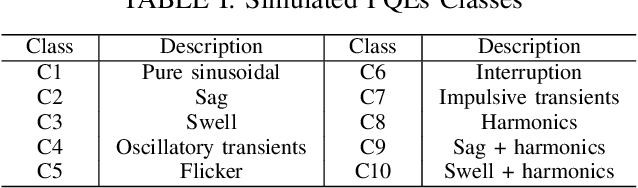
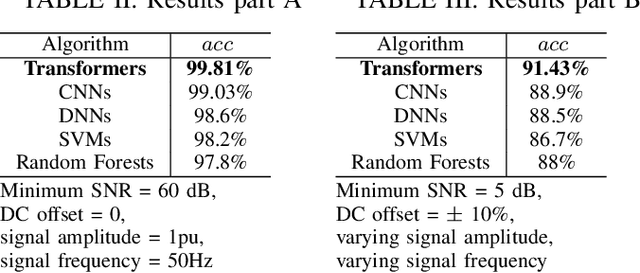
Recently, there has been a growing interest in utilizing machine learning for accurate classification of power quality events (PQEs). However, most of these studies are performed assuming an ideal situation, while in reality, we can have measurement noise, DC offset, and variations in the voltage signal's amplitude and frequency. Building on the prior PQE classification works using deep learning, this paper proposes a deep-learning framework that leverages attention-enabled Transformers as a tool to accurately classify PQEs under the aforementioned considerations. The proposed framework can operate directly on the voltage signals with no need for a separate feature extraction or calculation phase. Our results show that the proposed framework outperforms recently proposed learning-based techniques. It can accurately classify PQEs under the aforementioned conditions with an accuracy varying between 99.81%$-$91.43% depending on the signal-to-noise ratio, DC offsets, and variations in the signal amplitude and frequency.