 Add to Chrome
 Add to Firefox
 Add to Edge
Quantum Adaptive Sensing for Accelerated MRI
Jul 23, 2026
Compressed sensing accelerates MRI by reconstructing images from undersampled k-space, but performance depends strongly on sampling distribution. We propose an adaptive framework that selects Cartesian phase-encode lines sequentially using a fixed-cardinality quadratic unconstrained binary optimization (QUBO) formulation. The objective combines a preference for central k-space, signal-energy information from previously acquired measurements, and pairwise terms that encourage spatially dispersed sampling. The formulation is compatible with classical annealing and quantum-annealing hardware. Retrospective experiments used simulated eight-coil 3D MRI data; QUBO problems were solved with parallel tempering, and images were reconstructed with SENSE and total-variation regularization. At 20% and 10% sampling, the proposed method improved PSNR, SSIM, NMSE, and HFEN compared with the evaluated static Cartesian strategies, including variable-density Poisson-disc sampling, although gains varied with resolution, acceleration, and noise level. In a reduced-pool experiment, a D-Wave quantum-classical hybrid solver achieved reconstruction quality comparable to variable-density Poisson-disc sampling, demonstrating feasibility on current quantum optimization infrastructure. While these results do not establish quantum computational advantage, the direct QUBO representation provides a practical framework for adaptive MRI sampling and may benefit from future advances in quantum-annealing hardware. Prospective scanner validation and systematic quantum-classical benchmarking remain necessary.

AlpaPICO: Extraction of PICO Frames from Clinical Trial Documents Using LLMs
Sep 15, 2024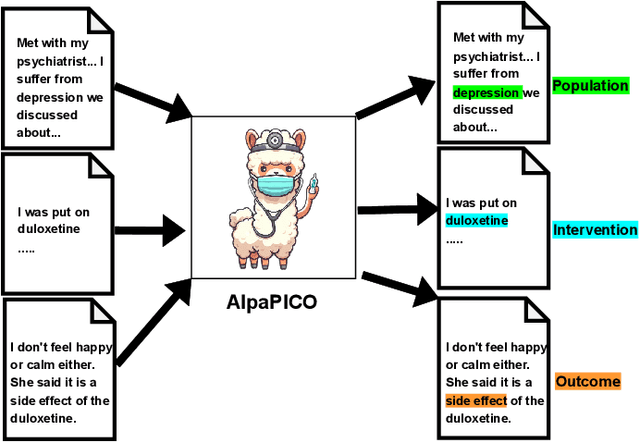


In recent years, there has been a surge in the publication of clinical trial reports, making it challenging to conduct systematic reviews. Automatically extracting Population, Intervention, Comparator, and Outcome (PICO) from clinical trial studies can alleviate the traditionally time-consuming process of manually scrutinizing systematic reviews. Existing approaches of PICO frame extraction involves supervised approach that relies on the existence of manually annotated data points in the form of BIO label tagging. Recent approaches, such as In-Context Learning (ICL), which has been shown to be effective for a number of downstream NLP tasks, require the use of labeled examples. In this work, we adopt ICL strategy by employing the pretrained knowledge of Large Language Models (LLMs), gathered during the pretraining phase of an LLM, to automatically extract the PICO-related terminologies from clinical trial documents in unsupervised set up to bypass the availability of large number of annotated data instances. Additionally, to showcase the highest effectiveness of LLM in oracle scenario where large number of annotated samples are available, we adopt the instruction tuning strategy by employing Low Rank Adaptation (LORA) to conduct the training of gigantic model in low resource environment for the PICO frame extraction task. Our empirical results show that our proposed ICL-based framework produces comparable results on all the version of EBM-NLP datasets and the proposed instruction tuned version of our framework produces state-of-the-art results on all the different EBM-NLP datasets. Our project is available at \url{https://github.com/shrimonmuke0202/AlpaPICO.git}.