 Add to Chrome
 Add to Firefox
 Add to Edge
DeltaCam: Differential Intrinsic Camera Modeling for Video Generation
May 24, 2026
Incorporating camera intrinsics into video generation models offers a principled way to control not only scene dynamics but also the imaging process that governs visual appearance. Prior work has primarily focused on extrinsic control, such as camera pose and motion, while treating intrinsic camera parameters as implicit or fixed. A key bottleneck is the lack of large-scale video datasets with accurate and diverse temporally varying camera metadata, which makes learning absolute camera parameterizations difficult. As a result, current models struggle to incorporate photographic camera behavior, including depth-of-field transitions, exposure variations, lens distortions, and color processing, in a controllable and temporally consistent manner. We introduce DeltaCam, a video diffusion framework that models camera behavior through $Δ$-parameterized neural camera adaptors, operating on relative changes in camera motion and intrinsics instead of absolute states. By learning this differential formulation from synthetic video data, we mitigate reliance on precise real-world camera labels and enable smooth, consistent control over imaging factors such as focal length, aperture, ISO, color temperature, and lens distortion. We extend this framework to real-world footage through two mechanisms: finetuning the controls on real image-metadata pairs for precise shot matching, and extracting disentangled embeddings for implicit video-to-video style transfer without requiring explicit camera parameters. By effectively separating scene content from intrinsic imaging behavior, DeltaCam enables camera-consistent video generation and editing operations that are difficult to achieve with existing models. Ultimately, our results establish a practical and scalable approach for bridging synthetic control and real-world photographic emulation.

UniCoRN: Latent Diffusion-based Unified Controllable Image Restoration Network across Multiple Degradations
Mar 21, 2025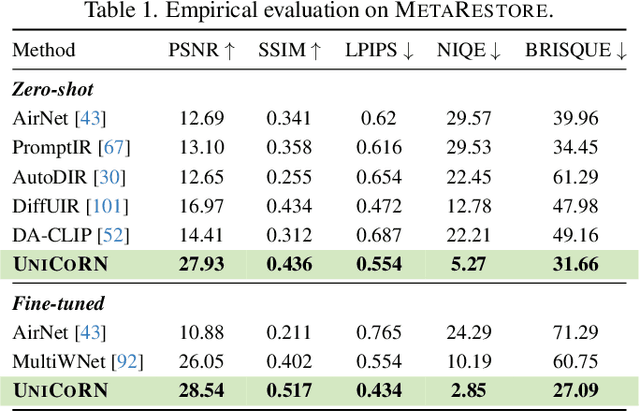
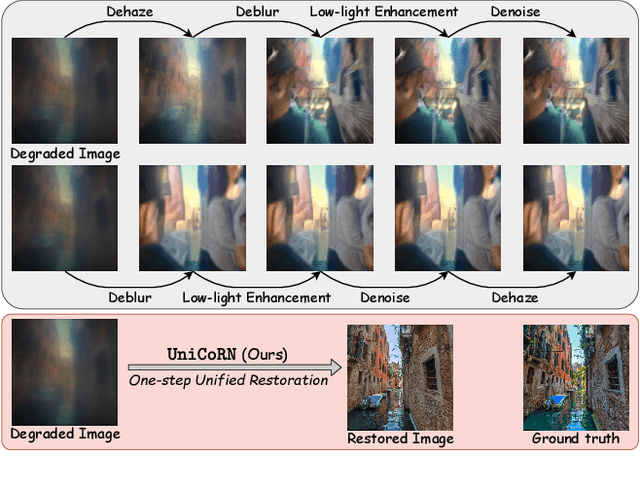
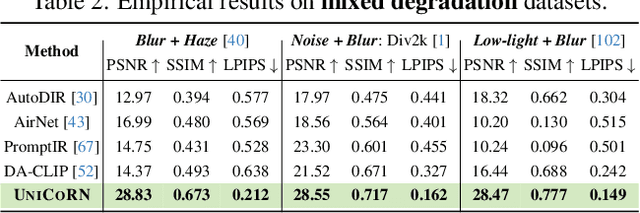
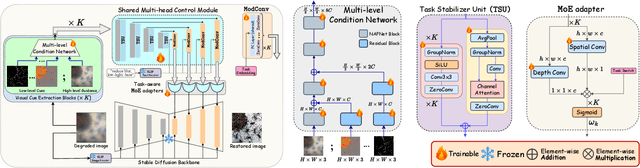
Image restoration is essential for enhancing degraded images across computer vision tasks. However, most existing methods address only a single type of degradation (e.g., blur, noise, or haze) at a time, limiting their real-world applicability where multiple degradations often occur simultaneously. In this paper, we propose UniCoRN, a unified image restoration approach capable of handling multiple degradation types simultaneously using a multi-head diffusion model. Specifically, we uncover the potential of low-level visual cues extracted from images in guiding a controllable diffusion model for real-world image restoration and we design a multi-head control network adaptable via a mixture-of-experts strategy. We train our model without any prior assumption of specific degradations, through a smartly designed curriculum learning recipe. Additionally, we also introduce MetaRestore, a metalens imaging benchmark containing images with multiple degradations and artifacts. Extensive evaluations on several challenging datasets, including our benchmark, demonstrate that our method achieves significant performance gains and can robustly restore images with severe degradations. Project page: https://codejaeger.github.io/unicorn-gh
MetaFormer: High-fidelity Metalens Imaging via Aberration Correcting Transformers
Dec 05, 2024

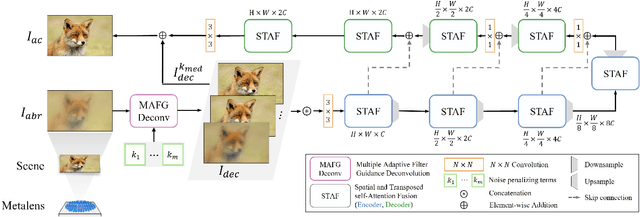
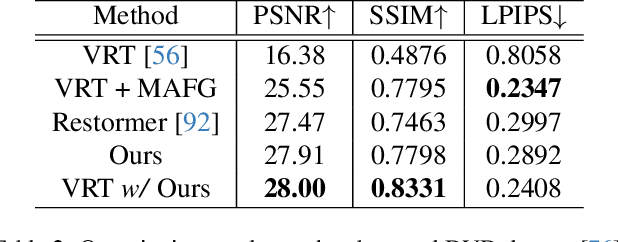
Metalens is an emerging optical system with an irreplaceable merit in that it can be manufactured in ultra-thin and compact sizes, which shows great promise of various applications such as medical imaging and augmented/virtual reality (AR/VR). Despite its advantage in miniaturization, its practicality is constrained by severe aberrations and distortions, which significantly degrade the image quality. Several previous arts have attempted to address different types of aberrations, yet most of them are mainly designed for the traditional bulky lens and not convincing enough to remedy harsh aberrations of the metalens. While there have existed aberration correction methods specifically for metalens, they still fall short of restoration quality. In this work, we propose MetaFormer, an aberration correction framework for metalens-captured images, harnessing Vision Transformers (ViT) that has shown remarkable restoration performance in diverse image restoration tasks. Specifically, we devise a Multiple Adaptive Filters Guidance (MAFG), where multiple Wiener filters enrich the degraded input images with various noise-detail balances, enhancing output restoration quality. In addition, we introduce a Spatial and Transposed self-Attention Fusion (STAF) module, which aggregates features from spatial self-attention and transposed self-attention modules to further ameliorate aberration correction. We conduct extensive experiments, including correcting aberrated images and videos, and clean 3D reconstruction from the degraded images. The proposed method outperforms the previous arts by a significant margin. We further fabricate a metalens and verify the practicality of MetaFormer by restoring the images captured with the manufactured metalens in the wild. Code and pre-trained models are available at https://benhenryl.github.io/MetaFormer