 Add to Chrome
 Add to Firefox
 Add to Edge
Budget-Aware Adaptive Adversarial Patches for Black-Box Object Detection
Jun 16, 2026
Adversarial patches pose a practical threat to modern object detectors. Prior work shows vulnerability, but three gaps limit actionable insight: (i) few \emph{score-based black-box} attacks \emph{jointly} optimize patch \emph{location, texture, and size} under tight query budgets; (ii) success is rarely tied to the patch's \emph{visual footprint}; and (iii) evaluations often conflate EOT robustness with plain-view suppression. We present \method{}, a query-efficient, budget-adaptive black-box attack that couples a lightweight \emph{Contextual Thompson-Sampling} placer with NES-style pixel updates, growing the patch only when progress stalls. Reporting is anchored by a \emph{strict plain-image} suppression test; EOT is audited but never used as a substitute for success, and optional appearance/printability weights expose strength--visibility trade-offs. Across YOLOv5, Faster R-CNN, and YOLOS, \method{} achieves strong suppression on CNN-based detectors and substantial suppression on the transformer-based detector, using compact patches and exposing clear query--footprint trade-offs relative to fixed-size and heuristic baselines. A print--capture pilot further shows transfer across unseen physical objects and viewpoints.

Comparative Analysis of Patch Attack on VLM-Based Autonomous Driving Architectures
Mar 09, 2026Vision-language models are emerging for autonomous driving, yet their robustness to physical adversarial attacks remains unexplored. This paper presents a systematic framework for comparative adversarial evaluation across three VLM architectures: Dolphins, OmniDrive (Omni-L), and LeapVAD. Using black-box optimization with semantic homogenization for fair comparison, we evaluate physically realizable patch attacks in CARLA simulation. Results reveal severe vulnerabilities across all architectures, sustained multi-frame failures, and critical object detection degradation. Our analysis exposes distinct architectural vulnerability patterns, demonstrating that current VLM designs inadequately address adversarial threats in safety-critical autonomous driving applications.
David vs. Goliath: A comparative study of different-sized LLMs for code generation in the domain of automotive scenario generation
Oct 15, 2025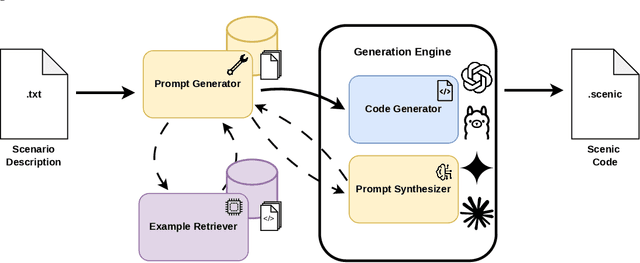
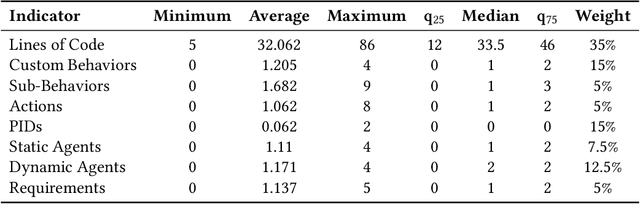
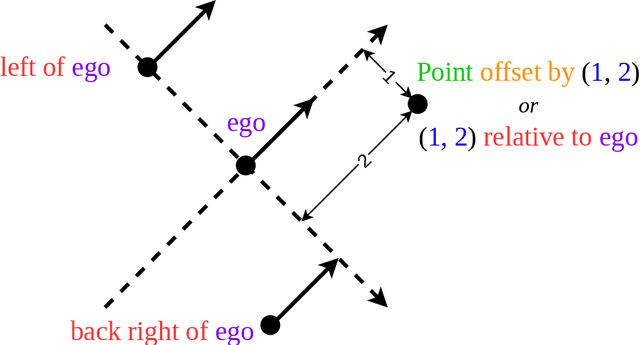
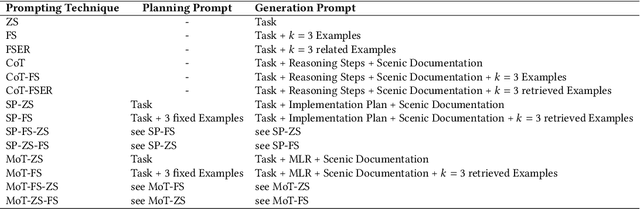
Scenario simulation is central to testing autonomous driving systems. Scenic, a domain-specific language (DSL) for CARLA, enables precise and reproducible scenarios, but NL-to-Scenic generation with large language models (LLMs) suffers from scarce data, limited reproducibility, and inconsistent metrics. We introduce NL2Scenic, an open dataset and framework with 146 NL/Scenic pairs, a difficulty-stratified 30-case test split, an Example Retriever, and 14 prompting variants (ZS, FS, CoT, SP, MoT). We evaluate 13 models: four proprietary (GPT-4o, GPT-5, Claude-Sonnet-4, Gemini-2.5-pro) and nine open-source code models (Qwen2.5Coder 0.5B-32B; CodeLlama 7B/13B/34B), using text metrics (BLEU, ChrF, EDIT-SIM, CrystalBLEU) and execution metrics (compilation and generation), and compare them with an expert study (n=11). EDIT-SIM correlates best with human judgments; we also propose EDIT-COMP (F1 of EDIT-SIM and compilation) as a robust dataset-level proxy that improves ranking fidelity. GPT-4o performs best overall, while Qwen2.5Coder-14B reaches about 88 percent of its expert score on local hardware. Retrieval-augmented prompting, Few-Shot with Example Retriever (FSER), consistently boosts smaller models, and scaling shows diminishing returns beyond mid-size, with Qwen2.5Coder outperforming CodeLlama at comparable scales. NL2Scenic and EDIT-COMP offer a standardized, reproducible basis for evaluating Scenic code generation and indicate that mid-size open-source models are practical, cost-effective options for autonomous-driving scenario programming.