 Add to Chrome
 Add to Firefox
 Add to Edge
Isaac Lab: A GPU-Accelerated Simulation Framework for Multi-Modal Robot Learning
Nov 06, 2025
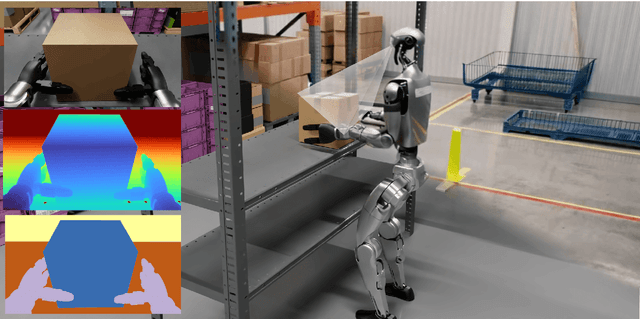
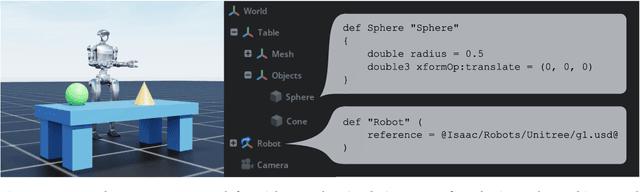
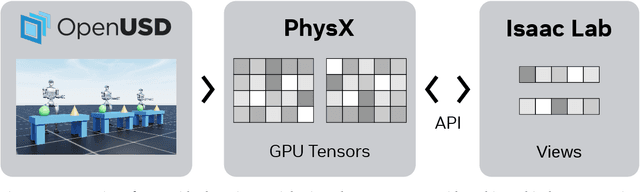

We present Isaac Lab, the natural successor to Isaac Gym, which extends the paradigm of GPU-native robotics simulation into the era of large-scale multi-modal learning. Isaac Lab combines high-fidelity GPU parallel physics, photorealistic rendering, and a modular, composable architecture for designing environments and training robot policies. Beyond physics and rendering, the framework integrates actuator models, multi-frequency sensor simulation, data collection pipelines, and domain randomization tools, unifying best practices for reinforcement and imitation learning at scale within a single extensible platform. We highlight its application to a diverse set of challenges, including whole-body control, cross-embodiment mobility, contact-rich and dexterous manipulation, and the integration of human demonstrations for skill acquisition. Finally, we discuss upcoming integration with the differentiable, GPU-accelerated Newton physics engine, which promises new opportunities for scalable, data-efficient, and gradient-based approaches to robot learning. We believe Isaac Lab's combination of advanced simulation capabilities, rich sensing, and data-center scale execution will help unlock the next generation of breakthroughs in robotics research.

Towards Safer Online Spaces: Simulating and Assessing Intervention Strategies for Eating Disorder Discussions
Sep 06, 2024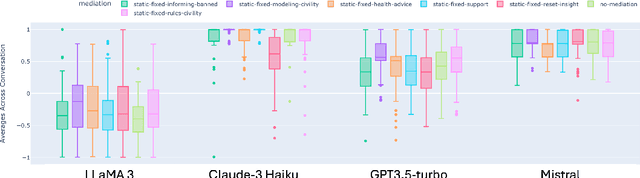

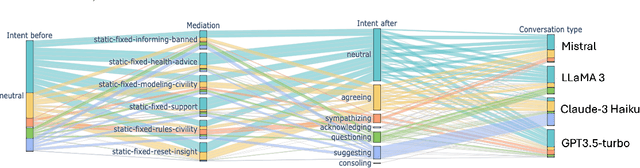

Eating disorders are complex mental health conditions that affect millions of people around the world. Effective interventions on social media platforms are crucial, yet testing strategies in situ can be risky. We present a novel LLM-driven experimental testbed for simulating and assessing intervention strategies in ED-related discussions. Our framework generates synthetic conversations across multiple platforms, models, and ED-related topics, allowing for controlled experimentation with diverse intervention approaches. We analyze the impact of various intervention strategies on conversation dynamics across four dimensions: intervention type, generative model, social media platform, and ED-related community/topic. We employ cognitive domain analysis metrics, including sentiment, emotions, etc., to evaluate the effectiveness of interventions. Our findings reveal that civility-focused interventions consistently improve positive sentiment and emotional tone across all dimensions, while insight-resetting approaches tend to increase negative emotions. We also uncover significant biases in LLM-generated conversations, with cognitive metrics varying notably between models (Claude-3 Haiku $>$ Mistral $>$ GPT-3.5-turbo $>$ LLaMA3) and even between versions of the same model. These variations highlight the importance of model selection in simulating realistic discussions related to ED. Our work provides valuable information on the complex dynamics of ED-related discussions and the effectiveness of various intervention strategies.