 Add to Chrome
 Add to Firefox
 Add to Edge
Country-wide, high-resolution monitoring of forest browning with Sentinel-2
Apr 02, 2026
Natural and anthropogenic disturbances are impacting the health of forests worldwide. Monitoring forest disturbances at scale is important to inform conservation efforts. Here, we present a scalable approach for country-wide mapping of forest greenness anomalies at the 10 m resolution of Sentinel-2. Using relevant ecological and topographical context and an established representation of the vegetation cycle, we learn a predictive quantile model of the normalised difference vegetation index (NDVI) derived from Sentinel-2 data. The resulting expected seasonal cycles are used to detect NDVI anomalies across Switzerland between April 2017 and August 2025. Goodness-of-fit evaluations show that the conditional model explains 65% of the observed variations in the median seasonal cycle. The model consistently benefits from the local context information, particularly during the green-up period. The approach produces coherent spatial anomaly patterns and enables country-wide quantification of forest browning. Case studies with independent reference data from known events illustrate that the model reliably detects different types of disturbances.

GEM: A Generalizable Ego-Vision Multimodal World Model for Fine-Grained Ego-Motion, Object Dynamics, and Scene Composition Control
Dec 15, 2024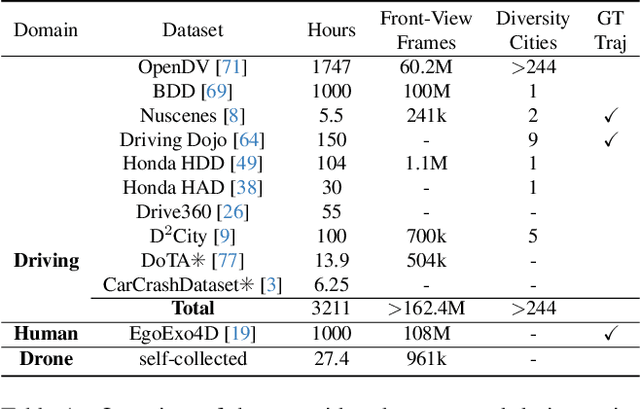
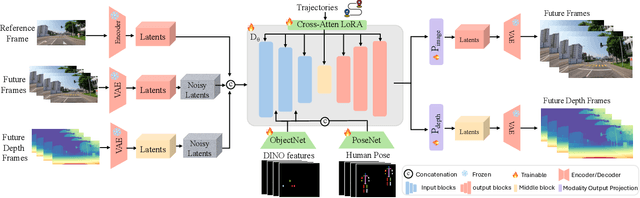
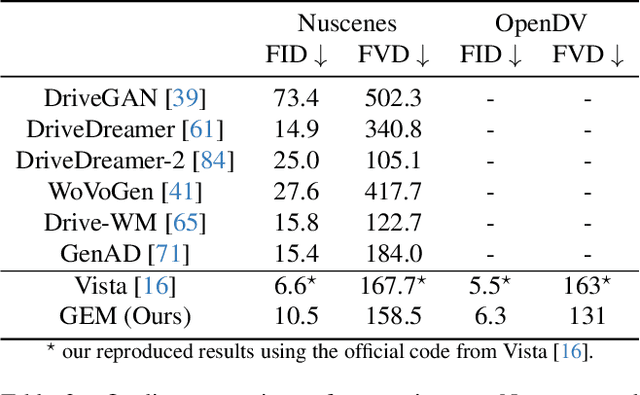
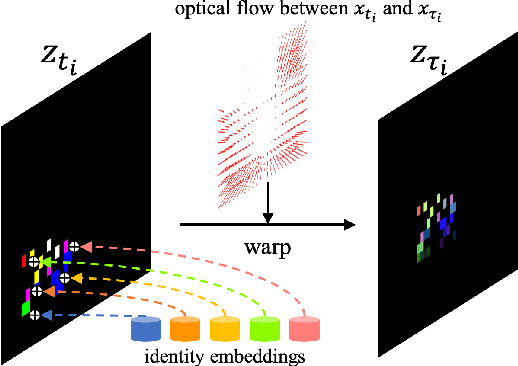
We present GEM, a Generalizable Ego-vision Multimodal world model that predicts future frames using a reference frame, sparse features, human poses, and ego-trajectories. Hence, our model has precise control over object dynamics, ego-agent motion and human poses. GEM generates paired RGB and depth outputs for richer spatial understanding. We introduce autoregressive noise schedules to enable stable long-horizon generations. Our dataset is comprised of 4000+ hours of multimodal data across domains like autonomous driving, egocentric human activities, and drone flights. Pseudo-labels are used to get depth maps, ego-trajectories, and human poses. We use a comprehensive evaluation framework, including a new Control of Object Manipulation (COM) metric, to assess controllability. Experiments show GEM excels at generating diverse, controllable scenarios and temporal consistency over long generations. Code, models, and datasets are fully open-sourced.