 Add to Chrome
 Add to Firefox
 Add to Edge
Reverse Distillation: Consistently Scaling Protein Language Model Representations
Mar 08, 2026
Unlike the predictable scaling laws in natural language processing and computer vision, protein language models (PLMs) scale poorly: for many tasks, models within the same family plateau or even decrease in performance, with mid-sized models often outperforming the largest in the family. We introduce Reverse Distillation, a principled framework that decomposes large PLM representations into orthogonal subspaces guided by smaller models of the same family. The resulting embeddings have a nested, Matryoshka-style structure: the first k dimensions of a larger model's embedding are exactly the representation from the smaller model. This ensures that larger reverse-distilled models consistently outperform smaller ones. A motivating intuition is that smaller models, constrained by capacity, preferentially encode broadly-shared protein features. Reverse distillation isolates these shared features and orthogonally extracts additional contributions from larger models, preventing interference between the two. On ProteinGym benchmarks, reverse-distilled ESM-2 variants outperform their respective baselines at the same embedding dimensionality, with the reverse-distilled 15 billion parameter model achieving the strongest performance. Our framework is generalizable to any model family where scaling challenges persist. Code and trained models are available at https://github.com/rohitsinghlab/plm_reverse_distillation.

Distilling the Knowledge of Romanian BERTs Using Multiple Teachers
Jan 11, 2022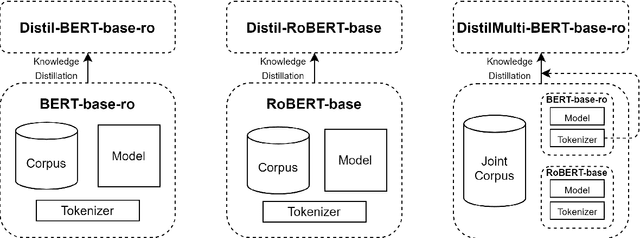
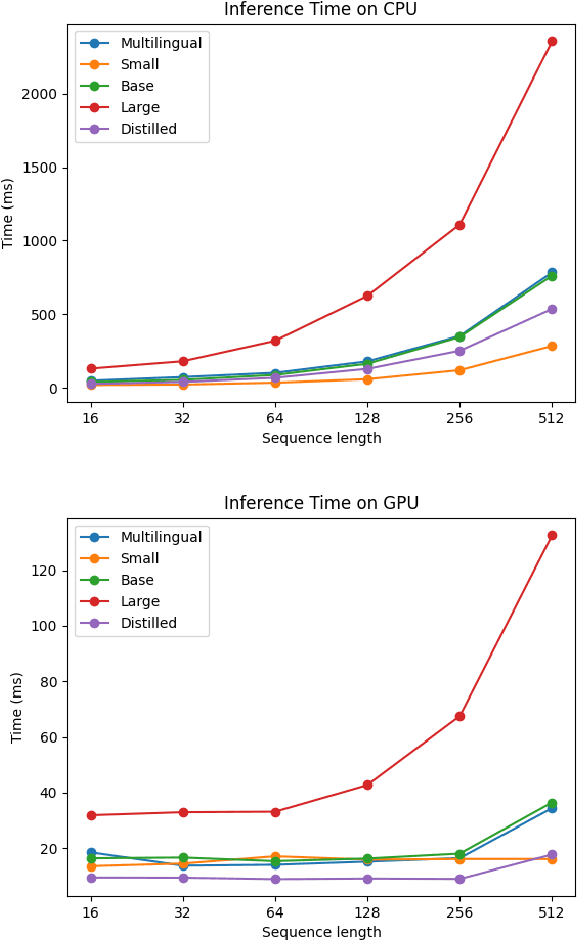
Running large-scale pre-trained language models in computationally constrained environments remains a challenging problem yet to be addressed, while transfer learning from these models has become prevalent in Natural Language Processing tasks. Several solutions, including knowledge distillation, network quantization, or network pruning have been previously proposed; however, these approaches focus mostly on the English language, thus widening the gap when considering low-resource languages. In this work, we introduce three light and fast versions of distilled BERT models for the Romanian language: Distil-BERT-base-ro, Distil-RoBERT-base, and DistilMulti-BERT-base-ro. The first two models resulted from the individual distillation of knowledge from two base versions of Romanian BERTs available in literature, while the last one was obtained by distilling their ensemble. To our knowledge, this is the first attempt to create publicly available Romanian distilled BERT models, which were thoroughly evaluated on five tasks: part-of-speech tagging, named entity recognition, sentiment analysis, semantic textual similarity, and dialect identification. Our experimental results argue that the three distilled models maintain most performance in terms of accuracy with their teachers, while being twice as fast on a GPU and ~35% smaller. In addition, we further test the similarity between the predictions of our students versus their teachers by measuring their label and probability loyalty, together with regression loyalty - a new metric introduced in this work.