 Add to Chrome
 Add to Firefox
 Add to Edge
Beyond Fluency: A Clinical Benchmark and Anomaly-Enhanced Baseline for Spine MRI Report Generation
Aug 07, 2026
Radiology reporting is time-consuming and subject to inter-rater variability, making automated report generation an attractive clinical application for Vision-Language Models (VLMs). We benchmark state-of-the-art VLMs on lumbar spine MRI with a focus on diagnostic accuracy and demonstrate that standard lexical and semantic metrics poorly reflect clinical correctness: fluent, well-structured reports can score highly while containing clinically meaningful diagnostic errors. To address this failure mode, we propose an architecture-agnostic framework that augments VLM inputs with spatially localized, disc-level anomaly heatmaps generated by a semi-supervised U-Net++ model. These heatmaps both improve anatomical sensitivity through explicit visual grounding and provide an independent interpretability output for clinical oversight, moving us closer to diagnostically reliable, visually grounded VLMs for lumbar spine MRI interpretation.
* Maria Monzon and Catherine R. Jutzeler contributed equally as shared last authors. Accepted at the CV4Clinic Workshop, CVPR 2026

Mechanistic Learning with Guided Diffusion Models to Predict Spatio-Temporal Brain Tumor Growth
Sep 11, 2025
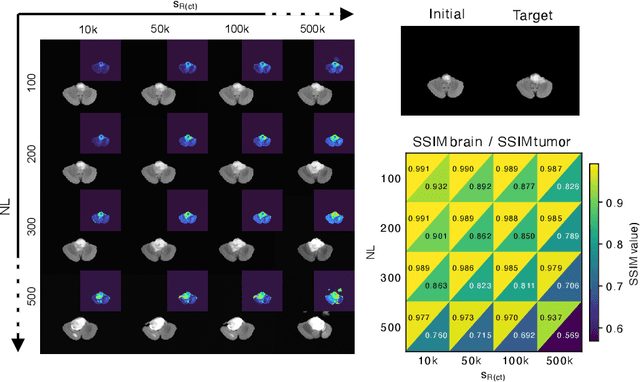
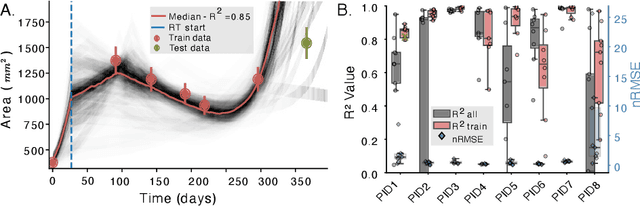

Predicting the spatio-temporal progression of brain tumors is essential for guiding clinical decisions in neuro-oncology. We propose a hybrid mechanistic learning framework that combines a mathematical tumor growth model with a guided denoising diffusion implicit model (DDIM) to synthesize anatomically feasible future MRIs from preceding scans. The mechanistic model, formulated as a system of ordinary differential equations, captures temporal tumor dynamics including radiotherapy effects and estimates future tumor burden. These estimates condition a gradient-guided DDIM, enabling image synthesis that aligns with both predicted growth and patient anatomy. We train our model on the BraTS adult and pediatric glioma datasets and evaluate on 60 axial slices of in-house longitudinal pediatric diffuse midline glioma (DMG) cases. Our framework generates realistic follow-up scans based on spatial similarity metrics. It also introduces tumor growth probability maps, which capture both clinically relevant extent and directionality of tumor growth as shown by 95th percentile Hausdorff Distance. The method enables biologically informed image generation in data-limited scenarios, offering generative-space-time predictions that account for mechanistic priors.