 Add to Chrome
 Add to Firefox
 Add to Edge
An Empirical Study of LLM-Generated Specifications for VeriFast
Jun 25, 2026
Static verification tools can assure industrial scale software, but require significant human labor to write specifications. This is particularly true of static verifiers based on separation logic (SL verifiers), which excel at verifying heapmanipulating programs, but require many complex auxiliary specifications to reason about heap structure. Recent work applies large language models (LLMs) to generate code, tests, and proofs, including specifications for verifiers, but mostly targeting non-SL verifiers. To address this gap, this paper thoroughly evaluates how well LLMs perform when prompted to generate specifications for verifying 303 C functions with the SL verifier VeriFast. We explored eight prompting approaches, ten LLMs, and three input types in two stages. Quantitative and qualitative analyses are used to assess the LLM-generated code and specifications for functional behavior, verifiability and errors. The results show that LLMs preserve functional behavior in source code and specifications (both over 91%), but achieve modest verification success (31.4%). Using Gemini 2.5 Pro and providing formal contracts lead to higher success rates in our setting. Moreover, most errors (94%) come from LLMs' mistakes in the domainspecific knowledge of SL verifiers such as VeriFast. These findings provide guidance for optimizing LLM-generated specifications for SL verifiers.

Validating Network Protocol Parsers with Traceable RFC Document Interpretation
Apr 25, 2025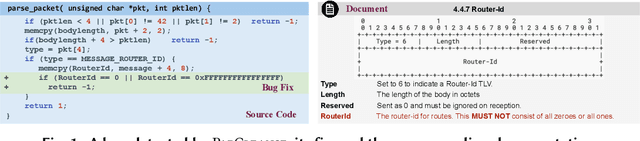
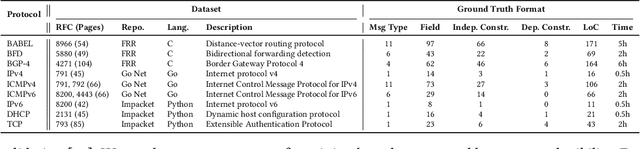
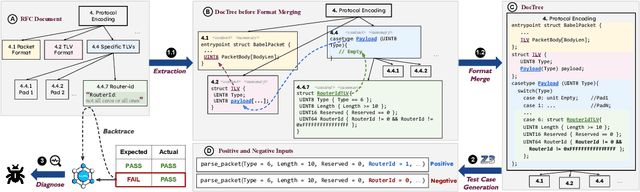
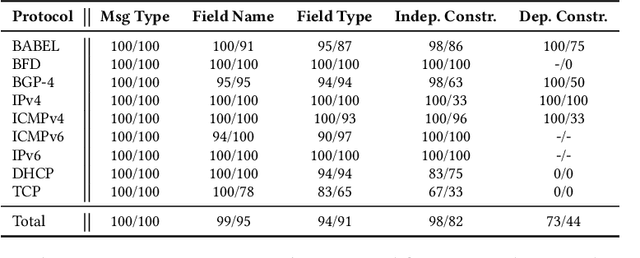
Validating the correctness of network protocol implementations is highly challenging due to the oracle and traceability problems. The former determines when a protocol implementation can be considered buggy, especially when the bugs do not cause any observable symptoms. The latter allows developers to understand how an implementation violates the protocol specification, thereby facilitating bug fixes. Unlike existing works that rarely take both problems into account, this work considers both and provides an effective solution using recent advances in large language models (LLMs). Our key observation is that network protocols are often released with structured specification documents, a.k.a. RFC documents, which can be systematically translated to formal protocol message specifications via LLMs. Such specifications, which may contain errors due to the hallucination of LLMs, are used as a quasi-oracle to validate protocol parsers, while the validation results in return gradually refine the oracle. Since the oracle is derived from the document, any bugs we find in a protocol implementation can be traced back to the document, thus addressing the traceability problem. We have extensively evaluated our approach using nine network protocols and their implementations written in C, Python, and Go. The results show that our approach outperforms the state-of-the-art and has detected 69 bugs, with 36 confirmed. The project also demonstrates the potential for fully automating software validation based on natural language specifications, a process previously considered predominantly manual due to the need to understand specification documents and derive expected outputs for test inputs.
Large Language Models for Validating Network Protocol Parsers
Apr 18, 2025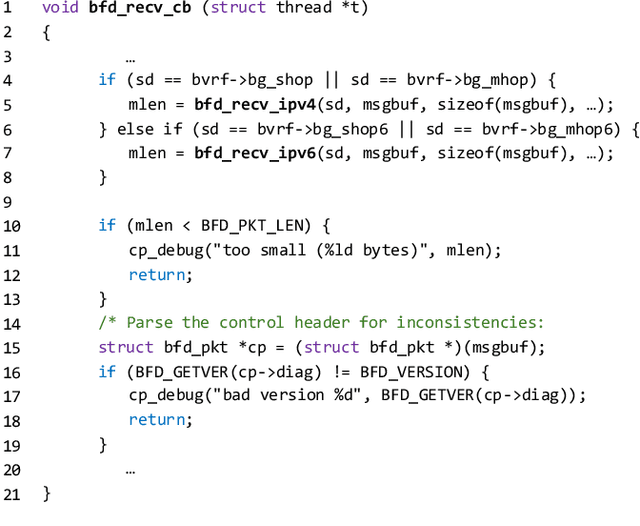
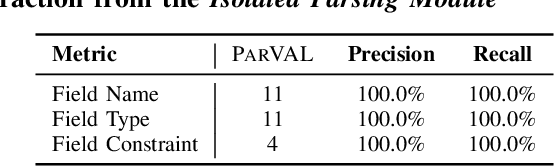
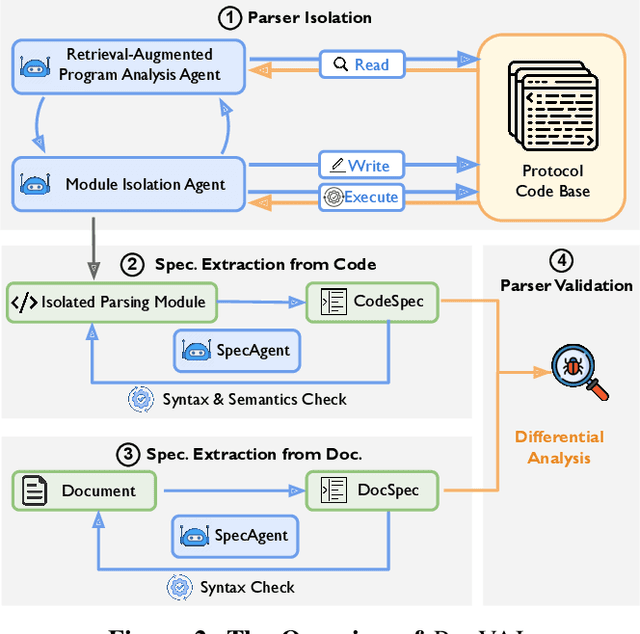
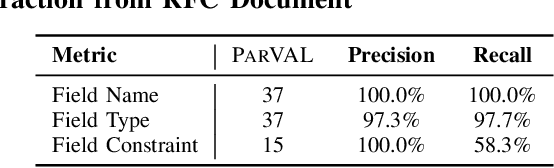
Network protocol parsers are essential for enabling correct and secure communication between devices. Bugs in these parsers can introduce critical vulnerabilities, including memory corruption, information leakage, and denial-of-service attacks. An intuitive way to assess parser correctness is to compare the implementation with its official protocol standard. However, this comparison is challenging because protocol standards are typically written in natural language, whereas implementations are in source code. Existing methods like model checking, fuzzing, and differential testing have been used to find parsing bugs, but they either require significant manual effort or ignore the protocol standards, limiting their ability to detect semantic violations. To enable more automated validation of parser implementations against protocol standards, we propose PARVAL, a multi-agent framework built on large language models (LLMs). PARVAL leverages the capabilities of LLMs to understand both natural language and code. It transforms both protocol standards and their implementations into a unified intermediate representation, referred to as format specifications, and performs a differential comparison to uncover inconsistencies. We evaluate PARVAL on the Bidirectional Forwarding Detection (BFD) protocol. Our experiments demonstrate that PARVAL successfully identifies inconsistencies between the implementation and its RFC standard, achieving a low false positive rate of 5.6%. PARVAL uncovers seven unique bugs, including five previously unknown issues.