 Add to Chrome
 Add to Firefox
 Add to Edge
Enhanced Water Leak Detection with Convolutional Neural Networks and One-Class Support Vector Machine
Nov 10, 2025
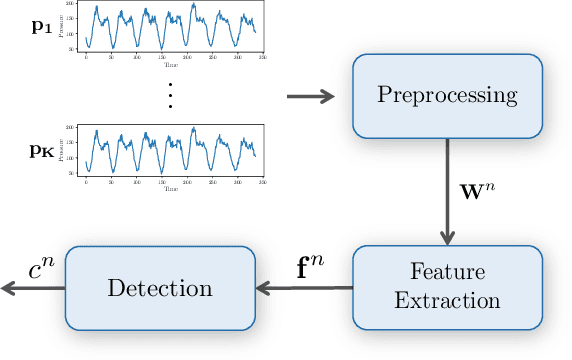
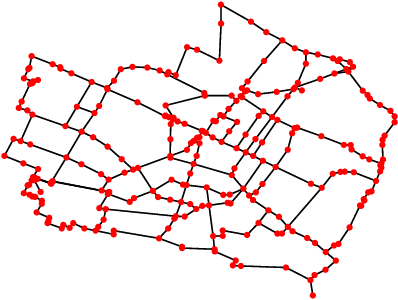
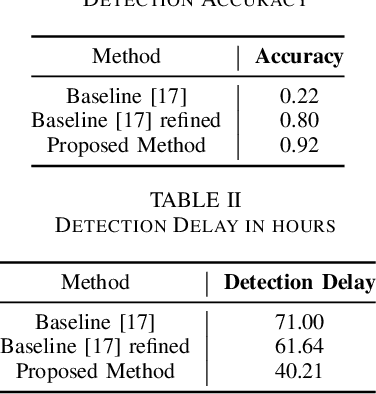
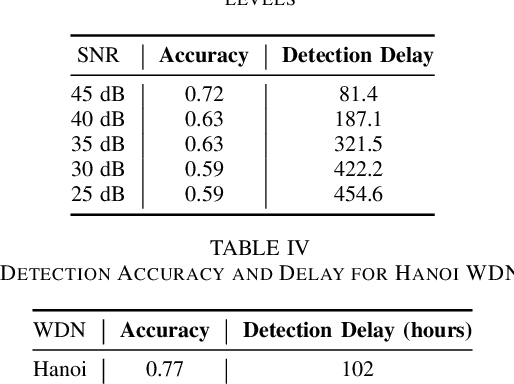
Water is a critical resource that must be managed efficiently. However, a substantial amount of water is lost each year due to leaks in Water Distribution Networks (WDNs). This underscores the need for reliable and effective leak detection and localization systems. In recent years, various solutions have been proposed, with data-driven approaches gaining increasing attention due to their superior performance. In this paper, we propose a new method for leak detection. The method is based on water pressure measurements acquired at a series of nodes of a WDN. Our technique is a fully data-driven solution that makes only use of the knowledge of the WDN topology, and a series of pressure data acquisitions obtained in absence of leaks. The proposed solution is based on an feature extractor and a one-class Support Vector Machines (SVM) trained on no-leak data, so that leaks are detected as anomalies. The results achieved on a simulate dataset using the Modena WDN demonstrate that the proposed solution outperforms recent methods for leak detection.

POLIPHONE: A Dataset for Smartphone Model Identification from Audio Recordings
Oct 08, 2024When dealing with multimedia data, source attribution is a key challenge from a forensic perspective. This task aims to determine how a given content was captured, providing valuable insights for various applications, including legal proceedings and integrity investigations. The source attribution problem has been addressed in different domains, from identifying the camera model used to capture specific photographs to detecting the synthetic speech generator or microphone model used to create or record given audio tracks. Recent advancements in this area rely heavily on machine learning and data-driven techniques, which often outperform traditional signal processing-based methods. However, a drawback of these systems is their need for large volumes of training data, which must reflect the latest technological trends to produce accurate and reliable predictions. This presents a significant challenge, as the rapid pace of technological progress makes it difficult to maintain datasets that are up-to-date with real-world conditions. For instance, in the task of smartphone model identification from audio recordings, the available datasets are often outdated or acquired inconsistently, making it difficult to develop solutions that are valid beyond a research environment. In this paper we present POLIPHONE, a dataset for smartphone model identification from audio recordings. It includes data from 20 recent smartphones recorded in a controlled environment to ensure reproducibility and scalability for future research. The released tracks contain audio data from various domains (i.e., speech, music, environmental sounds), making the corpus versatile and applicable to a wide range of use cases. We also present numerous experiments to benchmark the proposed dataset using a state-of-the-art classifier for smartphone model identification from audio recordings.