 Add to Chrome
 Add to Firefox
 Add to Edge
Posterior Inference of Hamiltonian Parameters from RIXS Spectroscopy
Aug 14, 2026
We present the first application of simulation-based inference to resonant inelastic X-ray scattering spectroscopy. Using truncated marginal neural ratio estimation to efficiently restrict the prior and conditional flow matching as the joint density estimator, we infer full posteriors with a modest simulation budget for two Ni$^{2+}$ compounds---NiPS$_3$ as a representative covalent case and K$_2$NiF$_4$ as a more atomic one. We demonstrate that a vision transformer encoder whose tokenization matches the physical layout of the RIXS map yields better-covered and sharper posteriors than generic image encoders. Applying the validated method to experimental NiPS$_3$ and K$_2$NiF$_4$ data, we recover a joint posterior that reveals parameter correlations invisible to point estimators, and a posterior predictive distribution that closely matches the observed spectrum. The amortized posterior unlocks a class of analyses not previously available to the field such as nuisance-marginalized uncertainty quantification, multi-measurement posterior fusion and active experimental design.

Domain Knowledge Guided Bayesian Optimization For Autonomous Alignment Of Complex Scientific Instruments
Feb 11, 2026Bayesian Optimization (BO) is a powerful tool for optimizing complex non-linear systems. However, its performance degrades in high-dimensional problems with tightly coupled parameters and highly asymmetric objective landscapes, where rewards are sparse. In such needle-in-a-haystack scenarios, even advanced methods like trust-region BO (TurBO) often lead to unsatisfactory results. We propose a domain knowledge guided Bayesian Optimization approach, which leverages physical insight to fundamentally simplify the search problem by transforming coordinates to decouple input features and align the active subspaces with the primary search axes. We demonstrate this approach's efficacy on a challenging 12-dimensional, 6-crystal Split-and-Delay optical system, where conventional approaches, including standard BO, TuRBO and multi-objective BO, consistently led to unsatisfactory results. When combined with an reverse annealing exploration strategy, this approach reliably converges to the global optimum. The coordinate transformation itself is the key to this success, significantly accelerating the search by aligning input co-ordinate axes with the problem's active subspaces. As increasingly complex scientific instruments, from large telescopes to new spectrometers at X-ray Free Electron Lasers are deployed, the demand for robust high-dimensional optimization grows. Our results demonstrate a generalizable paradigm: leveraging physical insight to transform high-dimensional, coupled optimization problems into simpler representations can enable rapid and robust automated tuning for consistent high performance while still retaining current optimization algorithms.
Supercharging Simulation-Based Inference for Bayesian Optimal Experimental Design
Feb 06, 2026Bayesian optimal experimental design (BOED) seeks to maximize the expected information gain (EIG) of experiments. This requires a likelihood estimate, which in many settings is intractable. Simulation-based inference (SBI) provides powerful tools for this regime. However, existing work explicitly connecting SBI and BOED is restricted to a single contrastive EIG bound. We show that the EIG admits multiple formulations which can directly leverage modern SBI density estimators, encompassing neural posterior, likelihood, and ratio estimation. Building on this perspective, we define a novel EIG estimator using neural likelihood estimation. Further, we identify optimization as a key bottleneck of gradient based EIG maximization and show that a simple multi-start parallel gradient ascent procedure can substantially improve reliability and performance. With these innovations, our SBI-based BOED methods are able to match or outperform by up to $22\%$ existing state-of-the-art approaches across standard BOED benchmarks.
Efficient Nudged Elastic Band Method using Neural Network Bayesian Algorithm Execution
Dec 17, 2025The discovery of a minimum energy pathway (MEP) between metastable states is crucial for scientific tasks including catalyst and biomolecular design. However, the standard nudged elastic band (NEB) algorithm requires hundreds to tens of thousands of compute-intensive simulations, making applications to complex systems prohibitively expensive. We introduce Neural Network Bayesian Algorithm Execution (NN-BAX), a framework that jointly learns the energy landscape and the MEP. NN-BAX sequentially fine-tunes a foundation model by actively selecting samples targeted at improving the MEP. Tested on Lennard-Jones and Embedded Atom Method systems, our approach achieves a one to two order of magnitude reduction in energy and force evaluations with negligible loss in MEP accuracy and demonstrates scalability to >100-dimensional systems. This work is therefore a promising step towards removing the computational barrier for MEP discovery in scientifically relevant systems, suggesting that weeks-long calculations may be achieved in hours or days with minimal loss in accuracy.
eLog analysis for accelerators: status and future outlook
Jun 15, 2025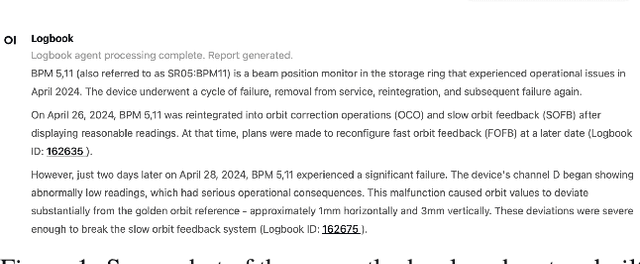
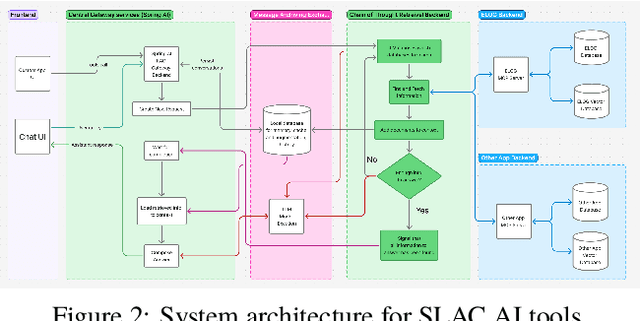
This work demonstrates electronic logbook (eLog) systems leveraging modern AI-driven information retrieval capabilities at the accelerator facilities of Fermilab, Jefferson Lab, Lawrence Berkeley National Laboratory (LBNL), SLAC National Accelerator Laboratory. We evaluate contemporary tools and methodologies for information retrieval with Retrieval Augmented Generation (RAGs), focusing on operational insights and integration with existing accelerator control systems. The study addresses challenges and proposes solutions for state-of-the-art eLog analysis through practical implementations, demonstrating applications and limitations. We present a framework for enhancing accelerator facility operations through improved information accessibility and knowledge management, which could potentially lead to more efficient operations.
A Start To End Machine Learning Approach To Maximize Scientific Throughput From The LCLS-II-HE
May 29, 2025With the increasing brightness of Light sources, including the Diffraction-Limited brightness upgrade of APS and the high-repetition-rate upgrade of LCLS, the proposed experiments therein are becoming increasingly complex. For instance, experiments at LCLS-II-HE will require the X-ray beam to be within a fraction of a micron in diameter, with pointing stability of a few nanoradians, at the end of a kilometer-long electron accelerator, a hundred-meter-long undulator section, and tens of meters long X-ray optics. This enhancement of brightness will increase the data production rate to rival the largest data generators in the world. Without real-time active feedback control and an optimized pipeline to transform measurements to scientific information and insights, researchers will drown in a deluge of mostly useless data, and fail to extract the highly sophisticated insights that the recent brightness upgrades promise. In this article, we outline the strategy we are developing at SLAC to implement Machine Learning driven optimization, automation and real-time knowledge extraction from the electron-injector at the start of the electron accelerator, to the multidimensional X-ray optical systems, and till the experimental endstations and the high readout rate, multi-megapixel detectors at LCLS to deliver the design performance to the users. This is illustrated via examples from Accelerator, Optics and End User applications.
Resilient VAE: Unsupervised Anomaly Detection at the SLAC Linac Coherent Light Source
Sep 05, 2023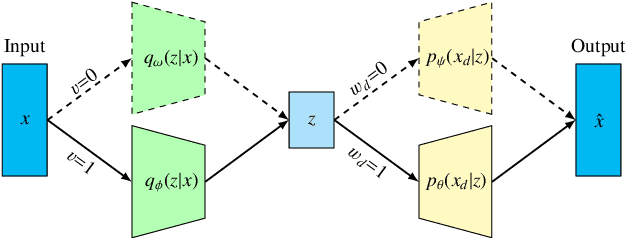
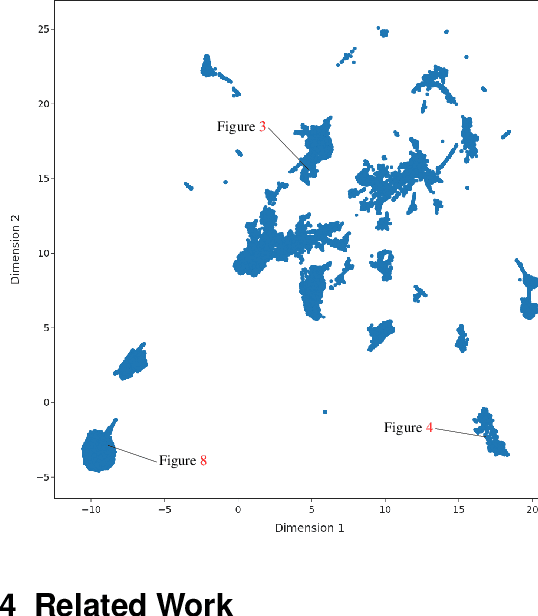
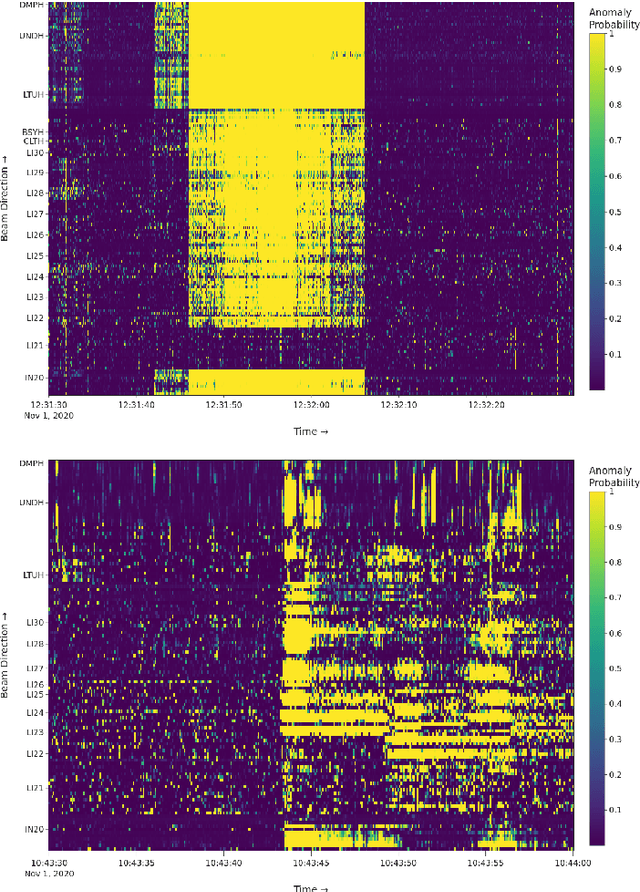
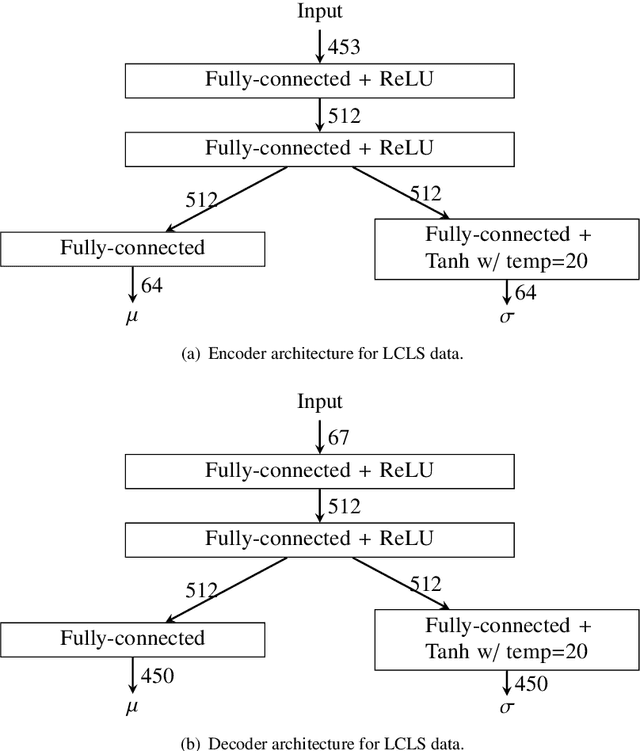
Significant advances in utilizing deep learning for anomaly detection have been made in recent years. However, these methods largely assume the existence of a normal training set (i.e., uncontaminated by anomalies) or even a completely labeled training set. In many complex engineering systems, such as particle accelerators, labels are sparse and expensive; in order to perform anomaly detection in these cases, we must drop these assumptions and utilize a completely unsupervised method. This paper introduces the Resilient Variational Autoencoder (ResVAE), a deep generative model specifically designed for anomaly detection. ResVAE exhibits resilience to anomalies present in the training data and provides feature-level anomaly attribution. During the training process, ResVAE learns the anomaly probability for each sample as well as each individual feature, utilizing these probabilities to effectively disregard anomalous examples in the training data. We apply our proposed method to detect anomalies in the accelerator status at the SLAC Linac Coherent Light Source (LCLS). By utilizing shot-to-shot data from the beam position monitoring system, we demonstrate the exceptional capability of ResVAE in identifying various types of anomalies that are visible in the accelerator.
Capturing dynamical correlations using implicit neural representations
Apr 08, 2023The observation and description of collective excitations in solids is a fundamental issue when seeking to understand the physics of a many-body system. Analysis of these excitations is usually carried out by measuring the dynamical structure factor, S(Q, $\omega$), with inelastic neutron or x-ray scattering techniques and comparing this against a calculated dynamical model. Here, we develop an artificial intelligence framework which combines a neural network trained to mimic simulated data from a model Hamiltonian with automatic differentiation to recover unknown parameters from experimental data. We benchmark this approach on a Linear Spin Wave Theory (LSWT) simulator and advanced inelastic neutron scattering data from the square-lattice spin-1 antiferromagnet La$_2$NiO$_4$. We find that the model predicts the unknown parameters with excellent agreement relative to analytical fitting. In doing so, we illustrate the ability to build and train a differentiable model only once, which then can be applied in real-time to multi-dimensional scattering data, without the need for human-guided peak finding and fitting algorithms. This prototypical approach promises a new technology for this field to automatically detect and refine more advanced models for ordered quantum systems.
Coincident Learning for Unsupervised Anomaly Detection
Jan 26, 2023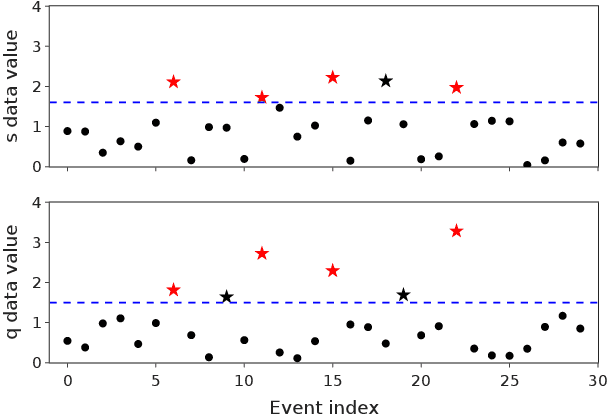
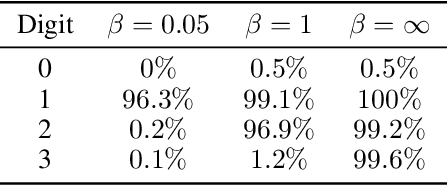
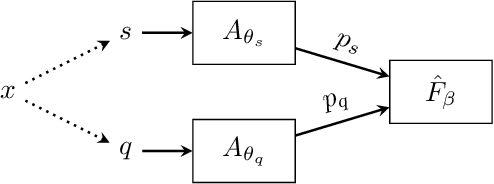

Anomaly detection is an important task for complex systems (e.g., industrial facilities, manufacturing, large-scale science experiments), where failures in a sub-system can lead to low yield, faulty products, or even damage to components. While complex systems often have a wealth of data, labeled anomalies are typically rare (or even nonexistent) and expensive to acquire. In this paper, we introduce a new method, called CoAD, for training anomaly detection models on unlabeled data, based on the expectation that anomalous behavior in one sub-system will produce coincident anomalies in downstream sub-systems and products. Given data split into two streams $s$ and $q$ (i.e., subsystem diagnostics and final product quality), we define an unsupervised metric, $\hat{F}_\beta$, out of analogy to the supervised classification $F_\beta$ statistic, which quantifies the performance of the independent anomaly detection algorithms on s and q based on their coincidence rate. We demonstrate our method in four cases: a synthetic time-series data set, a synthetic imaging data set generated from MNIST, a metal milling data set, and a data set taken from a particle accelerator.
Implicit Neural Representation as a Differentiable Surrogate for Photon Propagation in a Monolithic Neutrino Detector
Nov 02, 2022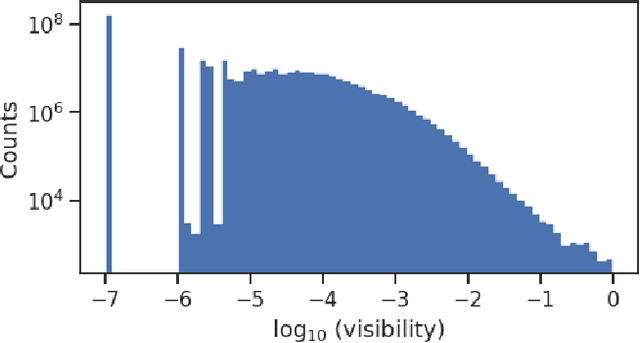
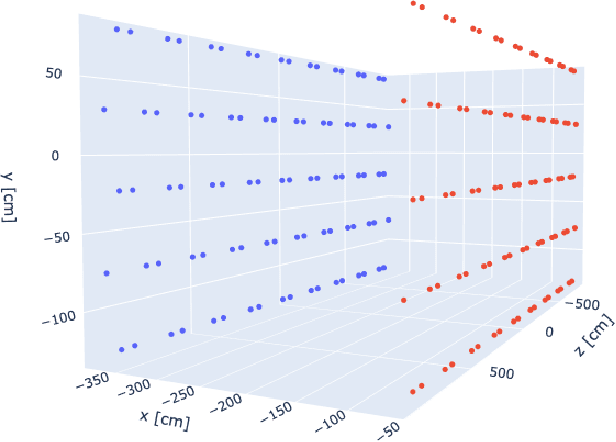
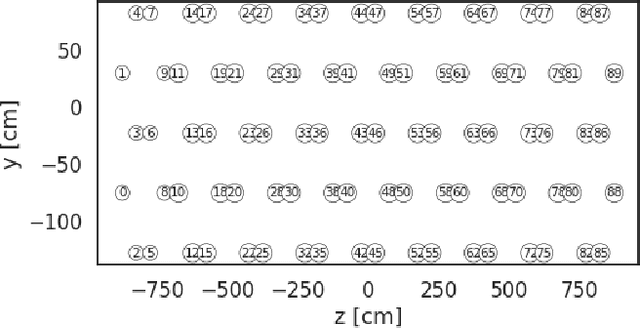
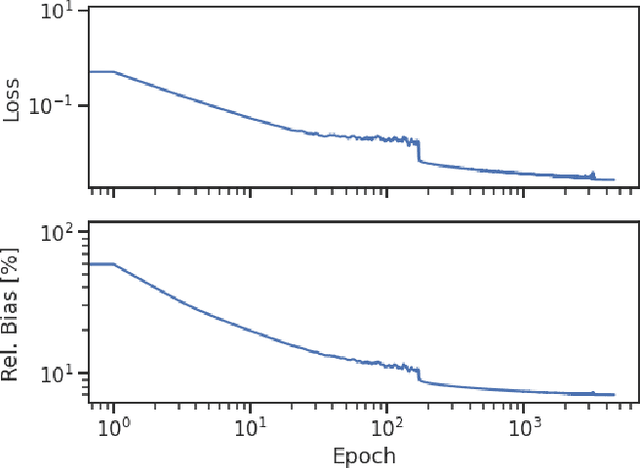
Optical photons are used as signal in a wide variety of particle detectors. Modern neutrino experiments employ hundreds to tens of thousands of photon detectors to observe signal from millions to billions of scintillation photons produced from energy deposition of charged particles. These neutrino detectors are typically large, containing kilotons of target volume, with different optical properties. Modeling individual photon propagation in form of look-up table requires huge computational resources. As the size of a table increases with detector volume for a fixed resolution, this method scales poorly for future larger detectors. Alternative approaches such as fitting a polynomial to the model could address the memory issue, but results in poorer performance. Both look-up table and fitting approaches are prone to discrepancies between the detector simulation and the data collected. We propose a new approach using SIREN, an implicit neural representation with periodic activation functions, to model the look-up table as a 3D scene and reproduces the acceptance map with high accuracy. The number of parameters in our SIREN model is orders of magnitude smaller than the number of voxels in the look-up table. As it models an underlying functional shape, SIREN is scalable to a larger detector. Furthermore, SIREN can successfully learn the spatial gradients of the photon library, providing additional information for downstream applications. Finally, as SIREN is a neural network representation, it is differentiable with respect to its parameters, and therefore tunable via gradient descent. We demonstrate the potential of optimizing SIREN directly on real data, which mitigates the concern of data vs. simulation discrepancies. We further present an application for data reconstruction where SIREN is used to form a likelihood function for photon statistics.