 Add to Chrome
 Add to Firefox
 Add to Edge
Event Embedding of Protein Networks : Compositional Learning of Biological Function
Apr 01, 2026
In this work, we study whether enforcing strict compositional structure in sequence embeddings yields meaningful geometric organization when applied to protein-protein interaction networks. Using Event2Vec, an additive sequence embedding model, we train 64-dimensional representations on random walks from the human STRING interactome, and compare against a DeepWalk baseline based on Word2Vec, trained on the same walks. We find that compositional structure substantially improves pathway coherence (30.2$\times$ vs 2.9$\times$ above random), functional analogy accuracy (mean similarity 0.966 vs 0.650), and hierarchical pathway organization, while geometric properties such as norm--degree anticorrelation are shared with or exceeded by the non-compositional baseline. These results indicate that enforced compositionality specifically benefits relational and compositional reasoning tasks in biological networks.

Modal Logical Neural Networks for Financial AI
Mar 12, 2026The financial industry faces a critical dichotomy in AI adoption: deep learning often delivers strong empirical performance, while symbolic logic offers interpretability and rule adherence expected in regulated settings. We use Modal Logical Neural Networks (MLNNs) as a bridge between these worlds, integrating Kripke semantics into neural architectures to enable differentiable reasoning about necessity, possibility, time, and knowledge. We illustrate MLNNs as a differentiable ``Logic Layer'' for finance by mapping core components, Necessity Neurons ($\Box$) and Learnable Accessibility ($A_θ$), to regulatory guardrails, market stress testing, and collusion detection. Four case studies show how MLNN-style constraints can promote compliance in trading agents, help recover latent trust networks for market surveillance, encourage robustness under stress scenarios, and distinguish statistical belief from verified knowledge to help mitigate robo-advisory hallucinations.
Continuous Modal Logical Neural Networks: Modal Reasoning via Stochastic Accessibility
Mar 04, 2026We propose Fluid Logic, a paradigm in which modal logical reasoning, temporal, epistemic, doxastic, deontic, is lifted from discrete Kripke structures to continuous manifolds via Neural Stochastic Differential Equations (Neural SDEs). Each type of modal operator is backed by a dedicated Neural SDE, and nested formulas compose these SDEs in a single differentiable graph. A key instantiation is Logic-Informed Neural Networks (LINNs): analogous to Physics-Informed Neural Networks (PINNs), LINNs embed modal logical formulas such as ($\Box$ bounded) and ($\Diamond$ visits\_lobe) directly into the training loss, guiding neural networks to produce solutions that are structurally consistent with prescribed logical properties, without requiring knowledge of the governing equations. The resulting framework, Continuous Modal Logical Neural Networks (CMLNNs), yields several key properties: (i) stochastic diffusion prevents quantifier collapse ($\Box$ and $\Diamond$ differ), unlike deterministic ODEs; (ii) modal operators are entropic risk measures, sound with respect to risk-based semantics with explicit Monte Carlo concentration guarantees; (iii)SDE-induced accessibility provides structural correspondence with classical modal axioms; (iv) parameterizing accessibility through dynamics reduces memory from quadratic in world count to linear in parameters. Three case studies demonstrate that Fluid Logic and LINNs can guide neural networks to produce consistent solutions across diverse domains: epistemic/doxastic logic (multi-robot hallucination detection), temporal logic (recovering the Lorenz attractor geometry from logical constraints alone), and deontic logic (learning safe confinement dynamics from a logical specification).
Differentiable Modal Logic for Multi-Agent Diagnosis, Orchestration and Communication
Feb 12, 2026As multi-agent AI systems evolve from simple chatbots to autonomous swarms, debugging semantic failures requires reasoning about knowledge, belief, causality, and obligation, precisely what modal logic was designed to formalize. However, traditional modal logic requires manual specification of relationship structures that are unknown or dynamic in real systems. This tutorial demonstrates differentiable modal logic (DML), implemented via Modal Logical Neural Networks (MLNNs), enabling systems to learn trust networks, causal chains, and regulatory boundaries from behavioral data alone. We present a unified neurosymbolic debugging framework through four modalities: epistemic (who to trust), temporal (when events cause failures), deontic (what actions are permitted), and doxastic (how to interpret agent confidence). Each modality is demonstrated on concrete multi-agent scenarios, from discovering deceptive alliances in diplomacy games to detecting LLM hallucinations, with complete implementations showing how logical contradictions become learnable optimization objectives. Key contributions for the neurosymbolic community: (1) interpretable learned structures where trust and causality are explicit parameters, not opaque embeddings; (2) knowledge injection via differentiable axioms that guide learning with sparse data (3) compositional multi-modal reasoning that combines epistemic, temporal, and deontic constraints; and (4) practical deployment patterns for monitoring, active control and communication of multi-agent systems. All code provided as executable Jupyter notebooks.
Solving PDEs in One Shot via Fourier Features with Exact Analytical Derivatives
Feb 11, 2026Recent random feature methods for solving partial differential equations (PDEs) reduce computational cost compared to physics-informed neural networks (PINNs) but still rely on iterative optimization or expensive derivative computation. We observe that sinusoidal random Fourier features possess a cyclic derivative structure: the derivative of any order of $\sin(\mathbf{W}\cdot\mathbf{x}+b)$ is a single sinusoid with a monomial prefactor, computable in $O(1)$ operations. Alternative activations such as $\tanh$, used in prior one-shot methods like PIELM, lack this property: their higher-order derivatives grow as $O(2^n)$ terms, requiring automatic differentiation for operator assembly. We propose FastLSQ, which combines frozen random Fourier features with analytical operator assembly to solve linear PDEs via a single least-squares call, and extend it to nonlinear PDEs via Newton--Raphson iteration where each linearized step is a FastLSQ solve. On a benchmark of 17 PDEs spanning 1 to 6 dimensions, FastLSQ achieves relative $L^2$ errors of $10^{-7}$ in 0.07\,s on linear problems, three orders of magnitude more accurate and significantly faster than state-of-the-art iterative PINN solvers, and $10^{-8}$ to $10^{-9}$ on nonlinear problems via Newton iteration in under 9s.
Differentiable Logical Programming for Quantum Circuit Discovery and Optimization
Feb 09, 2026Designing high-fidelity quantum circuits remains challenging, and current paradigms often depend on heuristic, fixed-ansatz structures or rule-based compilers that can be suboptimal or lack generality. We introduce a neuro-symbolic framework that reframes quantum circuit design as a differentiable logic programming problem. Our model represents a scaffold of potential quantum gates and parameterized operations as a set of learnable, continuous ``truth values'' or ``switches,'' $s \in [0, 1]^N$. These switches are optimized via standard gradient descent to satisfy a user-defined set of differentiable, logical axioms (e.g., correctness, simplicity, robustness). We provide a theoretical formulation bridging continuous logic (via T-norms) and unitary evolution (via geodesic interpolation), while addressing the barren plateau problem through biased initialization. We illustrate the approach on tasks including discovery of a 4-qubit Quantum Fourier Transform (QFT) from a scaffold of 21 candidate gates. We also report a hardware-aware adaptation experiment on the 133-qubit IBM Torino processor, where the method improved fidelity by 59.3 percentage points in a localized routing task while adapting to hardware failures.
From Natural Language to Control Signals: A Conceptual Framework for Semantic Channel Finding in Complex Experimental Infrastructure
Dec 21, 2025Modern experimental platforms such as particle accelerators, fusion devices, telescopes, and industrial process control systems expose tens to hundreds of thousands of control and diagnostic channels accumulated over decades of evolution. Operators and AI systems rely on informal expert knowledge, inconsistent naming conventions, and fragmented documentation to locate signals for monitoring, troubleshooting, and automated control, creating a persistent bottleneck for reliability, scalability, and language-model-driven interfaces. We formalize semantic channel finding-mapping natural-language intent to concrete control-system signals-as a general problem in complex experimental infrastructure, and introduce a four-paradigm framework to guide architecture selection across facility-specific data regimes. The paradigms span (i) direct in-context lookup over curated channel dictionaries, (ii) constrained hierarchical navigation through structured trees, (iii) interactive agent exploration using iterative reasoning and tool-based database queries, and (iv) ontology-grounded semantic search that decouples channel meaning from facility-specific naming conventions. We demonstrate each paradigm through proof-of-concept implementations at four operational facilities spanning two orders of magnitude in scale-from compact free-electron lasers to large synchrotron light sources-and diverse control-system architectures, from clean hierarchies to legacy environments. These implementations achieve 90-97% accuracy on expert-curated operational queries.
A Straightforward Pipeline for Targeted Entailment and Contradiction Detection
Aug 23, 2025Finding the relationships between sentences in a document is crucial for tasks like fact-checking, argument mining, and text summarization. A key challenge is to identify which sentences act as premises or contradictions for a specific claim. Existing methods often face a trade-off: transformer attention mechanisms can identify salient textual connections but lack explicit semantic labels, while Natural Language Inference (NLI) models can classify relationships between sentence pairs but operate independently of contextual saliency. In this work, we introduce a method that combines the strengths of both approaches for a targeted analysis. Our pipeline first identifies candidate sentences that are contextually relevant to a user-selected target sentence by aggregating token-level attention scores. It then uses a pretrained NLI model to classify each candidate as a premise (entailment) or contradiction. By filtering NLI-identified relationships with attention-based saliency scores, our method efficiently isolates the most significant semantic relationships for any given claim in a text.
Alpha Berkeley: A Scalable Framework for the Orchestration of Agentic Systems
Aug 20, 2025Coordinating workflows across heterogeneous control systems remains a central challenge in safety-critical environments such as scientific facilities, industrial plants, and energy infrastructures. Language-model-driven agents offer a natural interface for these tasks, but existing approaches often lack scalability, reliability, and human oversight. We introduce the Alpha Berkeley Framework, a production-ready architecture for scalable agentic systems that integrate conversational context with robust tool orchestration. The framework features dynamic capability classification to select only relevant tools per task, a plan-first orchestration model that generates execution plans with explicit dependencies and optional human approval, context-aware task extraction that combines dialogue history with external memory and domain resources, and production-ready execution environments with checkpointing, artifact management, and modular deployment. We demonstrate its versatility through two case studies: a tutorial-style wind farm monitoring example and a deployment at the Advanced Light Source particle accelerator. These results establish Alpha Berkeley as a reliable and transparent framework for agentic systems in high-stakes domains.
eLog analysis for accelerators: status and future outlook
Jun 15, 2025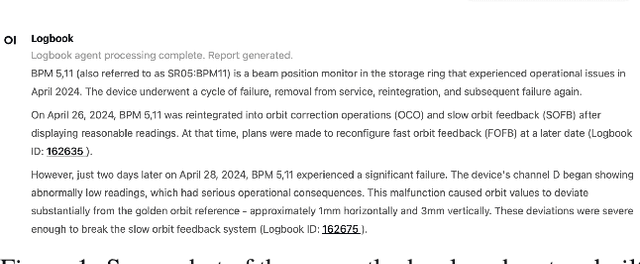
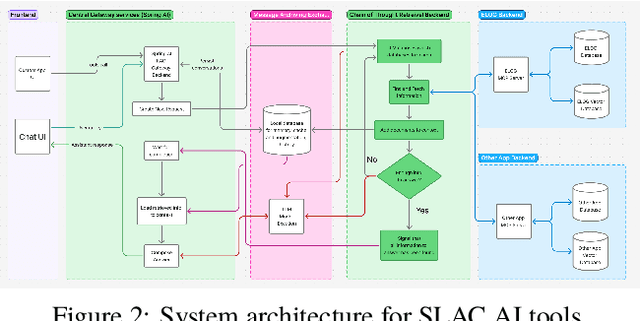
This work demonstrates electronic logbook (eLog) systems leveraging modern AI-driven information retrieval capabilities at the accelerator facilities of Fermilab, Jefferson Lab, Lawrence Berkeley National Laboratory (LBNL), SLAC National Accelerator Laboratory. We evaluate contemporary tools and methodologies for information retrieval with Retrieval Augmented Generation (RAGs), focusing on operational insights and integration with existing accelerator control systems. The study addresses challenges and proposes solutions for state-of-the-art eLog analysis through practical implementations, demonstrating applications and limitations. We present a framework for enhancing accelerator facility operations through improved information accessibility and knowledge management, which could potentially lead to more efficient operations.