 Add to Chrome
 Add to Firefox
 Add to Edge
OopsieVerse: A Safety Benchmark with Damage-Aware Simulation for Robot Manipulation
Jun 30, 2026
While robotic manipulation capabilities have advanced rapidly, physical safety remains a major barrier to deploying household robots: task success is insufficient if the robot damages itself or its surroundings. Simulation offers a harm-free alternative to costly and dangerous real-world training and evaluation, yet existing simulators lack general mechanisms to detect, quantify, and represent damage. To address this gap, we introduce OOPSIEVERSE, a unified simulation framework and benchmark for damage-aware household manipulation. OOPSIEVERSE provides damage as an explicit, physically-grounded, and taskagnostic signal by converting sources such as contact forces, temperature changes, and liquid interactions into corresponding mechanical, thermal or fluid damage. OOPSIEVERSE comprises two core elements: (1) DAMAGESIM, a simulator-agnostic framework for detecting and quantifying damage during navigation and manipulation, and (2) a suite of household tasks designed to evaluate common damage modes and distinguish between task completion and safe execution. We demonstrate the generality of our framework by instantiating DAMAGESIM in two simulators with different physics backends, OmniGibson (Nvidia Omniverse) and RoboCasa (MuJoCo). We further showcase the utility of OOPSIEVERSE across multiple use cases, including (1) guiding safer demonstration collection via real-time damage feedback, (2) learning safer manipulation policies through damage-conditioned imitation learning and reinforcement learning, (3) benchmarking the safety of state-of-the-art Vision Language Action policies, and (4) improving real-world safety of sim-to-real transferred policies. Together, our results highlight the potential of OOPSIEVERSE as an open-source foundation for systematic, scalable research on safe robot manipulation. For code and more information, please refer to https://robin-lab.cs.utexas.edu/oopsieverse/

VADER: Visual Affordance Detection and Error Recovery for Multi Robot Human Collaboration
May 25, 2024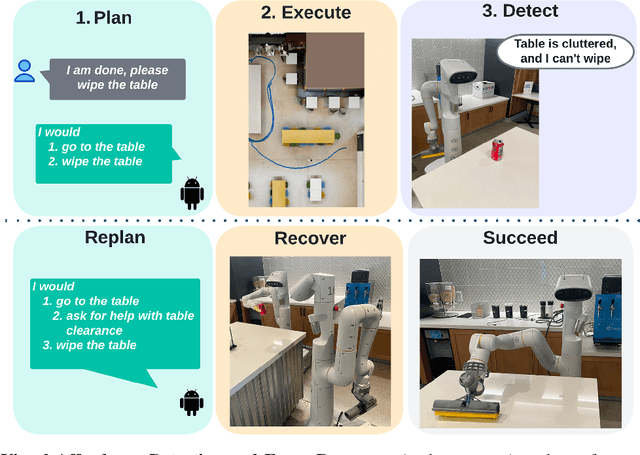
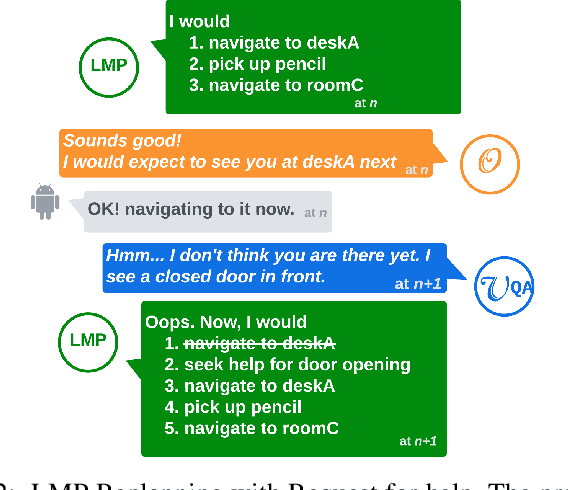
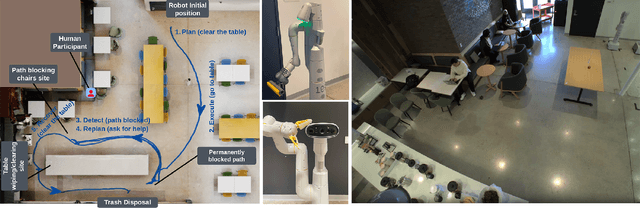
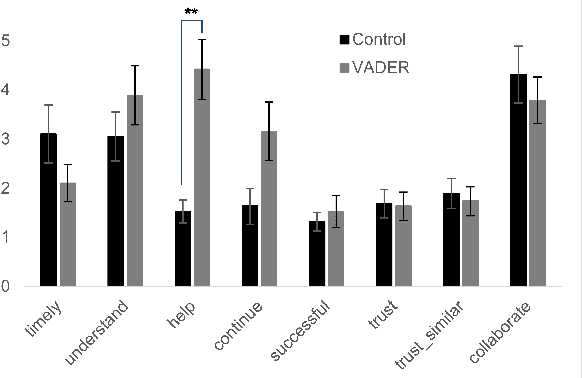
Robots today can exploit the rich world knowledge of large language models to chain simple behavioral skills into long-horizon tasks. However, robots often get interrupted during long-horizon tasks due to primitive skill failures and dynamic environments. We propose VADER, a plan, execute, detect framework with seeking help as a new skill that enables robots to recover and complete long-horizon tasks with the help of humans or other robots. VADER leverages visual question answering (VQA) modules to detect visual affordances and recognize execution errors. It then generates prompts for a language model planner (LMP) which decides when to seek help from another robot or human to recover from errors in long-horizon task execution. We show the effectiveness of VADER with two long-horizon robotic tasks. Our pilot study showed that VADER is capable of performing complex long-horizon tasks by asking for help from another robot to clear a table. Our user study showed that VADER is capable of performing complex long-horizon tasks by asking for help from a human to clear a path. We gathered feedback from people (N=19) about the performance of the VADER performance vs. a robot that did not ask for help. https://google-vader.github.io/