 Add to Chrome
 Add to Firefox
 Add to Edge
A Minimal Interpretable Architecture for Zero-Shot Reconstruction of Dynamical Systems
Jul 16, 2026
Recent foundation models (FMs) for zero-shot reconstruction of dynamical systems (DS) achieve strong out-of-domain generalization but provide little insight into the mechanisms that underlie their forecasts. Such an understanding could help to strip down overladen FM architectures to their bare essence and expose the minimal requirements for in-context learning in the DS domain. Toward this goal, here we iteratively reduce a recent powerful SOTA model for DS reconstruction, DynaMix (Hemmer & Durstewitz, 2025), to a minimal interpretable two-parameter form, which we call DynaBase. DynaBase produces forecasts through a linear blend of the current latent state and the nearest in-context neighbor and its temporal successor. Surprisingly, despite its extreme simplicity, DynaBase produces highly competitive zero-shot DS reconstructions across chaotic and cyclic systems, with a negligible parameter load, many orders of magnitude below that of other FMs. Even more, this extreme simplicity permits direct model optimization on DS reconstruction measures, as well as closed-form one-step analytical solutions on prediction MSE. Theoretical and empirical analysis of DynaBase further leads to a 1-parameter family of maps, with the context-parroting algorithm of (Zhang & Gilpin, 2026) recovered at one end, and chaotic (divergent but bounded) behavior at the other. We further show how different training strategies lead to models either optimal for short-term prediction or for DS reconstruction. Thus, DynaBase not only exposes the minimal mechanisms required for producing zero-shot DS reconstruction, but also reconciles within an accessible mathematical frame divergent observations in the literature.

Topological Out-of-Domain Generalization in Dynamical Systems Reconstruction
Jun 22, 2026Predicting the behavior of dynamical systems (DS) beyond the dynamical and parameter regimes observed in training is a pivotal and essentially unresolved problem in scientific ML. It is central to any good scientific theory, which we expect to be able to make predictions about regimes not covered by currently available data. Recent hierarchical and hyper-network guided approaches for DS reconstruction (DSR) enable training on many DS simultaneously, and revealed that extracted latent features are often related to crucial control parameters of the underlying DS that varied across the training corpus. However, true out-of-domain forecasting abilities of these models, e.g., across tipping points, remain limited, and fine-tuning, or even full model retraining, on time series from the new dynamical regime is usually required. Here, we mathematically analyze the root of these limitations in previous model formulations and identify three core shortcomings rooted in a mismatch between structural assumptions of the reconstruction model and typical properties of physical systems. We propose a combination of remedies for these shortcomings, most importantly feature splitting, and furthermore derive a closed-form bound on the reliable extrapolation range. We demonstrate empirically that our techniques allow for accurate zero-shot prediction into new dynamical regimes, outside the observed training regime, as, e.g., encountered across tipping points.
The Dynamic-Probabilistic Consistency Gap in Chaotic Surrogate Modeling
May 29, 2026Dynamical systems reconstruction (DSR) aims to learn surrogate models that capture the dynamics underlying time-series data. Reliably deploying these surrogates requires uncertainty estimates consistent with the learned dynamics. We expose a dynamic-probabilistic consistency (DPC) gap: the pursuit of finite-horizon probabilistic objectives can degrade dynamics or decouple predictive uncertainty from the local tangent dynamics it ought to reflect. We isolate three mechanisms behind this gap: core collapse, noise masking, and blind uncertainty. Specifically, we show that open-loop Gaussian rollout objectives can penalize Jacobian-generated covariance growth in chaotic systems, encouraging optimization shortcuts that weaken physical expansion or decouple uncertainty from it. To mitigate this gap, we propose KAFFEE (Kalman-Aware Framework For Ergodic Emulation), a differentiable extended Kalman filter-based training framework that evaluates likelihood on local predictive residuals (innovations) while transporting covariance through learned local Jacobians. On stochastic hyperchaotic Lorenz-96, KAFFEE reduces the identified failure modes, improves reconstruction of dynamical invariants relative to open-loop objectives, and maintains competitive predictive scores. We further show that the DPC gap appears when probabilistically adapting a DSR foundation model across 13 chaotic systems, where KAFFEE enables in-context Bayesian filtering while largely preserving zero-shot dynamics.
Parallel-in-Time Training of Recurrent Neural Networks for Dynamical Systems Reconstruction
May 12, 2026Reconstructing nonlinear dynamical systems (DS) from data (DSR) is a fundamental challenge in science and engineering, but it inherently relies on sequential models. Recent breakthroughs for sequential models have produced algorithms that parallelize computation along sequence length $T$, achieving logarithmic time complexity, $\mathcal{O}(\log T)$. Since sequence lengths have been practically limited due to the linear runtime complexity $\mathcal{O}(T)$ of classical backpropagation through time, this opens new avenues for DSR. This paper studies two prominent classes of parallel-in-time algorithms for this task, both of which leverage parallel associative scans as their core computational primitive. The first class comprises models with linear yet non-autonomous dynamics and a nonlinear readout, such as modern State Space Models (SSMs), while the second consists of general nonlinear models which can be parallelized using the DEER framework. We find that the linear training-time recurrence of the first class of models imposes limitations that often hinder learning of accurate nonlinear dynamics. To address this, we augment DEER with Generalized Teacher Forcing (GTF), a novel variant within the more general nonlinear framework that ensures stable and effective learning of nonlinear dynamics across arbitrary sequence lengths. Using GTF-DEER, we investigate the benefits of training on extremely long sequences ($T>10^4$) for DSR. Our results show that access to such long trajectories significantly improves DSR if the data features long time scales. This work establishes GTF-DEER as a robust tool for data-driven discovery and underscores the largely untapped potential of long-sequence learning in modeling complex DS.
Teacher Forcing as Generalized Bayes: Optimization Geometry Mismatch in Switching Surrogates for Chaotic Dynamics
Apr 28, 2026Identity teacher forcing (ITF) enables stable training of deterministic recurrent surrogates for chaotic dynamical systems and has been highly effective for dynamical systems reconstruction (DSR) with recurrent neural networks (RNNs), including interpretable almost-linear RNNs (AL-RNNs). However, as an intervention-based prediction loss (and thus a generalized Bayes update), teacher forcing need not match the free-running model's marginal likelihood geometry. We compare the objective-induced curvatures of ITF and marginal likelihood in a probabilistic switching augmentation of AL-RNNs, estimating ambiguity-aware observed information via Louis' identity. In the switching setting studied here, conditioning on a single forced regime path (as ITF does) inflates curvature, while marginal likelihood curvature is reduced by a missing-information correction when multiple switching explanations remain plausible. In Lorenz-63 experiments, windowed evidence fine-tuning improves held-out evidence but can degrade dynamical quantities of interest (QoIs) relative to ITF-pretrained models.
Position: Why a Dynamical Systems Perspective is Needed to Advance Time Series Modeling
Feb 18, 2026Time series (TS) modeling has come a long way from early statistical, mainly linear, approaches to the current trend in TS foundation models. With a lot of hype and industrial demand in this field, it is not always clear how much progress there really is. To advance TS forecasting and analysis to the next level, here we argue that the field needs a dynamical systems (DS) perspective. TS of observations from natural or engineered systems almost always originate from some underlying DS, and arguably access to its governing equations would yield theoretically optimal forecasts. This is the promise of DS reconstruction (DSR), a class of ML/AI approaches that aim to infer surrogate models of the underlying DS from data. But models based on DS principles offer other profound advantages: Beyond short-term forecasts, they enable to predict the long-term statistics of an observed system, which in many practical scenarios may be the more relevant quantities. DS theory furthermore provides domain-independent theoretical insight into mechanisms underlying TS generation, and thereby will inform us, e.g., about upper bounds on performance of any TS model, generalization into unseen regimes as in tipping points, or potential control strategies. After reviewing some of the central concepts, methods, measures, and models in DS theory and DSR, we will discuss how insights from this field can advance TS modeling in crucial ways, enabling better forecasting with much lower computational and memory footprints. We conclude with a number of specific suggestions for translating insights from DSR into TS modeling.
Continuous-Time Piecewise-Linear Recurrent Neural Networks
Feb 17, 2026In dynamical systems reconstruction (DSR) we aim to recover the dynamical system (DS) underlying observed time series. Specifically, we aim to learn a generative surrogate model which approximates the underlying, data-generating DS, and recreates its long-term properties (`climate statistics'). In scientific and medical areas, in particular, these models need to be mechanistically tractable -- through their mathematical analysis we would like to obtain insight into the recovered system's workings. Piecewise-linear (PL), ReLU-based RNNs (PLRNNs) have a strong track-record in this regard, representing SOTA DSR models while allowing mathematical insight by virtue of their PL design. However, all current PLRNN variants are discrete-time maps. This is in disaccord with the assumed continuous-time nature of most physical and biological processes, and makes it hard to accommodate data arriving at irregular temporal intervals. Neural ODEs are one solution, but they do not reach the DSR performance of PLRNNs and often lack their tractability. Here we develop theory for continuous-time PLRNNs (cPLRNNs): We present a novel algorithm for training and simulating such models, bypassing numerical integration by efficiently exploiting their PL structure. We further demonstrate how important topological objects like equilibria or limit cycles can be determined semi-analytically in trained models. We compare cPLRNNs to both their discrete-time cousins as well as Neural ODEs on DSR benchmarks, including systems with discontinuities which come with hard thresholds.
What Neuroscience Can Teach AI About Learning in Continuously Changing Environments
Jul 02, 2025Modern AI models, such as large language models, are usually trained once on a huge corpus of data, potentially fine-tuned for a specific task, and then deployed with fixed parameters. Their training is costly, slow, and gradual, requiring billions of repetitions. In stark contrast, animals continuously adapt to the ever-changing contingencies in their environments. This is particularly important for social species, where behavioral policies and reward outcomes may frequently change in interaction with peers. The underlying computational processes are often marked by rapid shifts in an animal's behaviour and rather sudden transitions in neuronal population activity. Such computational capacities are of growing importance for AI systems operating in the real world, like those guiding robots or autonomous vehicles, or for agentic AI interacting with humans online. Can AI learn from neuroscience? This Perspective explores this question, integrating the literature on continual and in-context learning in AI with the neuroscience of learning on behavioral tasks with shifting rules, reward probabilities, or outcomes. We will outline an agenda for how specifically insights from neuroscience may inform current developments in AI in this area, and - vice versa - what neuroscience may learn from AI, contributing to the evolving field of NeuroAI.
True Zero-Shot Inference of Dynamical Systems Preserving Long-Term Statistics
May 19, 2025Complex, temporally evolving phenomena, from climate to brain activity, are governed by dynamical systems (DS). DS reconstruction (DSR) seeks to infer generative surrogate models of these from observed data, reproducing their long-term behavior. Existing DSR approaches require purpose-training for any new system observed, lacking the zero-shot and in-context inference capabilities known from LLMs. Here we introduce DynaMix, a novel multivariate ALRNN-based mixture-of-experts architecture pre-trained for DSR, the first DSR model able to generalize zero-shot to out-of-domain DS. Just from a provided context signal, without any re-training, DynaMix faithfully forecasts the long-term evolution of novel DS where existing time series (TS) foundation models, like Chronos, fail -- at a fraction of the number of parameters and orders of magnitude faster inference times. DynaMix outperforms TS foundation models in terms of long-term statistics, and often also short-term forecasts, even on real-world time series, like traffic or weather data, typically used for training and evaluating TS models, but not at all part of DynaMix' training corpus. We illustrate some of the failure modes of TS models for DSR problems, and conclude that models built on DS principles may bear a huge potential also for advancing the TS prediction field.
dsLassoCov: a federated machine learning approach incorporating covariate control
Dec 11, 2024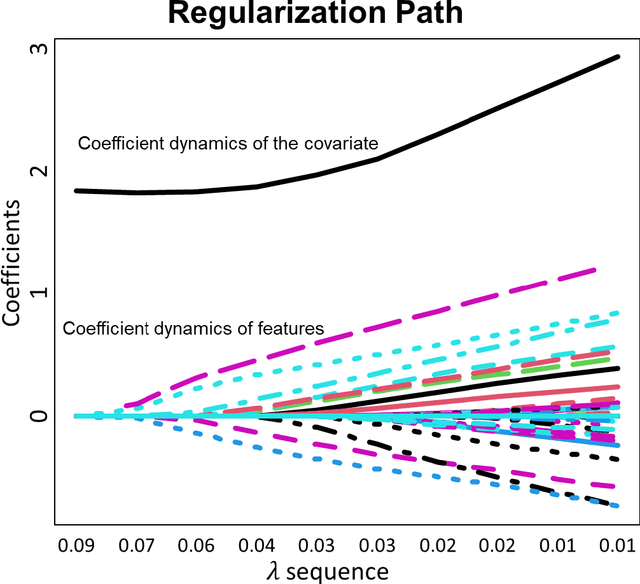
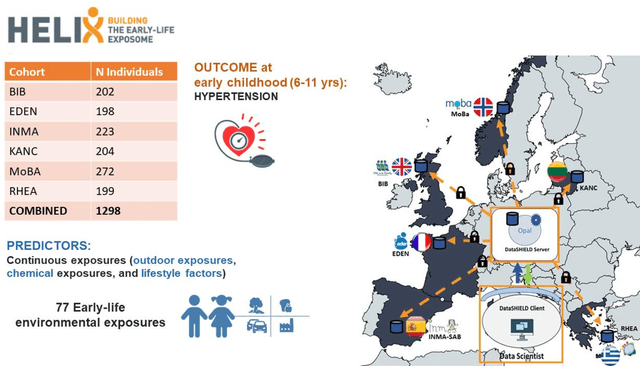
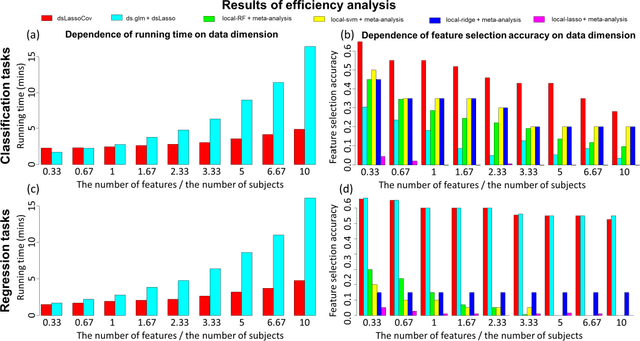
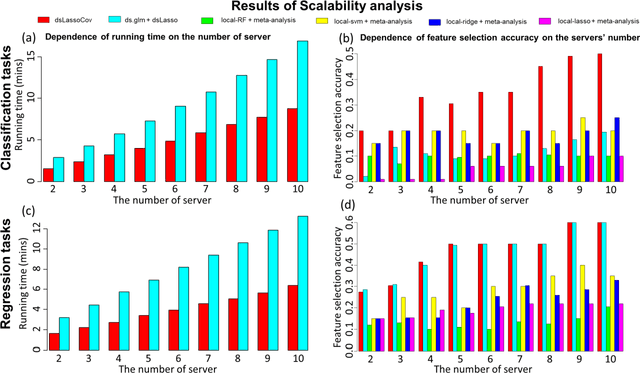
Machine learning has been widely adopted in biomedical research, fueled by the increasing availability of data. However, integrating datasets across institutions is challenging due to legal restrictions and data governance complexities. Federated learning allows the direct, privacy preserving training of machine learning models using geographically distributed datasets, but faces the challenge of how to appropriately control for covariate effects. The naive implementation of conventional covariate control methods in federated learning scenarios is often impractical due to the substantial communication costs, particularly with high-dimensional data. To address this issue, we introduce dsLassoCov, a machine learning approach designed to control for covariate effects and allow an efficient training in federated learning. In biomedical analysis, this allow the biomarker selection against the confounding effects. Using simulated data, we demonstrate that dsLassoCov can efficiently and effectively manage confounding effects during model training. In our real-world data analysis, we replicated a large-scale Exposome analysis using data from six geographically distinct databases, achieving results consistent with previous studies. By resolving the challenge of covariate control, our proposed approach can accelerate the application of federated learning in large-scale biomedical studies.