 Add to Chrome
 Add to Firefox
 Add to Edge
Continuous-Time Piecewise-Linear Recurrent Neural Networks
Feb 17, 2026
In dynamical systems reconstruction (DSR) we aim to recover the dynamical system (DS) underlying observed time series. Specifically, we aim to learn a generative surrogate model which approximates the underlying, data-generating DS, and recreates its long-term properties (`climate statistics'). In scientific and medical areas, in particular, these models need to be mechanistically tractable -- through their mathematical analysis we would like to obtain insight into the recovered system's workings. Piecewise-linear (PL), ReLU-based RNNs (PLRNNs) have a strong track-record in this regard, representing SOTA DSR models while allowing mathematical insight by virtue of their PL design. However, all current PLRNN variants are discrete-time maps. This is in disaccord with the assumed continuous-time nature of most physical and biological processes, and makes it hard to accommodate data arriving at irregular temporal intervals. Neural ODEs are one solution, but they do not reach the DSR performance of PLRNNs and often lack their tractability. Here we develop theory for continuous-time PLRNNs (cPLRNNs): We present a novel algorithm for training and simulating such models, bypassing numerical integration by efficiently exploiting their PL structure. We further demonstrate how important topological objects like equilibria or limit cycles can be determined semi-analytically in trained models. We compare cPLRNNs to both their discrete-time cousins as well as Neural ODEs on DSR benchmarks, including systems with discontinuities which come with hard thresholds.

A scalable generative model for dynamical system reconstruction from neuroimaging data
Nov 05, 2024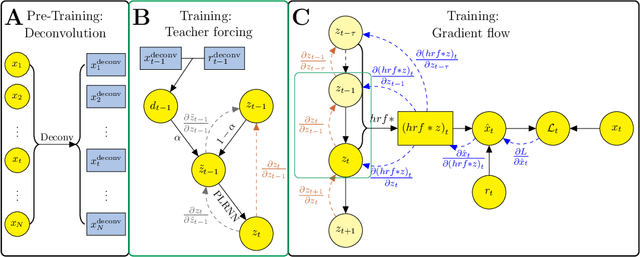

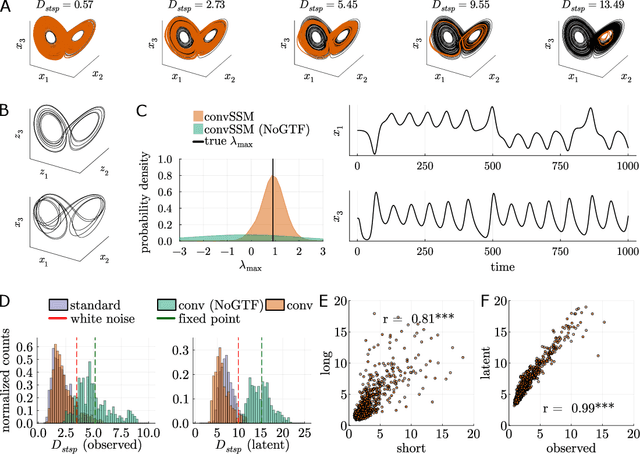
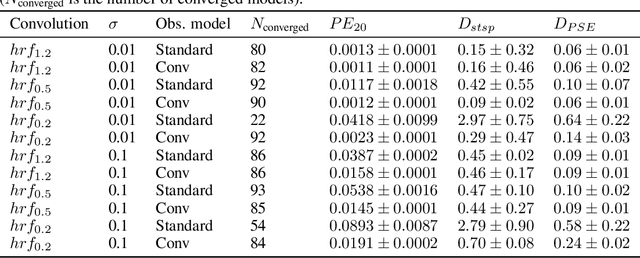
Data-driven inference of the generative dynamics underlying a set of observed time series is of growing interest in machine learning and the natural sciences. In neuroscience, such methods promise to alleviate the need to handcraft models based on biophysical principles and allow to automatize the inference of inter-individual differences in brain dynamics. Recent breakthroughs in training techniques for state space models (SSMs) specifically geared toward dynamical systems (DS) reconstruction (DSR) enable to recover the underlying system including its geometrical (attractor) and long-term statistical invariants from even short time series. These techniques are based on control-theoretic ideas, like modern variants of teacher forcing (TF), to ensure stable loss gradient propagation while training. However, as it currently stands, these techniques are not directly applicable to data modalities where current observations depend on an entire history of previous states due to a signal's filtering properties, as common in neuroscience (and physiology more generally). Prominent examples are the blood oxygenation level dependent (BOLD) signal in functional magnetic resonance imaging (fMRI) or Ca$^{2+}$ imaging data. Such types of signals render the SSM's decoder model non-invertible, a requirement for previous TF-based methods. Here, exploiting the recent success of control techniques for training SSMs, we propose a novel algorithm that solves this problem and scales exceptionally well with model dimensionality and filter length. We demonstrate its efficiency in reconstructing dynamical systems, including their state space geometry and long-term temporal properties, from just short BOLD time series.