 Add to Chrome
 Add to Firefox
 Add to Edge
Topological Out-of-Domain Generalization in Dynamical Systems Reconstruction
Jun 22, 2026
Predicting the behavior of dynamical systems (DS) beyond the dynamical and parameter regimes observed in training is a pivotal and essentially unresolved problem in scientific ML. It is central to any good scientific theory, which we expect to be able to make predictions about regimes not covered by currently available data. Recent hierarchical and hyper-network guided approaches for DS reconstruction (DSR) enable training on many DS simultaneously, and revealed that extracted latent features are often related to crucial control parameters of the underlying DS that varied across the training corpus. However, true out-of-domain forecasting abilities of these models, e.g., across tipping points, remain limited, and fine-tuning, or even full model retraining, on time series from the new dynamical regime is usually required. Here, we mathematically analyze the root of these limitations in previous model formulations and identify three core shortcomings rooted in a mismatch between structural assumptions of the reconstruction model and typical properties of physical systems. We propose a combination of remedies for these shortcomings, most importantly feature splitting, and furthermore derive a closed-form bound on the reliable extrapolation range. We demonstrate empirically that our techniques allow for accurate zero-shot prediction into new dynamical regimes, outside the observed training regime, as, e.g., encountered across tipping points.

Learning Interpretable Hierarchical Dynamical Systems Models from Time Series Data
Oct 07, 2024
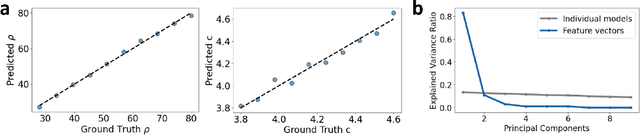

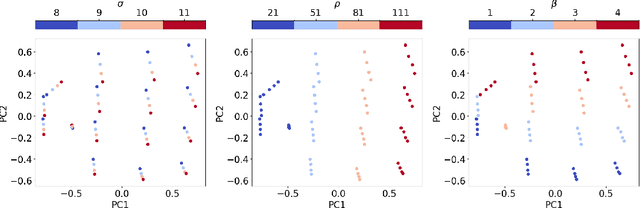
In science, we are often interested in obtaining a generative model of the underlying system dynamics from observed time series. While powerful methods for dynamical systems reconstruction (DSR) exist when data come from a single domain, how to best integrate data from multiple dynamical regimes and leverage it for generalization is still an open question. This becomes particularly important when individual time series are short, and group-level information may help to fill in for gaps in single-domain data. At the same time, averaging is not an option in DSR, as it will wipe out crucial dynamical properties (e.g., limit cycles in one domain vs. chaos in another). Hence, a framework is needed that enables to efficiently harvest group-level (multi-domain) information while retaining all single-domain dynamical characteristics. Here we provide such a hierarchical approach and showcase it on popular DSR benchmarks, as well as on neuroscientific and medical time series. In addition to faithful reconstruction of all individual dynamical regimes, our unsupervised methodology discovers common low-dimensional feature spaces in which datasets with similar dynamics cluster. The features spanning these spaces were further dynamically highly interpretable, surprisingly in often linear relation to control parameters that govern the dynamics of the underlying system. Finally, we illustrate transfer learning and generalization to new parameter regimes.