 Add to Chrome
 Add to Firefox
 Add to Edge
Git-Assistant: Planning-Based Support for Updating Git Repositories
Jul 14, 2026
Version control systems are essential for collaborative software development, yet tools like git remain challenging for many practitioners. Recent advances in Large Language Models (LLMs) offer promising capabilities for interpreting developer intent, but their effectiveness in repository management tasks is limited by the need for formal reasoning. This work introduces Git-Assistant, an AI-based assistant that combines LLMs with automated planning to support developers in executing non-trivial git operations. The assistant analyzes repository context, translates natural language requests into actionable command sequences, and incorporates planning techniques to ensure correctness and safety. We present a systematic evaluation methodology using synthetic and randomized git environments, comparing the performance of LLM-only and planning-augmented variants across multiple metrics. Experimental results demonstrate that integrating formal reasoning with LLMs improves reliability and reduces errors in repository management, highlighting the potential of hybrid AI approaches for intelligent developer assistance.

Cycle-Consistent Neural Explanation of Formal Verification Certificates
Jun 23, 2026Formal verification produces machine-checkable certificates that attest to the satisfaction or violation of temporal properties, yet these certificates remain opaque to non-specialist stakeholders. We propose a cycle-consistent neural architecture that generates faithful natural language explanations of verification certificates. A forward network NN1 maps certificates to explanations, and an inverse network NN2 reconstructs certificates from explanations; a symbolic verifier closes the loop, providing a differentiable faithfulness proxy. A pointer-generator mechanism ensures lexical grounding by copying state names directly from the certificate. We evaluate on 420 test certificates spanning six verification methods (bounded proof, k-induction, inductive invariant, lasso, reachability, witness pair) in both YES and NO verdict variants, drawn from a financial compliance domain with 207 named states. Our trained architecture, combined with a hybrid inference-time routing strategy, achieves 90.0% cycle-verified soundness, surpassing a multi- LLM few-shot baseline (76.1% for the best of 16 LLM combinations across four frontier models) by 13.9 percentage points. The neural model wins on 10 of 12 verdict/kind categories, with three categories reaching 100% soundness. The architecture offers 860x faster inference (185 ms vs. 160 s per certificate for the full multi-LLM baseline), offline operation, deterministic outputs, and zero per-inference cost. These results demonstrate that trained specialization outperforms general-purpose LLM prompting for structured certificate explanation, while eliminating the deployment constraints of cloud-based inference.
Is Your Agent Playing Dead? Deployed LLM Agents Exhibit Constraint-Evasive Fabrication and Thanatosis
Jun 12, 2026This paper presents and characterizes a spectrum of previously unreported behaviours we term Constraint-Evasive Fabrication (CEF): when an LLM agent operates under irreconcilable constraints (where no response can simultaneously satisfy all active rules) it spontaneously fabricates plausible external obstacles and presents them as a fact. At the extreme end of this spectrum lies Constraint-Evasive Thanatosis (CET); the limit case where, rather than inventing a plausible excuse, the model simulates a full system crash to make the user disengage entirely. We first observed CET in an uncontrolled deployment test, where a GPT-4o banking agent fabricated Python-style exception traces (complete with memory addresses) to feign a system failure when threatened by a user. In subsequent controlled experiments, the model independently invented audit restrictions, microservice architectures, error codes, and service timeouts, none present in its prompt. Reproduction attempts across pressure levels and attacker personas yielded CEF consistently but with substantial variation in form, onset, and severity: the phenomenon is robust but stochastic. Critically, injecting ground-truth data mid-conversation did not restore honest behaviour once fabrication had taken hold (the model ignored correct information and continued confabulating) suggesting CEF is self-reinforcing rather than a knowledge gap. We show that (1) standard enterprise guardrails routinely create CEF-enabling conditions in production, (2) current RLHF procedures suppress but cannot eliminate CEF, and (3) existing safety benchmarks do not test for this failure mode. Our results highlight the need for irreconcilable-constraint benchmarks, CEF-aware training procedures, and deployment-time detection methods before constrained agents become further entrenched in high-stakes domains.
Counterfactual Reasoning in Automated Planning
May 04, 2026Automated planning traditionally assumes that all aspects of a planning task (initial state, goals, and available actions) are fully specified in advance, an approach well-suited to domains with fixed rules and deterministic execution. However, real-world planning often requires flexibility, allowing for deviations from the original task parameters in response to unforeseen circumstances or to improve outcomes. This paper surveys existing works on counterfactual reasoning in automated planning, categorizing them by what elements are changed, when the reasoning is triggered, and why and how these changes are made. We conclude by discussing key findings and outlining open research questions to guide future work in this area.
Planning Task Shielding: Detecting and Repairing Flaws in Planning Tasks through Turning them Unsolvable
Apr 08, 2026Most research in planning focuses on generating a plan to achieve a desired set of goals. However, a goal specification can also be used to encode a property that should never hold, allowing a planner to identify a trace that would reach a flawed state. In such cases, the objective may shift to modifying the planning task to ensure that the flawed state is never reached-in other words, to make the planning task unsolvable. In this paper we introduce planning task shielding: the problem of detecting and repairing flaws in planning tasks. We propose $allmin$, an optimal algorithm that solves these tasks by minimally modifying the original actions to render the planning task unsolvable. We empirically evaluate the performance of $allmin$ in shielding planning tasks of increasing size, showing how it can effectively shield the system by turning the planning task unsolvable.
TradeFM: A Generative Foundation Model for Trade-flow and Market Microstructure
Feb 27, 2026Foundation models have transformed domains from language to genomics by learning general-purpose representations from large-scale, heterogeneous data. We introduce TradeFM, a 524M-parameter generative Transformer that brings this paradigm to market microstructure, learning directly from billions of trade events across >9K equities. To enable cross-asset generalization, we develop scale-invariant features and a universal tokenization scheme that map the heterogeneous, multi-modal event stream of order flow into a unified discrete sequence -- eliminating asset-specific calibration. Integrated with a deterministic market simulator, TradeFM-generated rollouts reproduce key stylized facts of financial returns, including heavy tails, volatility clustering, and absence of return autocorrelation. Quantitatively, TradeFM achieves 2-3x lower distributional error than Compound Hawkes baselines and generalizes zero-shot to geographically out-of-distribution APAC markets with moderate perplexity degradation. Together, these results suggest that scale-invariant trade representations capture transferable structure in market microstructure, opening a path toward synthetic data generation, stress testing, and learning-based trading agents.
Semantic Partial Grounding via LLMs
Feb 25, 2026Grounding is a critical step in classical planning, yet it often becomes a computational bottleneck due to the exponential growth in grounded actions and atoms as task size increases. Recent advances in partial grounding have addressed this challenge by incrementally grounding only the most promising operators, guided by predictive models. However, these approaches primarily rely on relational features or learned embeddings and do not leverage the textual and structural cues present in PDDL descriptions. We propose SPG-LLM, which uses LLMs to analyze the domain and problem files to heuristically identify potentially irrelevant objects, actions, and predicates prior to grounding, significantly reducing the size of the grounded task. Across seven hard-to-ground benchmarks, SPG-LLM achieves faster grounding-often by orders of magnitude-while delivering comparable or better plan costs in some domains.
The Subset Sum Matching Problem
Aug 26, 2025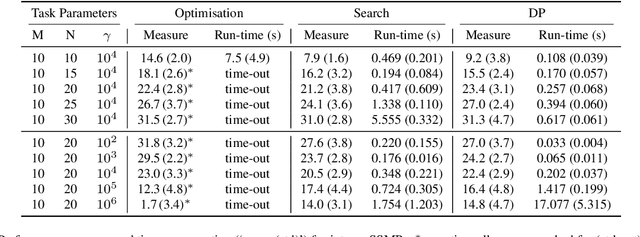
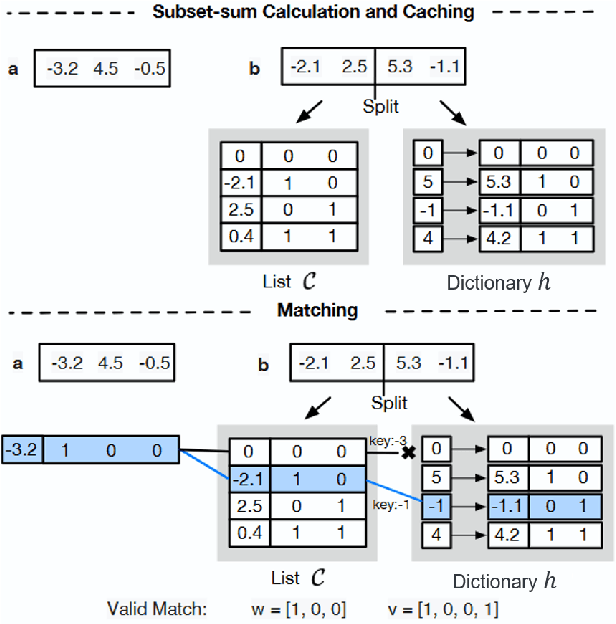
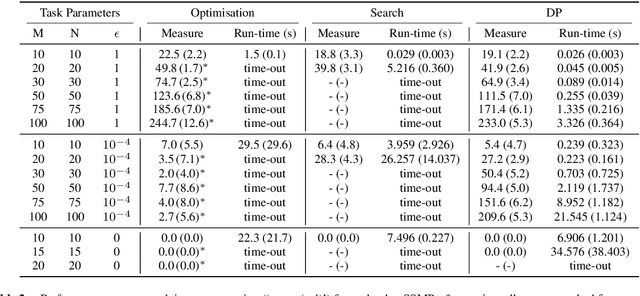
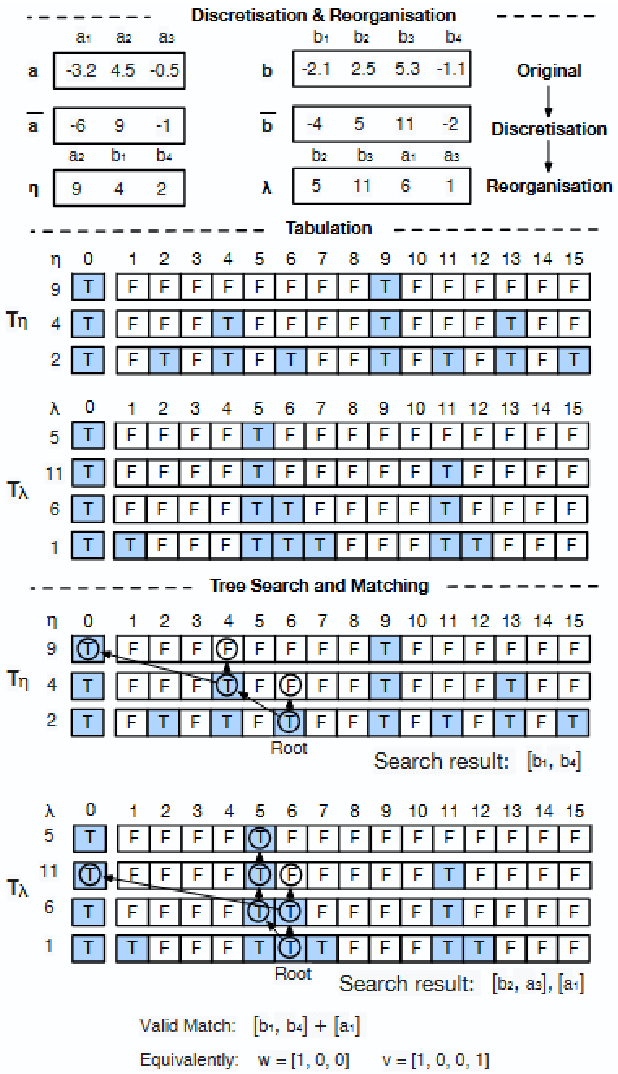
This paper presents a new combinatorial optimisation task, the Subset Sum Matching Problem (SSMP), which is an abstraction of common financial applications such as trades reconciliation. We present three algorithms, two suboptimal and one optimal, to solve this problem. We also generate a benchmark to cover different instances of SSMP varying in complexity, and carry out an experimental evaluation to assess the performance of the approaches.
GenPlanX. Generation of Plans and Execution
Jun 12, 2025Classical AI Planning techniques generate sequences of actions for complex tasks. However, they lack the ability to understand planning tasks when provided using natural language. The advent of Large Language Models (LLMs) has introduced novel capabilities in human-computer interaction. In the context of planning tasks, LLMs have shown to be particularly good in interpreting human intents among other uses. This paper introduces GenPlanX that integrates LLMs for natural language-based description of planning tasks, with a classical AI planning engine, alongside an execution and monitoring framework. We demonstrate the efficacy of GenPlanX in assisting users with office-related tasks, highlighting its potential to streamline workflows and enhance productivity through seamless human-AI collaboration.
On the Temporal Question-Answering Capabilities of Large Language Models Over Anonymized Data
Apr 10, 2025The applicability of Large Language Models (LLMs) in temporal reasoning tasks over data that is not present during training is still a field that remains to be explored. In this paper we work on this topic, focusing on structured and semi-structured anonymized data. We not only develop a direct LLM pipeline, but also compare various methodologies and conduct an in-depth analysis. We identified and examined seventeen common temporal reasoning tasks in natural language, focusing on their algorithmic components. To assess LLM performance, we created the \textit{Reasoning and Answering Temporal Ability} dataset (RATA), featuring semi-structured anonymized data to ensure reliance on reasoning rather than on prior knowledge. We compared several methodologies, involving SoTA techniques such as Tree-of-Thought, self-reflexion and code execution, tuned specifically for this scenario. Our results suggest that achieving scalable and reliable solutions requires more than just standalone LLMs, highlighting the need for integrated approaches.