 Add to Chrome
 Add to Firefox
 Add to Edge
Git-Assistant: Planning-Based Support for Updating Git Repositories
Jul 14, 2026
Version control systems are essential for collaborative software development, yet tools like git remain challenging for many practitioners. Recent advances in Large Language Models (LLMs) offer promising capabilities for interpreting developer intent, but their effectiveness in repository management tasks is limited by the need for formal reasoning. This work introduces Git-Assistant, an AI-based assistant that combines LLMs with automated planning to support developers in executing non-trivial git operations. The assistant analyzes repository context, translates natural language requests into actionable command sequences, and incorporates planning techniques to ensure correctness and safety. We present a systematic evaluation methodology using synthetic and randomized git environments, comparing the performance of LLM-only and planning-augmented variants across multiple metrics. Experimental results demonstrate that integrating formal reasoning with LLMs improves reliability and reduces errors in repository management, highlighting the potential of hybrid AI approaches for intelligent developer assistance.

On the Temporal Question-Answering Capabilities of Large Language Models Over Anonymized Data
Apr 10, 2025The applicability of Large Language Models (LLMs) in temporal reasoning tasks over data that is not present during training is still a field that remains to be explored. In this paper we work on this topic, focusing on structured and semi-structured anonymized data. We not only develop a direct LLM pipeline, but also compare various methodologies and conduct an in-depth analysis. We identified and examined seventeen common temporal reasoning tasks in natural language, focusing on their algorithmic components. To assess LLM performance, we created the \textit{Reasoning and Answering Temporal Ability} dataset (RATA), featuring semi-structured anonymized data to ensure reliance on reasoning rather than on prior knowledge. We compared several methodologies, involving SoTA techniques such as Tree-of-Thought, self-reflexion and code execution, tuned specifically for this scenario. Our results suggest that achieving scalable and reliable solutions requires more than just standalone LLMs, highlighting the need for integrated approaches.
TRIM: Token Reduction and Inference Modeling for Cost-Effective Language Generation
Dec 10, 2024

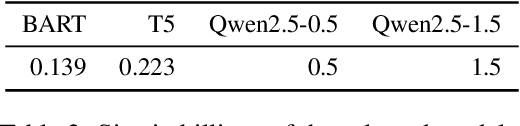

The inference cost of Large Language Models (LLMs) is a significant challenge due to their computational demands, specially on tasks requiring long outputs. However, natural language often contains redundancy, which presents an opportunity for optimization. We have observed that LLMs can generate distilled language-concise outputs that retain essential meaning, when prompted appropriately. We propose a framework for saving computational cost, in which a shorter distilled output from the LLM is reconstructed into a full narrative by a smaller model with lower inference costs. Our experiments show promising results, particularly in general knowledge domains with 20.58% saved tokens on average with tiny decrease in evaluation metrics, hinting that this approach can effectively balance efficiency and accuracy in language processing tasks.