 Add to Chrome
 Add to Firefox
 Add to Edge
Abra: Scaling Diffusion Image Training
Aug 18, 2026
Compute-optimal scaling laws guide the training of frontier language models yet remain largely unexplored for visual generation. We present a systematic scaling law study for text-to-image diffusion models using Abra, a controlled family of flow-matching transformers trained across three orders of magnitude worth of compute ($10^{19}$ to $10^{22}$ FLOPs), reaching significantly larger compute budgets than previous works. We demonstrate that diffusion models scale just as predictably as language models but require far more data to train optimally: compute optimality occurs at approximately $200$ image tokens per parameter, ten times the Chinchilla compute-optimal prescription for LLMs. We show that unlike language models, diffusion models are robust to overtraining and that practitioners should err on the side of more data rather than a larger model. Finally, we show that this predictability extends beyond training loss to generative quality metrics, optimal CFG settings, representation quality, and even the shape of the training curves, which collapse onto a universal form.

Reasoning and Generalization in RL: A Tool Use Perspective
Jul 03, 2019

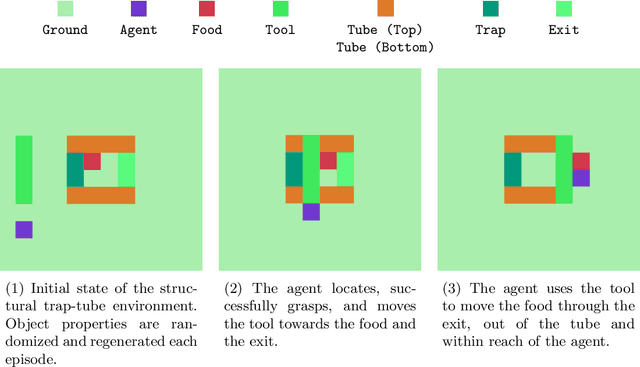

Learning to use tools to solve a variety of tasks is an innate ability of humans and has been observed of animals in the wild. However, the underlying mechanisms that are required to learn to use tools are abstract and widely contested in the literature. In this paper, we study tool use in the context of reinforcement learning and propose a framework for analyzing generalization inspired by a classic study of tool using behavior, the trap-tube task. Recently, it has become common in reinforcement learning to measure generalization performance on a single test set of environments. We instead propose transfers that produce multiple test sets that are used to measure specified types of generalization, inspired by abilities demonstrated by animal and human tool users. The source code to reproduce our experiments is publicly available at https://github.com/fomorians/gym_tool_use.