 Add to Chrome
 Add to Firefox
 Add to Edge
Diffusion Graph Posterior Sampling for Nonlinear Inverse Problems with Application to Electrical Impedance Tomography
May 19, 2026
Deep generative models have emerged as state-of-the-art for solving inverse problems, but applying them to inverse problems for PDEs, like electrical impedance tomography (EIT) remains challenging. Because physical domains are naturally discretized as unstructured meshes rather than regular grids, standard convolutional architectures are often inadequate. In this paper, we propose a novel framework that extends diffusion posterior sampling (DPS) to graph-structured data. We develop an unconditional score-based diffusion model directly on a 2D triangular mesh to learn an accurate prior over the physical solution space. Furthermore, we introduce a regularized variant, RDPS, which incorporates explicit regularization terms, such as total variation and generalized Tikhonov, to complement the implicit diffusion prior and mitigate severe ill-posedness. Extensive experiments on synthetic and real 2D EIT datasets demonstrate that RDPS produces stable, physically plausible reconstructions. Our approach generalizes well to out-of-distribution inclusion geometries, is highly robust to measurement noise, and outperforms current state-of-the-art solvers (e.g., GPnP-BM3D, DP-SGS) in reconstruction accuracy and artifact reduction.

Deep Unfolding Network for Nonlinear Multi-Frequency Electrical Impedance Tomography
Jul 22, 2025Multi-frequency Electrical Impedance Tomography (mfEIT) represents a promising biomedical imaging modality that enables the estimation of tissue conductivities across a range of frequencies. Addressing this challenge, we present a novel variational network, a model-based learning paradigm that strategically merges the advantages and interpretability of classical iterative reconstruction with the power of deep learning. This approach integrates graph neural networks (GNNs) within the iterative Proximal Regularized Gauss Newton (PRGN) framework. By unrolling the PRGN algorithm, where each iteration corresponds to a network layer, we leverage the physical insights of nonlinear model fitting alongside the GNN's capacity to capture inter-frequency correlations. Notably, the GNN architecture preserves the irregular triangular mesh structure used in the solution of the nonlinear forward model, enabling accurate reconstruction of overlapping tissue fraction concentrations.
Quantum median filter for Total Variation image denoising
Dec 02, 2022In this new computing paradigm, named quantum computing, researchers from all over the world are taking their first steps in designing quantum circuits for image processing, through a difficult process of knowledge transfer. This effort is named Quantum Image Processing, an emerging research field pushed by powerful parallel computing capabilities of quantum computers. This work goes in this direction and proposes the challenging development of a powerful method of image denoising, such as the Total Variation (TV) model, in a quantum environment. The proposed Quantum TV is described and its sub-components are analysed. Despite the natural limitations of the current capabilities of quantum devices, the experimental results show a competitive denoising performance compared to the classical variational TV counterpart.
A fast nonconvex Compressed Sensing algorithm for highly low-sampled MR images reconstruction
Nov 29, 2017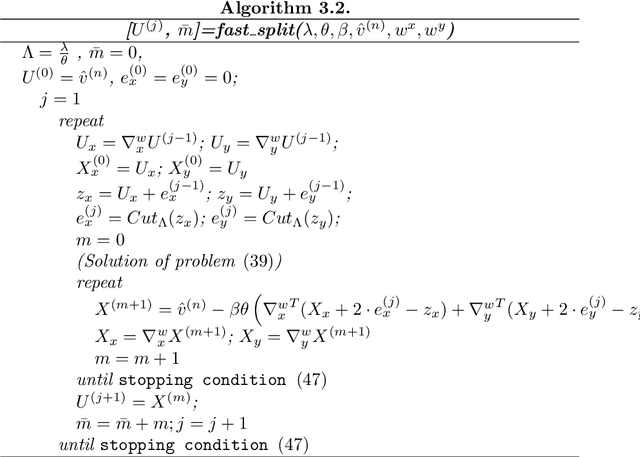
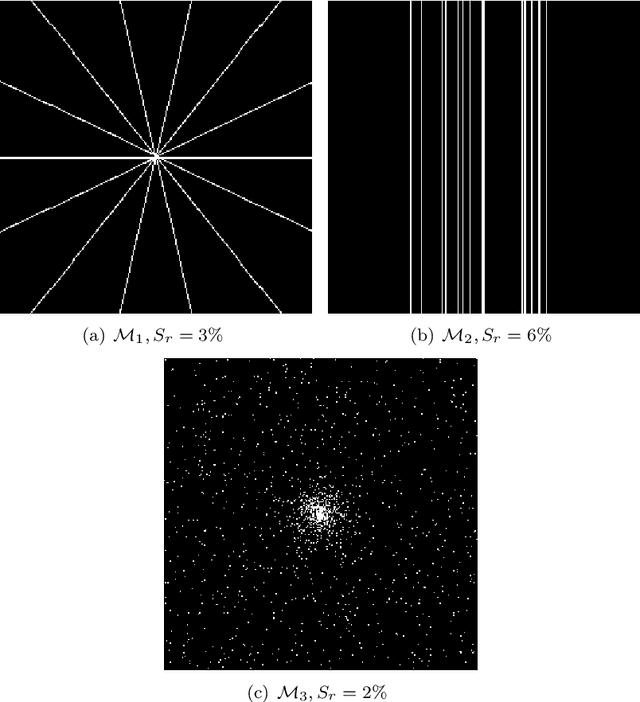
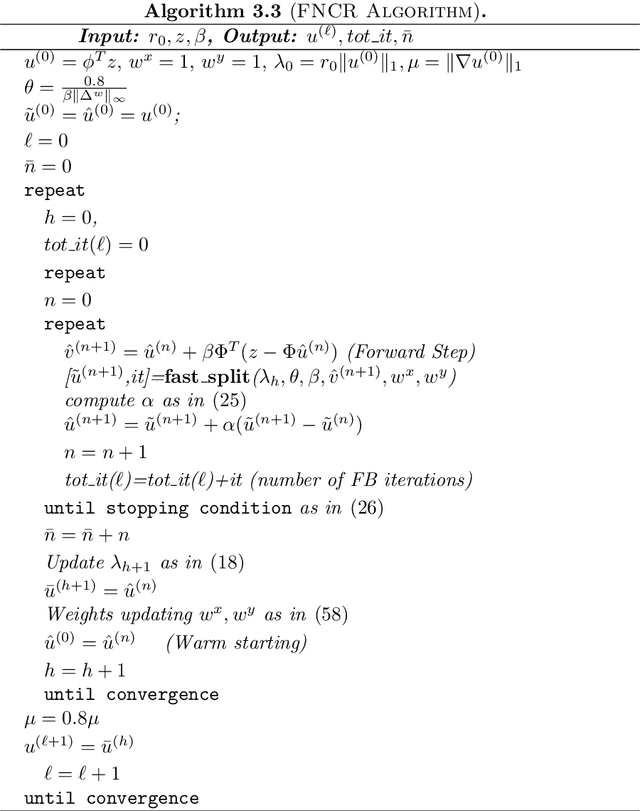
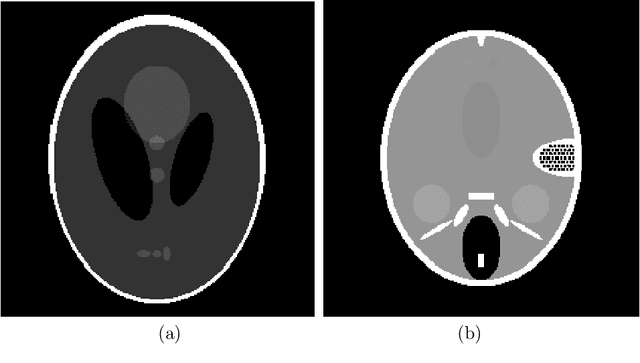
In this paper we present a fast and efficient method for the reconstruction of Magnetic Resonance Images (MRI) from severely under-sampled data. From the Compressed Sensing theory we have mathematically modeled the problem as a constrained minimization problem with a family of non-convex regularizing objective functions depending on a parameter and a least squares data fit constraint. We propose a fast and efficient algorithm, named Fast NonConvex Reweighting (FNCR) algorithm, based on an iterative scheme where the non-convex problem is approximated by its convex linearization and the penalization parameter is automatically updated. The convex problem is solved by a Forward-Backward procedure, where the Backward step is performed by a Split Bregman strategy. Moreover, we propose a new efficient iterative solver for the arising linear systems. We prove the convergence of the proposed FNCR method. The results on synthetic phantoms and real images show that the algorithm is very well performing and computationally efficient, even when compared to the best performing methods proposed in the literature.