 Add to Chrome
 Add to Firefox
 Add to Edge
SynMVCrowd: A Large Synthetic Benchmark for Multi-view Crowd Counting and Localization
Mar 25, 2026
Existing multi-view crowd counting and localization methods are evaluated under relatively small scenes with limited crowd numbers, camera views, and frames. This makes the evaluation and comparison of existing methods impractical, as small datasets are easily overfit by these methods. To avoid these issues, 3DROM proposes a data augmentation method. Instead, in this paper, we propose a large synthetic benchmark, SynMVCrowd, for more practical evaluation and comparison of multi-view crowd counting and localization tasks. The SynMVCrowd benchmark consists of 50 synthetic scenes with a large number of multi-view frames and camera views and a much larger crowd number (up to 1000), which is more suitable for large-scene multi-view crowd vision tasks. Besides, we propose strong multi-view crowd localization and counting baselines that outperform all comparison methods on the new SynMVCrowd benchmark. Moreover, we prove that better domain transferring multi-view and single-image counting performance could be achieved with the aid of the benchmark on novel new real scenes. As a result, the proposed benchmark could advance the research for multi-view and single-image crowd counting and localization to more practical applications. The codes and datasets are here: https://github.com/zqyq/SynMVCrowd.

Multi-View People Detection in Large Scenes via Supervised View-Wise Contribution Weighting
May 30, 2024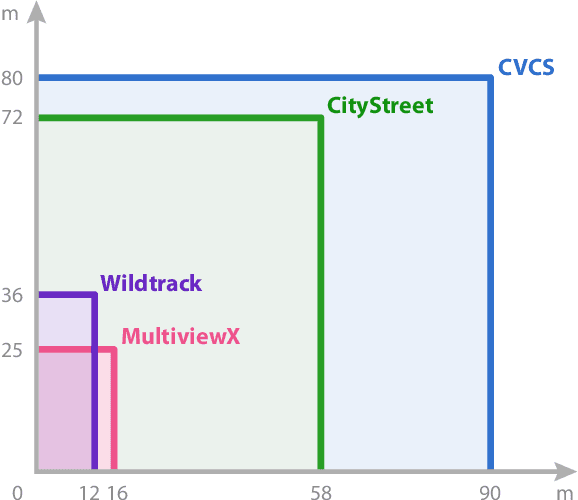
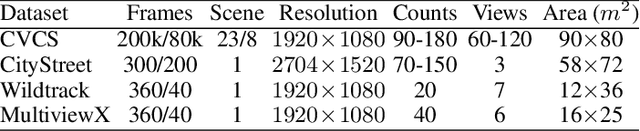
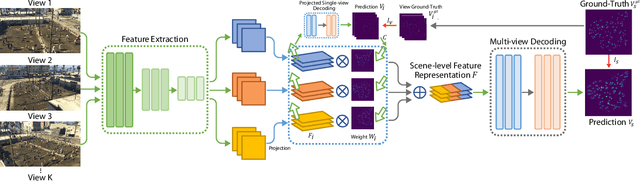

Recent deep learning-based multi-view people detection (MVD) methods have shown promising results on existing datasets. However, current methods are mainly trained and evaluated on small, single scenes with a limited number of multi-view frames and fixed camera views. As a result, these methods may not be practical for detecting people in larger, more complex scenes with severe occlusions and camera calibration errors. This paper focuses on improving multi-view people detection by developing a supervised view-wise contribution weighting approach that better fuses multi-camera information under large scenes. Besides, a large synthetic dataset is adopted to enhance the model's generalization ability and enable more practical evaluation and comparison. The model's performance on new testing scenes is further improved with a simple domain adaptation technique. Experimental results demonstrate the effectiveness of our approach in achieving promising cross-scene multi-view people detection performance. See code here: https://vcc.tech/research/2024/MVD.