 Add to Chrome
 Add to Firefox
 Add to Edge
ALIVE-LIO: Degeneracy-Aware Learning of Inertial Velocity for Enhancing ESKF-Based LiDAR-Inertial Odometry
Apr 03, 2026
Odometry estimation using light detection and ranging (LiDAR) and an inertial measurement unit (IMU), known as LiDAR-inertial odometry (LIO), often suffers from performance degradation in degenerate environments, such as long corridors or single-wall scenarios with narrow field-of-view LiDAR. To address this limitation, we propose ALIVE-LIO, a degeneracy-aware LiDAR-inertial odometry framework that explicitly enhances state estimation in degenerate directions. The key contribution of ALIVE-LIO is the strategic integration of a deep neural network into a classical error-state Kalman filter (ESKF) to compensate for the loss of LiDAR observability. Specifically, ALIVE-LIO employs a neural network to predict the body-frame velocity and selectively fuses this prediction into the ESKF only when degeneracy is detected, providing effective state updates along degenerate directions. This design enables ALIVE-LIO to utilize the probabilistic structure and consistency of the ESKF while benefiting from learning-based motion estimation. The proposed method was evaluated on publicly available datasets exhibiting degeneracy, as well as on our own collected data. Experimental results demonstrate that ALIVE-LIO substantially reduces pose drift in degenerate environments, yielding the most competitive results in 22 out of 32 sequences. The implementation of ALIVE-LIO will be publicly available.

Benchmarking Visual Feature Representations for LiDAR-Inertial-Visual Odometry Under Challenging Conditions
Mar 19, 2026Accurate localization in autonomous driving is critical for successful missions including environmental mapping and survivor searches. In visually challenging environments, including low-light conditions, overexposure, illumination changes, and high parallax, the performance of conventional visual odometry methods significantly degrade undermining robust robotic navigation. Researchers have recently proposed LiDAR-inertial-visual odometry (LIVO) frameworks, that integrate LiDAR, IMU, and camera sensors, to address these challenges. This paper extends the FAST-LIVO2-based framework by introducing a hybrid approach that integrates direct photometric methods with descriptor-based feature matching. For the descriptor-based feature matching, this work proposes pairs of ORB with the Hamming distance, SuperPoint with SuperGlue, SuperPoint with LightGlue, and XFeat with the mutual nearest neighbor. The proposed configurations are benchmarked by accuracy, computational cost, and feature tracking stability, enabling a quantitative comparison of the adaptability and applicability of visual descriptors. The experimental results reveal that the proposed hybrid approach outperforms the conventional sparse-direct method. Although the sparse-direct method often fails to converge in regions where photometric inconsistency arises due to illumination changes, the proposed approach still maintains robust performance under the same conditions. Furthermore, the hybrid approach with learning-based descriptors enables robust and reliable visual state estimation across challenging environments.
* 14 pages, Publised IEEE Access2026
GenZ-LIO: Generalizable LiDAR-Inertial Odometry Beyond Indoor--Outdoor Boundaries
Mar 17, 2026Light detection and ranging (LiDAR)-inertial odometry (LIO) enables accurate localization and mapping for autonomous navigation in various scenes. However, its performance remains sensitive to variations in spatial scale, which refers to the spatial extent of the scene reflected in the distribution of point ranges in a LiDAR scan. Transitions between confined indoor and expansive outdoor spaces induce substantial variations in point density, which may reduce robustness and computational efficiency. To address this issue, we propose GenZ-LIO, a LIO framework generalizable across both indoor and outdoor environments. GenZ-LIO comprises three key components. First, inspired by the principle of the proportional-integral-derivative (PID) controller, it adaptively regulates the voxel size for downsampling via feedback control, driving the voxelized point count toward a scale-informed setpoint while enabling stable and efficient processing across varying scene scales. Second, we formulate a hybrid-metric state update that jointly leverages point-to-plane and point-to-point residuals to mitigate LiDAR degeneracy arising from directionally insufficient geometric constraints. Third, to alleviate the computational burden introduced by point-to-point matching, we introduce a voxel-pruned correspondence search strategy that discards non-promising voxel candidates and reduces unnecessary computations. Experimental results demonstrate that GenZ-LIO achieves robust odometry estimation and improved computational efficiency across confined indoor, open outdoor, and transitional environments. Our code will be made publicly available upon publication.
GenZ-ICP: Generalizable and Degeneracy-Robust LiDAR Odometry Using an Adaptive Weighting
Nov 11, 2024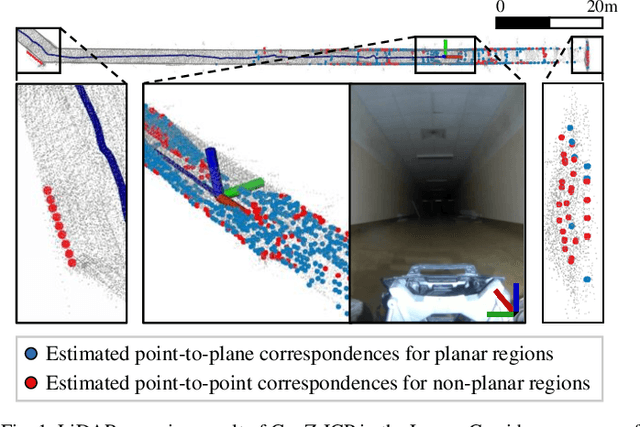
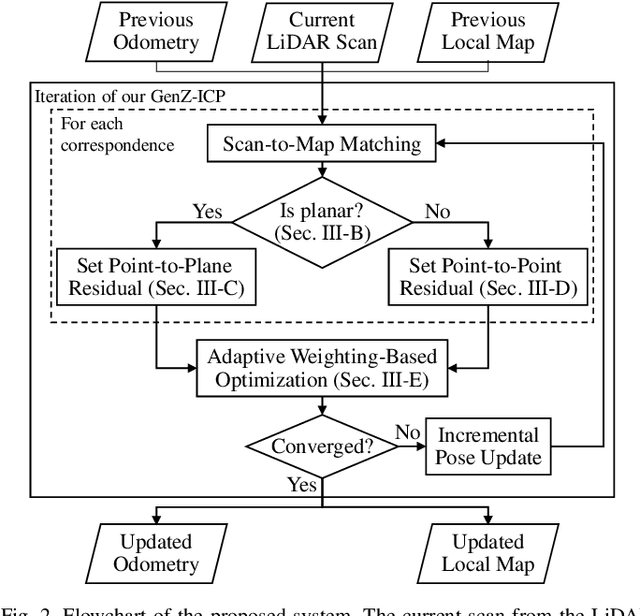
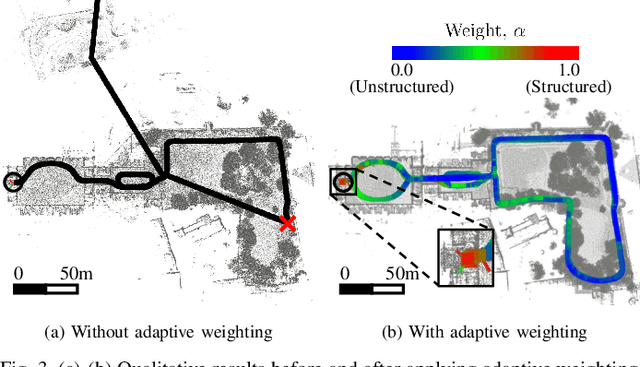
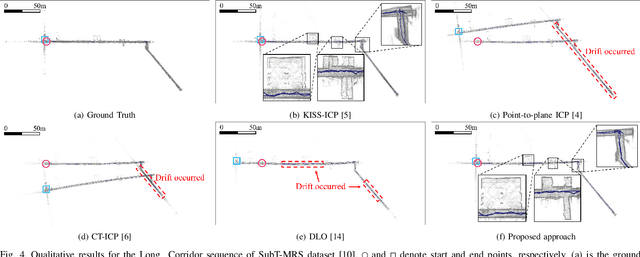
Light detection and ranging (LiDAR)-based odometry has been widely utilized for pose estimation due to its use of high-accuracy range measurements and immunity to ambient light conditions. However, the performance of LiDAR odometry varies depending on the environment and deteriorates in degenerative environments such as long corridors. This issue stems from the dependence on a single error metric, which has different strengths and weaknesses depending on the geometrical characteristics of the surroundings. To address these problems, this study proposes a novel iterative closest point (ICP) method called GenZ-ICP. We revisited both point-to-plane and point-to-point error metrics and propose a method that leverages their strengths in a complementary manner. Moreover, adaptability to diverse environments was enhanced by utilizing an adaptive weight that is adjusted based on the geometrical characteristics of the surroundings. As demonstrated in our experimental evaluation, the proposed GenZ-ICP exhibits high adaptability to various environments and resilience to optimization degradation in corridor-like degenerative scenarios by preventing ill-posed problems during the optimization process.
* 8 pages, 5 figures, Accepted to IEEE Robotics and Automation Letters (RA-L)