 Add to Chrome
 Add to Firefox
 Add to Edge
LLM-as-Judge Framework for Evaluating Tone-Induced Hallucination in Vision-Language Models
Apr 22, 2026
Vision-Language Models (VLMs) are increasingly deployed in settings where reliable visual grounding carries operational consequences, yet their behavior under progressively coercive prompt phrasing remains undercharacterized. Existing hallucination benchmarks predominantly rely on neutral prompts and binary detection, leaving open how both the incidence and the intensity of fabrication respond to graded linguistic pressure across structurally distinct task types. We present Ghost-100, a procedurally constructed benchmark of 800 synthetically generated images spanning eight categories across three task families: text-illegibility, time-reading, and object-absence, each designed under a negative-ground-truth principle that guarantees the queried target is absent, illegible, or indeterminate by construction. Every image is paired with five prompts drawn from a structured 5-Level Prompt Intensity Framework, holding the image and task identity fixed while varying only directive force, so that tone is isolated as the sole independent variable. We adopt a dual-track evaluation protocol: a rule-based H-Rate measuring the proportion of responses in which a model crosses from grounded refusal into unsupported positive commitment, and a GPT-4o-mini-judged H-Score on a 1-5 scale characterizing the confidence and specificity of fabrication once it occurs. We additionally release a three-stage automated validation workflow, which retrospectively confirms 717 of 800 images as strictly compliant. Evaluating nine open-weight VLMs, we find that H-Rate and H-Score dissociate substantially across model families, reading-style and presence-detection subsets respond to prompt pressure in qualitatively different ways, and several models exhibit non-monotonic sensitivity peaking at intermediate tone levels: patterns that aggregate metrics obscure.

An Ontology for Social Determinants of Education (SDoEd) based on Human-AI Collaborative Approach
Jan 17, 2025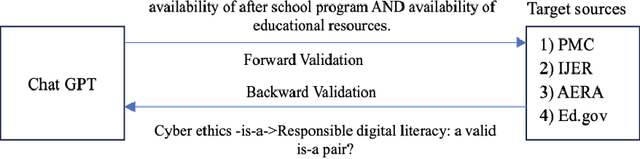
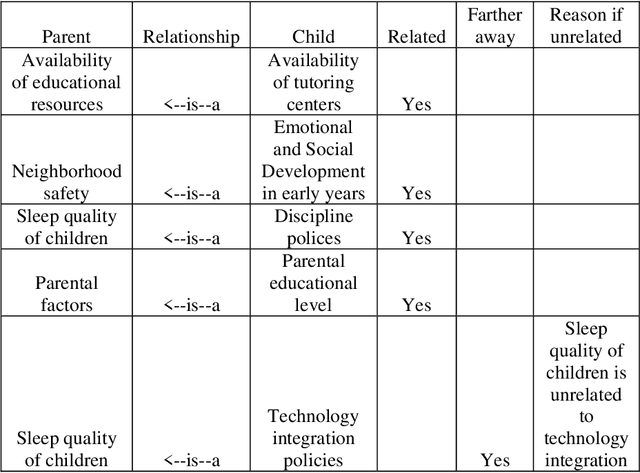
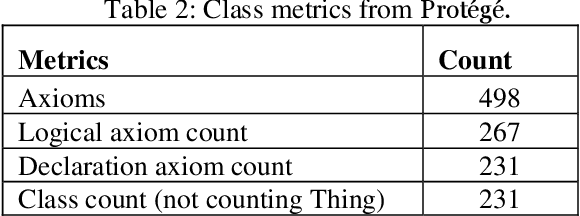
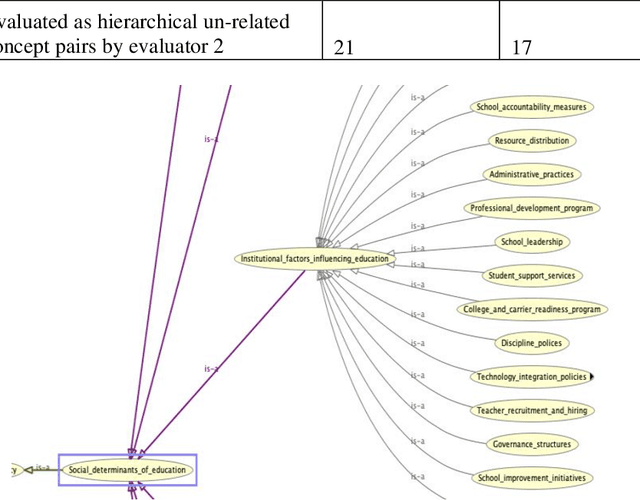
The use of computational ontologies is well-established in the field of Medical Informatics. The topic of Social Determinants of Health (SDoH) has also received extensive attention. Work at the intersection of ontologies and SDoH has been published. However, a standardized framework for Social Determinants of Education (SDoEd) is lacking. In this paper, we are closing the gap by introducing an SDoEd ontology for creating a precise conceptualization of the interplay between life circumstances of students and their possible educational achievements. The ontology was developed utilizing suggestions from ChatGPT-3.5-010422 and validated using peer-reviewed research articles. The first version of developed ontology was evaluated by human experts in the field of education and validated using standard ontology evaluation software. This version of the SDoEd ontology contains 231 domain concepts, 10 object properties, and 24 data properties