 Add to Chrome
 Add to Firefox
 Add to Edge
Novel Claim or Déjà Vu? Rethinking "Contamination-Free'' Dynamic Evaluation for Multimodal Automated Fact-Checking
Jul 26, 2026
Multimodal automated fact-checking (MAFC) verifies claims by retrieving and reasoning over external evidence. However, most existing static benchmarks risk contamination: they primarily consist of outdated claims verifiable using an LLM's internal knowledge without external evidence. This can inflate performance estimates and fail to reflect true capability on novel claims that require up-to-date information. To address this, emerging dynamic benchmarks collect claims published after LLMs' knowledge cut-off dates, assuming they are uncontaminated. This work revisits this assumption by empirically studying contamination risks in both the state-of-the-art (SOTA) static AVeriTeC benchmark and our newly constructed dynamic ClaimReview2025Q4 benchmark, as well as their impact on MAFC evaluation. Our experiments yield 16 findings, highlighting three key results: (1) Dynamic evaluation reduces but does not eliminate contamination risks, as 17.09\%--29.30\% of post-cut-off claims remain potentially contaminated; (2) Many newly published claims can be verified either directly or by synthesizing multiple pieces of public knowledge available before the cut-off; and (3) Contamination can induce statistically significant inflation in MAFC performance, increasing Macro-F1 by up to 11.34 points and distorting system rankings. In light of these findings, we re-evaluate SOTA LLMs under a strictly contamination-controlled setting. Our study provides practical guidelines for trustworthy MAFC evaluation.

MCFEND: A Multi-source Benchmark Dataset for Chinese Fake News Detection
Mar 14, 2024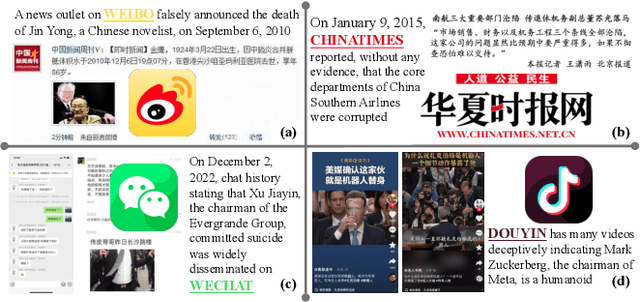


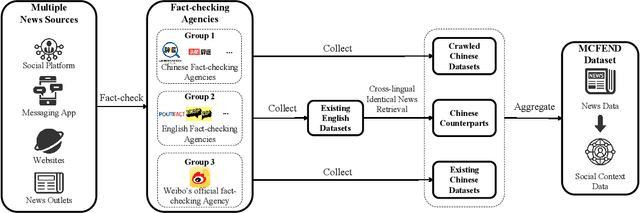
The prevalence of fake news across various online sources has had a significant influence on the public. Existing Chinese fake news detection datasets are limited to news sourced solely from Weibo. However, fake news originating from multiple sources exhibits diversity in various aspects, including its content and social context. Methods trained on purely one single news source can hardly be applicable to real-world scenarios. Our pilot experiment demonstrates that the F1 score of the state-of-the-art method that learns from a large Chinese fake news detection dataset, Weibo-21, drops significantly from 0.943 to 0.470 when the test data is changed to multi-source news data, failing to identify more than one-third of the multi-source fake news. To address this limitation, we constructed the first multi-source benchmark dataset for Chinese fake news detection, termed MCFEND, which is composed of news we collected from diverse sources such as social platforms, messaging apps, and traditional online news outlets. Notably, such news has been fact-checked by 14 authoritative fact-checking agencies worldwide. In addition, various existing Chinese fake news detection methods are thoroughly evaluated on our proposed dataset in cross-source, multi-source, and unseen source ways. MCFEND, as a benchmark dataset, aims to advance Chinese fake news detection approaches in real-world scenarios.
A Survey of Machine Learning-Based Ride-Hailing Planning
Mar 26, 2023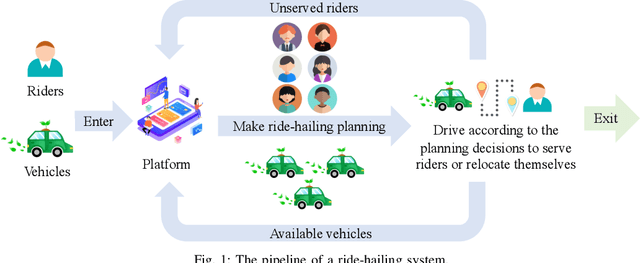
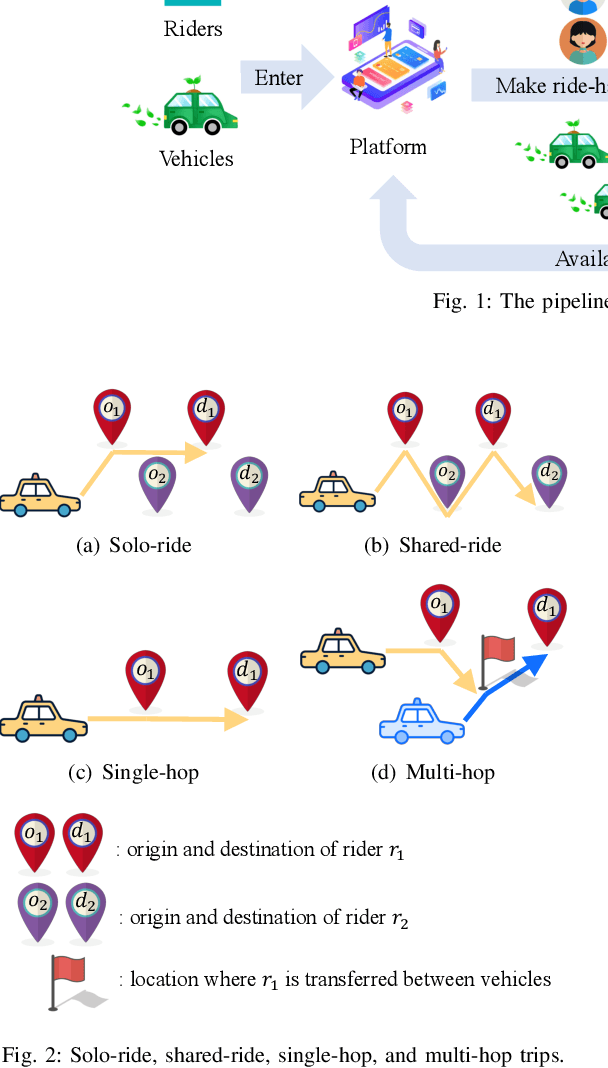
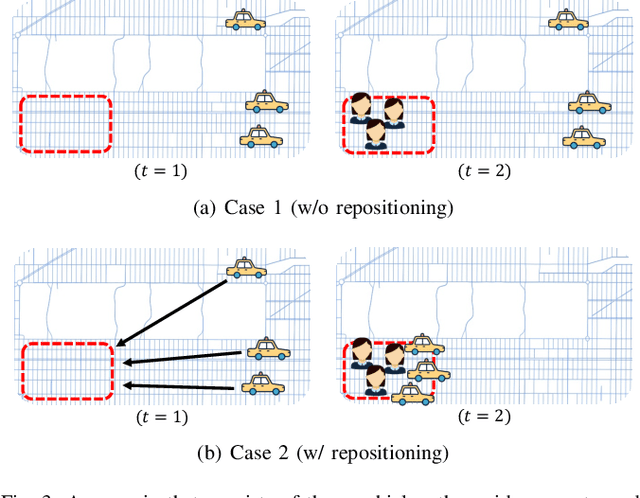
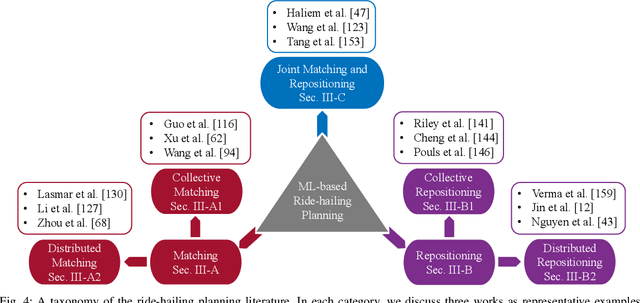
Ride-hailing is a sustainable transportation paradigm where riders access door-to-door traveling services through a mobile phone application, which has attracted a colossal amount of usage. There are two major planning tasks in a ride-hailing system: (1) matching, i.e., assigning available vehicles to pick up the riders, and (2) repositioning, i.e., proactively relocating vehicles to certain locations to balance the supply and demand of ride-hailing services. Recently, many studies of ride-hailing planning that leverage machine learning techniques have emerged. In this article, we present a comprehensive overview on latest developments of machine learning-based ride-hailing planning. To offer a clear and structured review, we introduce a taxonomy into which we carefully fit the different categories of related works according to the types of their planning tasks and solution schemes, which include collective matching, distributed matching, collective repositioning, distributed repositioning, and joint matching and repositioning. We further shed light on many real-world datasets and simulators that are indispensable for empirical studies on machine learning-based ride-hailing planning strategies. At last, we propose several promising research directions for this rapidly growing research and practical field.