 Add to Chrome
 Add to Firefox
 Add to Edge
Back to Back with a Copy: A Computational Analysis of AI-Generated Visual Contemporary Art Pastiches
Jul 22, 2026
The aim of this paper is twofold. First, it investigates whether newer generative models are getting better at pastiching contemporary artworks. Second, it explores the consistency of the multidimensional nature of stylistic evaluation across different LLMs. Building on previous work, we analyze stylistic similarity between AI generated pastiches and the original artworks of twelve contemporary artists. We used five complementary computer vision models to capture texture, color, semantics, composition, and perceptual features through cosine distance in high-dimensional embedding spaces. The distances obtained show that the newer image generation model that we used has produced pastiches with improved semantic alignment and greater diversity than the model used in previous work. However, it was slightly less performant on shallow features such as color, texture, and perceptual adherence. Our findings confirm that artistic style is inherently multidimensional, and measuring it does not depend on any spatial architecture. These quantitative findings are contextualized through feedback from human evaluators, which are the artists themselves.

RALS: Resources and Baselines for Romanian Automatic Lexical Simplification
Jul 22, 2026We introduce the first dataset that jointly covers both lexical complexity prediction (LCP) annotations and lexical simplification (LS) for Romanian, along with a comparison of lexical simplification approaches. We propose a methodology for ordering simplification suggestions using a pairwise ranking approximation method, arranging candidates from simple to complex based on a separate set of human judgments. In addition, we provide human lexical complexity annotations for 3,921 word samples in context. Finally, we explore several novel pipelines for complexity prediction and simplification and present the first text simplification system for Romanian.
Transformer and Hybrid Deep Learning Based Models for Machine-Generated Text Detection
May 28, 2024

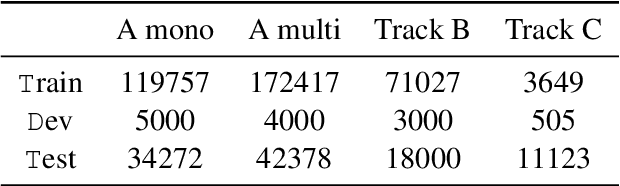

This paper describes the approach of the UniBuc - NLP team in tackling the SemEval 2024 Task 8: Multigenerator, Multidomain, and Multilingual Black-Box Machine-Generated Text Detection. We explored transformer-based and hybrid deep learning architectures. For subtask B, our transformer-based model achieved a strong \textbf{second-place} out of $77$ teams with an accuracy of \textbf{86.95\%}, demonstrating the architecture's suitability for this task. However, our models showed overfitting in subtask A which could potentially be fixed with less fine-tunning and increasing maximum sequence length. For subtask C (token-level classification), our hybrid model overfit during training, hindering its ability to detect transitions between human and machine-generated text.
Transformer based neural networks for emotion recognition in conversations
May 18, 2024This paper outlines the approach of the ISDS-NLP team in the SemEval 2024 Task 10: Emotion Discovery and Reasoning its Flip in Conversation (EDiReF). For Subtask 1 we obtained a weighted F1 score of 0.43 and placed 12 in the leaderboard. We investigate two distinct approaches: Masked Language Modeling (MLM) and Causal Language Modeling (CLM). For MLM, we employ pre-trained BERT-like models in a multilingual setting, fine-tuning them with a classifier to predict emotions. Experiments with varying input lengths, classifier architectures, and fine-tuning strategies demonstrate the effectiveness of this approach. Additionally, we utilize Mistral 7B Instruct V0.2, a state-of-the-art model, applying zero-shot and few-shot prompting techniques. Our findings indicate that while Mistral shows promise, MLMs currently outperform them in sentence-level emotion classification.
Designing NLP Systems That Adapt to Diverse Worldviews
May 18, 2024Natural Language Inference (NLI) is foundational for evaluating language understanding in AI. However, progress has plateaued, with models failing on ambiguous examples and exhibiting poor generalization. We argue that this stems from disregarding the subjective nature of meaning, which is intrinsically tied to an individual's \textit{weltanschauung} (which roughly translates to worldview). Existing NLP datasets often obscure this by aggregating labels or filtering out disagreement. We propose a perspectivist approach: building datasets that capture annotator demographics, values, and justifications for their labels. Such datasets would explicitly model diverse worldviews. Our initial experiments with a subset of the SBIC dataset demonstrate that even limited annotator metadata can improve model performance.
Automated Text Identification Using CNN and Training Dynamics
May 18, 2024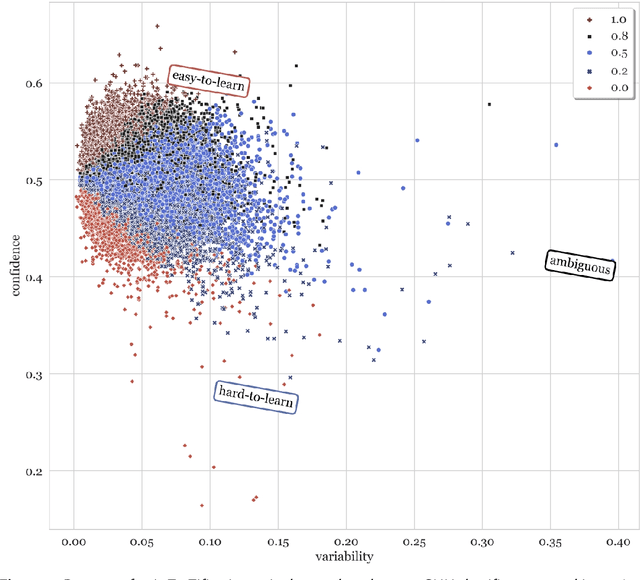
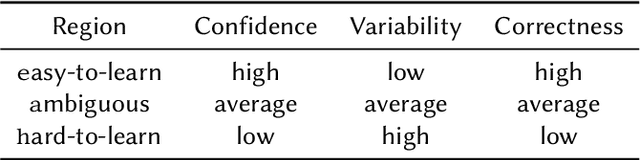
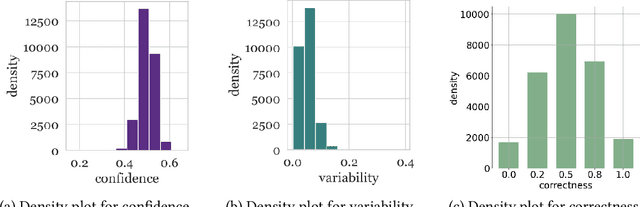
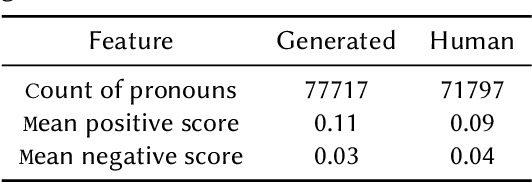
We used Data Maps to model and characterize the AuTexTification dataset. This provides insights about the behaviour of individual samples during training across epochs (training dynamics). We characterized the samples across 3 dimensions: confidence, variability and correctness. This shows the presence of 3 regions: easy-to-learn, ambiguous and hard-to-learn examples. We used a classic CNN architecture and found out that training the model only on a subset of ambiguous examples improves the model's out-of-distribution generalization.