 Add to Chrome
 Add to Firefox
 Add to Edge
Quantum Advantage in Multi Agent Reinforcement Learning
May 14, 2026
We present an empirical evaluation of quantum entanglement in agent coordination within quantum multi agent reinforcement learning (QMARL). While QMARL has attracted growing interest recently, most prior work evaluates quantum policies without provable baselines, making it impossible to rigorously distinguish quantum advantage from algorithmic coincidence. We address this directly by evaluating a decentralized QMARL framework with variational quantum circuit (VQC) actors with shared entangled states. In the CHSH game, which has a mathematically proven classical performance ceiling of 0.75 win rate, we show that entangled QMARL agents approach the Tsirelson limit of 0.854, providing clear evidence of their quantum advantage. We show that unentangled quantum circuits match the classical baseline, confirming that entanglement and not the quantum circuit itself is the active coordination mechanism. We also explore the effect of specific entanglement structures, as some Bell states enable coordination gains while others actively harm performance. On cooperative navigation (CoopNav), QMARL without entanglement achieves $\sim2\times$ improvement in success rate over classical MAA2C ($\sim$0.85 versus $\sim$0.40), with the hybrid configuration, quantum actor paired with a classical centralised critic, outperforming both fully classical and fully quantum solutions. We present our experimental analysis and discuss future work.

Finding the Weakest Link: Adversarial Attack against Multi-Agent Communications
May 13, 2026Multi-agent systems rely on communication for information sharing and action coordination, which exposes a vulnerability to attacks. We investigate single-victim communication perturbation attacks against Multi-Agent Reinforcement Learning-trained systems and propose methods that use gradient information from the Jacobian to identify which messages, agent, and timesteps are most susceptible to attack and have the greatest impact on the system. We enhance these methods with two proposed adversarial loss functions that trade-off attack success for attack impact which also create more effective perturbations. We empirically demonstrate the effectiveness of our methods against two different multi-agent communication methods in navigation, PredatorPrey, and TrafficJunction environments. Our results show that our novel message selection method achieves a similar or greater impact than random message selection across almost all tested scenarios. Our victim selection, message selection, tempo, and loss functions improve attack effectiveness in half of the thirty scenarios we tested.
ChatNVD: Advancing Cybersecurity Vulnerability Assessment with Large Language Models
Dec 06, 2024The increasing frequency and sophistication of cybersecurity vulnerabilities in software systems underscore the urgent need for robust and effective methods of vulnerability assessment. However, existing approaches often rely on highly technical and abstract frameworks, which hinders understanding and increases the likelihood of exploitation, resulting in severe cyberattacks. Given the growing adoption of Large Language Models (LLMs) across diverse domains, this paper explores their potential application in cybersecurity, specifically for enhancing the assessment of software vulnerabilities. We propose ChatNVD, an LLM-based cybersecurity vulnerability assessment tool leveraging the National Vulnerability Database (NVD) to provide context-rich insights and streamline vulnerability analysis for cybersecurity professionals, developers, and non-technical users. We develop three variants of ChatNVD, utilizing three prominent LLMs: GPT-4o mini by OpenAI, Llama 3 by Meta, and Gemini 1.5 Pro by Google. To evaluate their efficacy, we conduct a comparative analysis of these models using a comprehensive questionnaire comprising common security vulnerability questions, assessing their accuracy in identifying and analyzing software vulnerabilities. This study provides valuable insights into the potential of LLMs to address critical challenges in understanding and mitigation of software vulnerabilities.
SoK: Adversarial Machine Learning Attacks and Defences in Multi-Agent Reinforcement Learning
Jan 11, 2023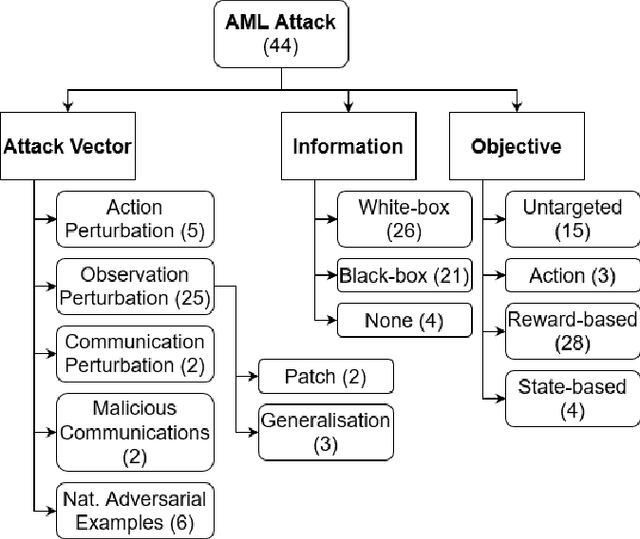
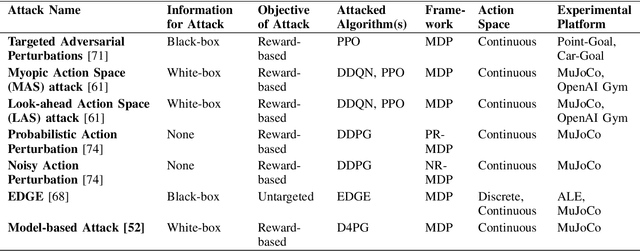
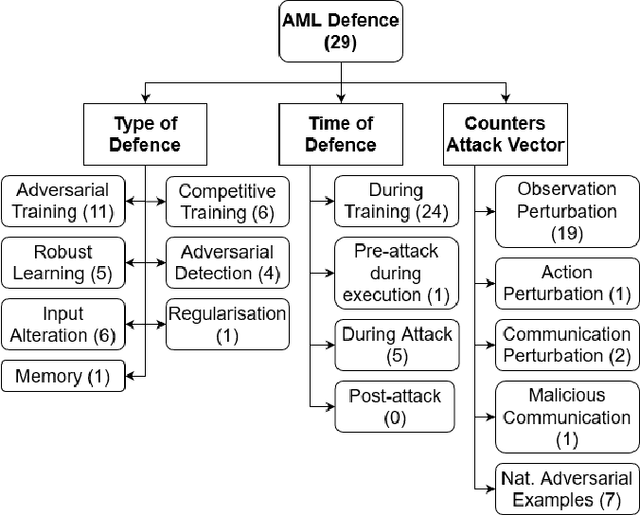
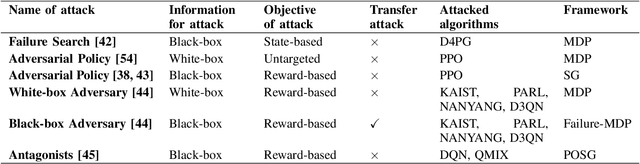
Multi-Agent Reinforcement Learning (MARL) is vulnerable to Adversarial Machine Learning (AML) attacks and needs adequate defences before it can be used in real world applications. We have conducted a survey into the use of execution-time AML attacks against MARL and the defences against those attacks. We surveyed related work in the application of AML in Deep Reinforcement Learning (DRL) and Multi-Agent Learning (MAL) to inform our analysis of AML for MARL. We propose a novel perspective to understand the manner of perpetrating an AML attack, by defining Attack Vectors. We develop two new frameworks to address a gap in current modelling frameworks, focusing on the means and tempo of an AML attack against MARL, and identify knowledge gaps and future avenues of research.