 Add to Chrome
 Add to Firefox
 Add to Edge
Reproducing FACTER: Fairness via Conformal Thresholding and Prompt Repair
Jun 26, 2026
Fayyazi et al. (2025) recently proposed FACTER, a model-agnostic framework designed to jointly enforce fairness and statistical coverage in LLM-based recommendation through conformal thresholding and iterative prompt repair. In this work, we conduct a reproducibility study of the FACTER framework across diverse architectures and dataset sparsity levels, evaluating both the original open-ended generation task and a constrained re-ranking extension. Under the strict reproduction, we observe a divergence in recommendation utility, which we trace to underspecified target-set evaluation in the original study. We then use the constrained re-ranking setting to evaluate FACTER when the candidate set is fixed, and introduce a static Fair Zero-Shot baseline to isolate the contribution of the iterative prompt repair loop. Our analysis shows that FACTER consistently reduces adaptive-threshold violation counts, but that these reductions are not consistently reflected under the fixed threshold or in global fairness metrics. In the constrained ranking setting, static fairness instructions achieve comparable semantic-parity outcomes to FACTER's dynamic repair loop, suggesting that the additional online repair mechanism provides limited benefit in this formulation. All code and reproduction artifacts are available at https://github.com/oscar-omlf/facter-repr.

FairDiverse: A Comprehensive Toolkit for Fair and Diverse Information Retrieval Algorithms
Feb 17, 2025In modern information retrieval (IR). achieving more than just accuracy is essential to sustaining a healthy ecosystem, especially when addressing fairness and diversity considerations. To meet these needs, various datasets, algorithms, and evaluation frameworks have been introduced. However, these algorithms are often tested across diverse metrics, datasets, and experimental setups, leading to inconsistencies and difficulties in direct comparisons. This highlights the need for a comprehensive IR toolkit that enables standardized evaluation of fairness- and diversity-aware algorithms across different IR tasks. To address this challenge, we present FairDiverse, an open-source and standardized toolkit. FairDiverse offers a framework for integrating fair and diverse methods, including pre-processing, in-processing, and post-processing techniques, at different stages of the IR pipeline. The toolkit supports the evaluation of 28 fairness and diversity algorithms across 16 base models, covering two core IR tasks (search and recommendation) thereby establishing a comprehensive benchmark. Moreover, FairDiverse is highly extensible, providing multiple APIs that empower IR researchers to swiftly develop and evaluate their own fairness and diversity aware models, while ensuring fair comparisons with existing baselines. The project is open-sourced and available on https://github.com/XuChen0427/FairDiverse.
Closing the Gender Wage Gap: Adversarial Fairness in Job Recommendation
Sep 20, 2022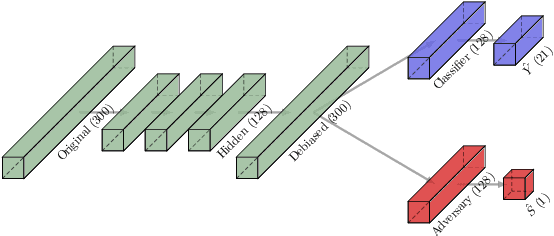
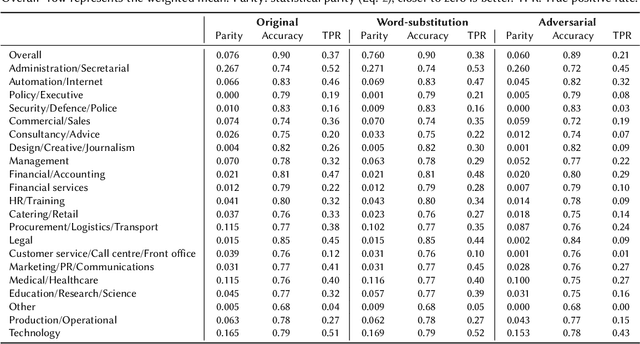
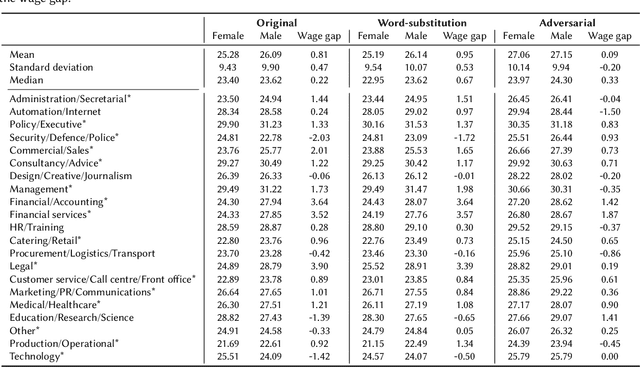
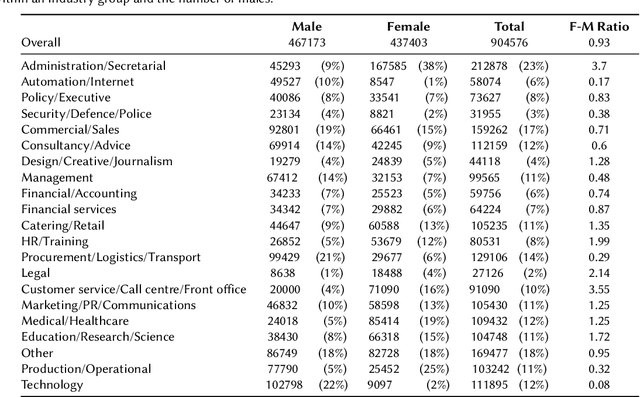
The goal of this work is to help mitigate the already existing gender wage gap by supplying unbiased job recommendations based on resumes from job seekers. We employ a generative adversarial network to remove gender bias from word2vec representations of 12M job vacancy texts and 900k resumes. Our results show that representations created from recruitment texts contain algorithmic bias and that this bias results in real-world consequences for recommendation systems. Without controlling for bias, women are recommended jobs with significantly lower salary in our data. With adversarially fair representations, this wage gap disappears, meaning that our debiased job recommendations reduce wage discrimination. We conclude that adversarial debiasing of word representations can increase real-world fairness of systems and thus may be part of the solution for creating fairness-aware recommendation systems.