 Add to Chrome
 Add to Firefox
 Add to Edge
TransX: Scaling Transformer-based Recommendation via Behavioral and Serving Stream Crossings
Jul 31, 2026
Modern industrial recommender systems (RecSys) increasingly adopt Transformer-based sequence models, with an emerging paradigm that frames recommendation as next-token prediction over a unified monolithic user sequence. However, collapsing heterogeneous data sources -- such as long-term user behaviors and real-time serving events -- into a single monolithic token stream that obscures their distinct causal roles and temporal characteristics, leading to inefficient modeling and elevated training and serving costs. We propose TransX, a production-oriented encoder-decoder architecture that reformulates recommendation as a sequence-to-sequence action transduction problem. TransX explicitly decouples behavior-stream modeling from serving-event modeling and conditions next-action decoding on scalable cross-attention between nearline behavior encodings and real-time serving representations. To enable low-latency, high-QPS deployment, TransX is co-designed with an amortized serving strategy that combines incremental behavior encoding with per-request key-value caching, rendering serving latency insensitive to behavior sequence length. Extensive offline experiments and large-scale online A/B tests on LinkedIn's recommender systems show that TransX consistently outperforms state-of-the-art DLRMs and sequential baselines, and delivers substantial CTR lift (+6.0%) and conversion gain (+4.4%) while maintaining serving costs comparable to existing production models where our co-designed serving strategy reduces online computation by approximately 80%.

Survey for Landing Generative AI in Social and E-commerce Recsys -- the Industry Perspectives
Jun 10, 2024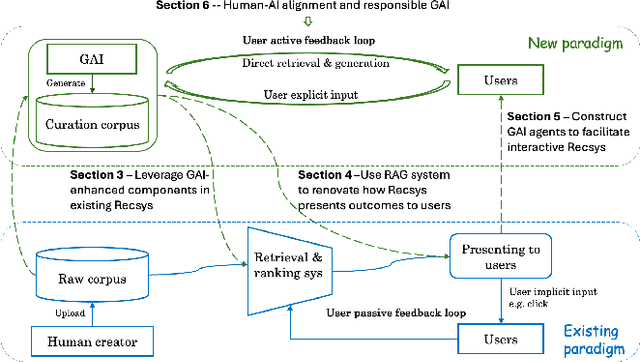
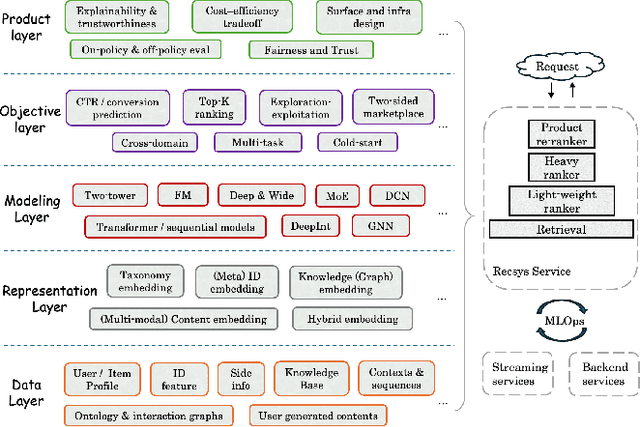
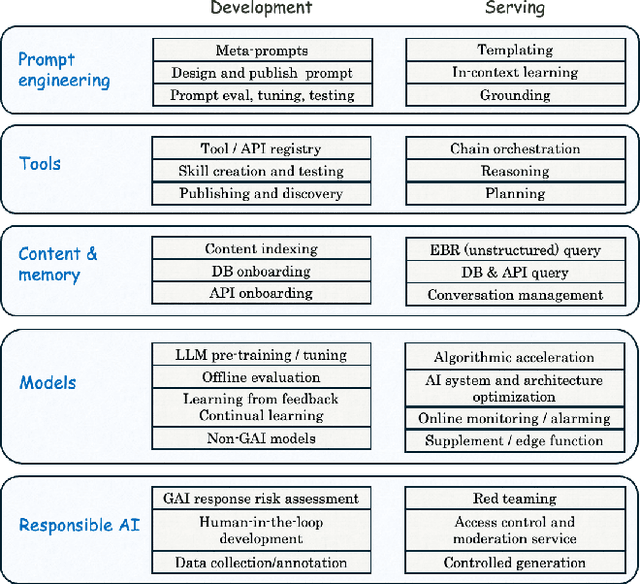
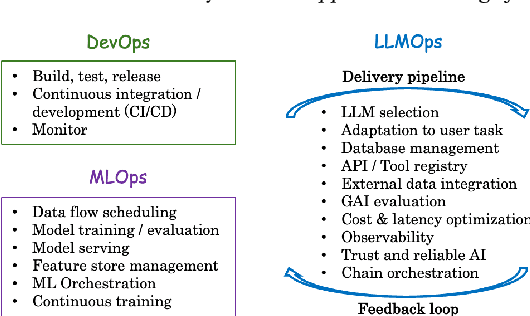
Recently, generative AI (GAI), with their emerging capabilities, have presented unique opportunities for augmenting and revolutionizing industrial recommender systems (Recsys). Despite growing research efforts at the intersection of these fields, the integration of GAI into industrial Recsys remains in its infancy, largely due to the intricate nature of modern industrial Recsys infrastructure, operations, and product sophistication. Drawing upon our experiences in successfully integrating GAI into several major social and e-commerce platforms, this survey aims to comprehensively examine the underlying system and AI foundations, solution frameworks, connections to key research advancements, as well as summarize the practical insights and challenges encountered in the endeavor to integrate GAI into industrial Recsys. As pioneering work in this domain, we hope outline the representative developments of relevant fields, shed lights on practical GAI adoptions in the industry, and motivate future research.