 Add to Chrome
 Add to Firefox
 Add to Edge
TransX: Scaling Transformer-based Recommendation via Behavioral and Serving Stream Crossings
Jul 31, 2026
Modern industrial recommender systems (RecSys) increasingly adopt Transformer-based sequence models, with an emerging paradigm that frames recommendation as next-token prediction over a unified monolithic user sequence. However, collapsing heterogeneous data sources -- such as long-term user behaviors and real-time serving events -- into a single monolithic token stream that obscures their distinct causal roles and temporal characteristics, leading to inefficient modeling and elevated training and serving costs. We propose TransX, a production-oriented encoder-decoder architecture that reformulates recommendation as a sequence-to-sequence action transduction problem. TransX explicitly decouples behavior-stream modeling from serving-event modeling and conditions next-action decoding on scalable cross-attention between nearline behavior encodings and real-time serving representations. To enable low-latency, high-QPS deployment, TransX is co-designed with an amortized serving strategy that combines incremental behavior encoding with per-request key-value caching, rendering serving latency insensitive to behavior sequence length. Extensive offline experiments and large-scale online A/B tests on LinkedIn's recommender systems show that TransX consistently outperforms state-of-the-art DLRMs and sequential baselines, and delivers substantial CTR lift (+6.0%) and conversion gain (+4.4%) while maintaining serving costs comparable to existing production models where our co-designed serving strategy reduces online computation by approximately 80%.

LiMAML: Personalization of Deep Recommender Models via Meta Learning
Feb 23, 2024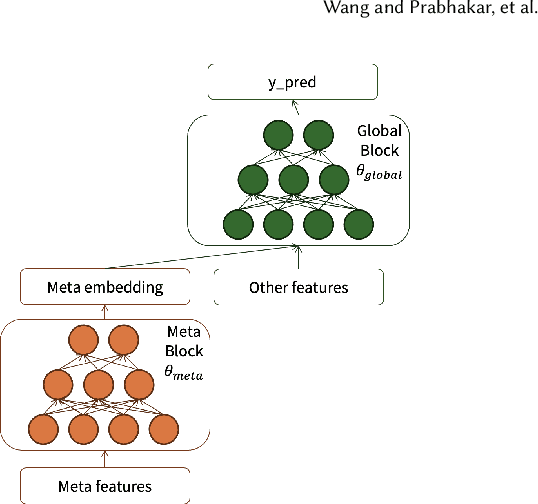
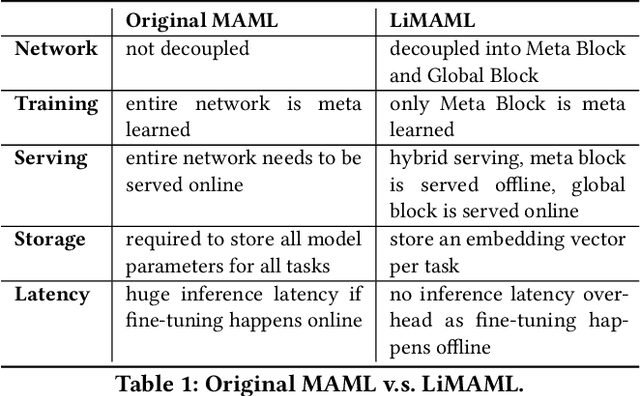
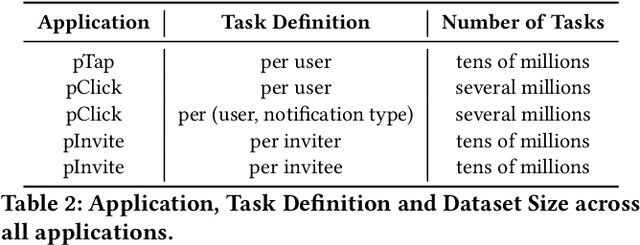

In the realm of recommender systems, the ubiquitous adoption of deep neural networks has emerged as a dominant paradigm for modeling diverse business objectives. As user bases continue to expand, the necessity of personalization and frequent model updates have assumed paramount significance to ensure the delivery of relevant and refreshed experiences to a diverse array of members. In this work, we introduce an innovative meta-learning solution tailored to the personalization of models for individual members and other entities, coupled with the frequent updates based on the latest user interaction signals. Specifically, we leverage the Model-Agnostic Meta Learning (MAML) algorithm to adapt per-task sub-networks using recent user interaction data. Given the near infeasibility of productionizing original MAML-based models in online recommendation systems, we propose an efficient strategy to operationalize meta-learned sub-networks in production, which involves transforming them into fixed-sized vectors, termed meta embeddings, thereby enabling the seamless deployment of models with hundreds of billions of parameters for online serving. Through extensive experimentation on production data drawn from various applications at LinkedIn, we demonstrate that the proposed solution consistently outperforms the baseline models of those applications, including strong baselines such as using wide-and-deep ID based personalization approach. Our approach has enabled the deployment of a range of highly personalized AI models across diverse LinkedIn applications, leading to substantial improvements in business metrics as well as refreshed experience for our members.