 Add to Chrome
 Add to Firefox
 Add to Edge
DIVER-1 : Deep Integration of Vast Electrophysiological Recordings at Scale
Dec 22, 2025
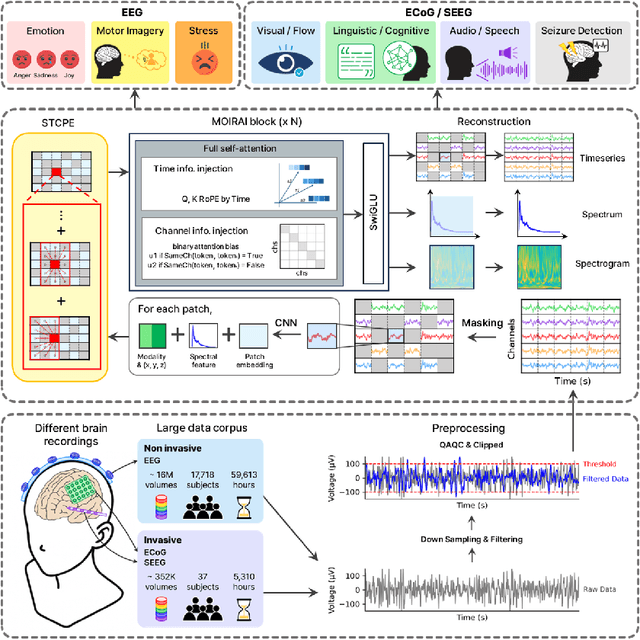
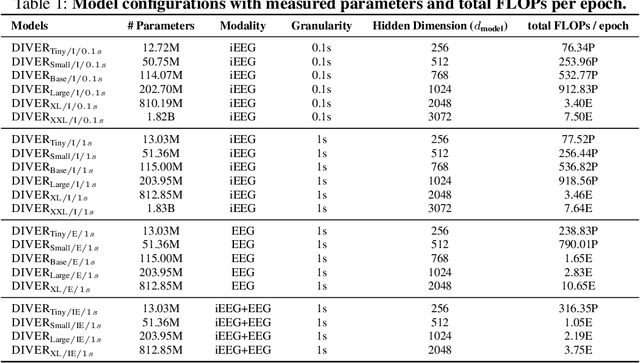
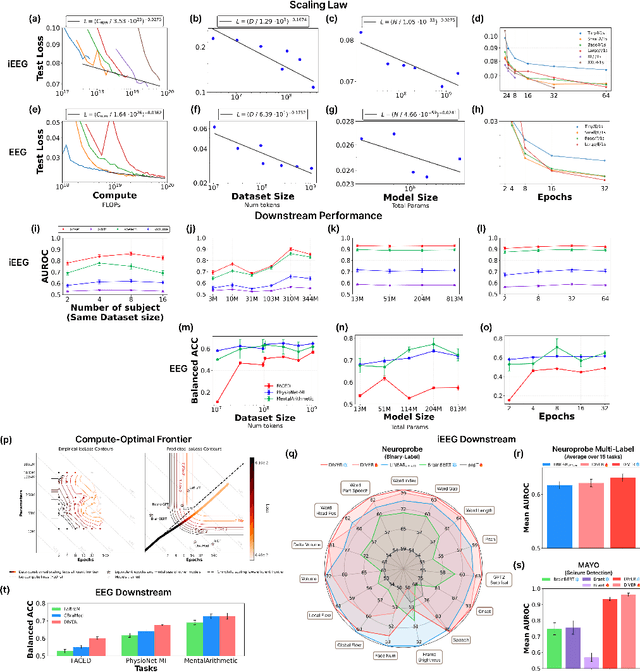
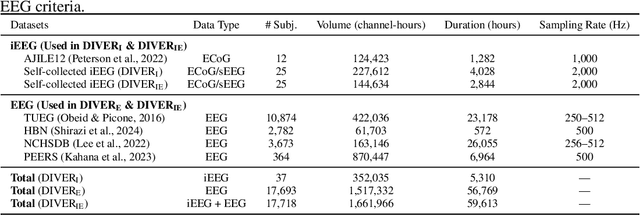
Electrophysiology signals such as EEG and iEEG are central to neuroscience, brain-computer interfaces, and clinical applications, yet existing foundation models remain limited in scale despite clear evidence that scaling improves performance. We introduce DIVER-1, a family of EEG and iEEG foundation models trained on the largest and most diverse corpus to date-5.3k hours of iEEG and 54k hours of EEG (1.6M channel-hours from over 17.7k subjects)-and scaled up to 1.82B parameters. We present the first systematic scaling law analysis for this domain, showing that they follow data-constrained scaling laws: for a given amount of data and compute, smaller models trained for extended epochs consistently outperform larger models trained briefly. This behavior contrasts with prior electrophysiology foundation models that emphasized model size over training duration. To achieve strong performance, we also design architectural innovations including any-variate attention, sliding temporal conditional positional encoding, and multi-domain reconstruction. DIVER-1 iEEG and EEG models each achieve state-of-the-art performance on their respective benchmarks, establishing a concrete guidelines for efficient scaling and resource allocation in electrophysiology foundation model development.

On the Information Processing of One-Dimensional Wasserstein Distances with Finite Samples
Nov 17, 2025Leveraging the Wasserstein distance -- a summation of sample-wise transport distances in data space -- is advantageous in many applications for measuring support differences between two underlying density functions. However, when supports significantly overlap while densities exhibit substantial pointwise differences, it remains unclear whether and how this transport information can accurately identify these differences, particularly their analytic characterization in finite-sample settings. We address this issue by conducting an analysis of the information processing capabilities of the one-dimensional Wasserstein distance with finite samples. By utilizing the Poisson process and isolating the rate factor, we demonstrate the capability of capturing the pointwise density difference with Wasserstein distances and how this information harmonizes with support differences. The analyzed properties are confirmed using neural spike train decoding and amino acid contact frequency data. The results reveal that the one-dimensional Wasserstein distance highlights meaningful density differences related to both rate and support.