 Add to Chrome
 Add to Firefox
 Add to Edge
DIVER-1 : Deep Integration of Vast Electrophysiological Recordings at Scale
Dec 22, 2025
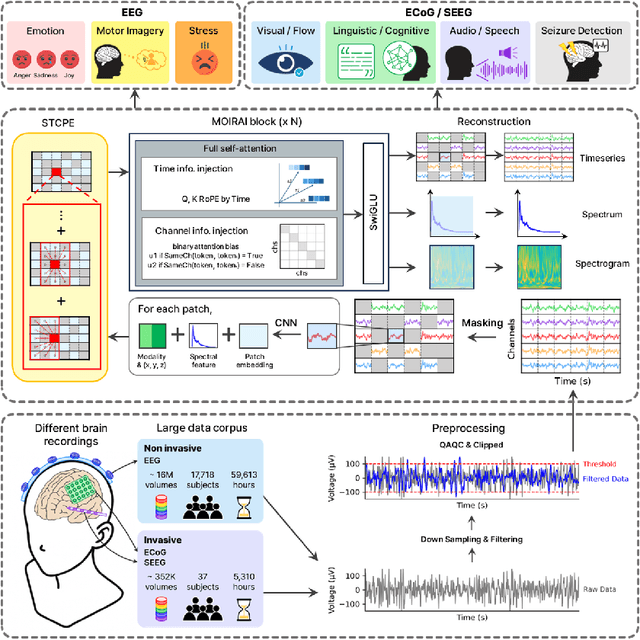
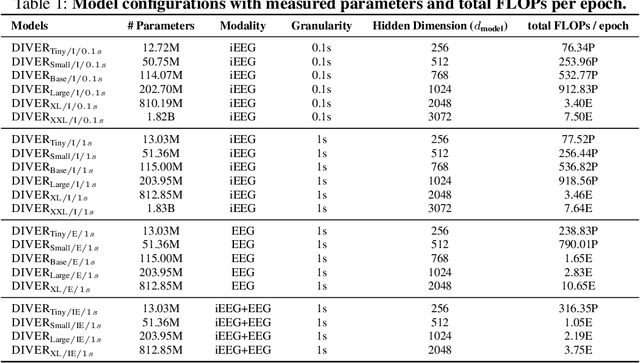
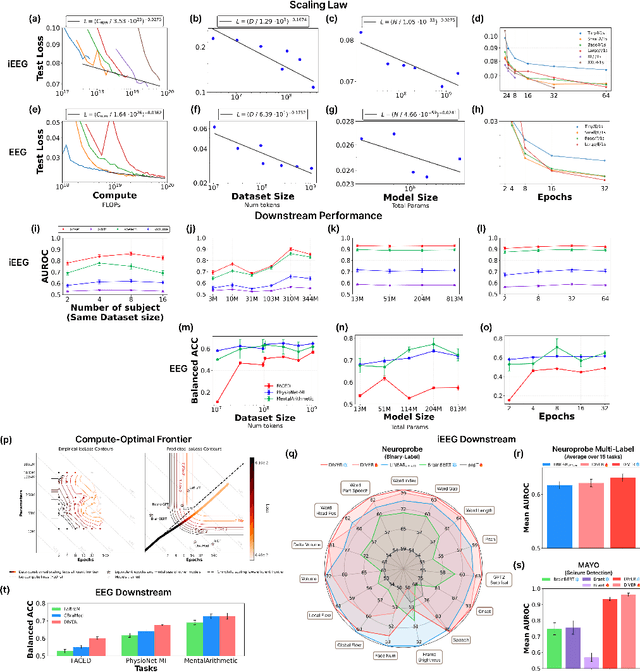
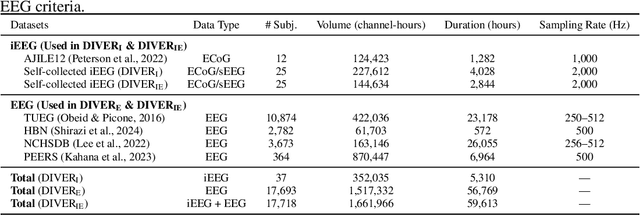
Electrophysiology signals such as EEG and iEEG are central to neuroscience, brain-computer interfaces, and clinical applications, yet existing foundation models remain limited in scale despite clear evidence that scaling improves performance. We introduce DIVER-1, a family of EEG and iEEG foundation models trained on the largest and most diverse corpus to date-5.3k hours of iEEG and 54k hours of EEG (1.6M channel-hours from over 17.7k subjects)-and scaled up to 1.82B parameters. We present the first systematic scaling law analysis for this domain, showing that they follow data-constrained scaling laws: for a given amount of data and compute, smaller models trained for extended epochs consistently outperform larger models trained briefly. This behavior contrasts with prior electrophysiology foundation models that emphasized model size over training duration. To achieve strong performance, we also design architectural innovations including any-variate attention, sliding temporal conditional positional encoding, and multi-domain reconstruction. DIVER-1 iEEG and EEG models each achieve state-of-the-art performance on their respective benchmarks, establishing a concrete guidelines for efficient scaling and resource allocation in electrophysiology foundation model development.

Mind the Gap: Aligning the Brain with Language Models Requires a Nonlinear and Multimodal Approach
Feb 18, 2025Self-supervised language and audio models effectively predict brain responses to speech. However, traditional prediction models rely on linear mappings from unimodal features, despite the complex integration of auditory signals with linguistic and semantic information across widespread brain networks during speech comprehension. Here, we introduce a nonlinear, multimodal prediction model that combines audio and linguistic features from pre-trained models (e.g., LLAMA, Whisper). Our approach achieves a 17.2% and 17.9% improvement in prediction performance (unnormalized and normalized correlation) over traditional unimodal linear models, as well as a 7.7% and 14.4% improvement, respectively, over prior state-of-the-art models. These improvements represent a major step towards future robust in-silico testing and improved decoding performance. They also reveal how auditory and semantic information are fused in motor, somatosensory, and higher-level semantic regions, aligning with existing neurolinguistic theories. Overall, our work highlights the often neglected potential of nonlinear and multimodal approaches to brain modeling, paving the way for future studies to embrace these strategies in naturalistic neurolinguistics research.