 Add to Chrome
 Add to Firefox
 Add to Edge
Cheaper is Better: A Discount-Aware Network for Conversion Rate Prediction in E-commerce Recommendation System
Jul 14, 2026
Post-click conversion rate (CVR) is a crucial element in online recommendation systems, which addresses significant challenges such as data sparsity (DS), sample selection bias (SSB), and delayed feedback. However, the impact of item discount rate-a key factor influencing both pricing and user purchasing behavior, has received limited attention. In this paper, we introduce the Discount-Aware Network (DANet) to model the relationship between item discount rates and CVR. DANet comprises three main components: 1) a time-frequency transformation module that utilizes Fourier transform to derive the frequency spectrum and capture the long-term discount rate trends of items; 2) a distribution de-bias module designed to mitigate the biases in user-specific discount rates caused by various purchase combinations and promotional activities, as well as periodic deviations linked to different promotion periods on e-commerce platforms; and 3) a supervised regression auxiliary task that establishes the explicit item discount labels to enhance the model's performance in terms of value accuracy, facilitating an effective representation of item discount rates. Experimental results on real datasets demonstrate the superiority of DANet, with offline AUC improving by 1.61%, and online A/B test also shows that DANet achieves impressive gains of 3.63% on pCVR and 2.23% on GMV. DANet has been successfully deployed on Alibaba Tmall APP. The code is available at https://github.com/tangrc/DANet.

Appformer: A Novel Framework for Mobile App Usage Prediction Leveraging Progressive Multi-Modal Data Fusion and Feature Extraction
Jul 28, 2024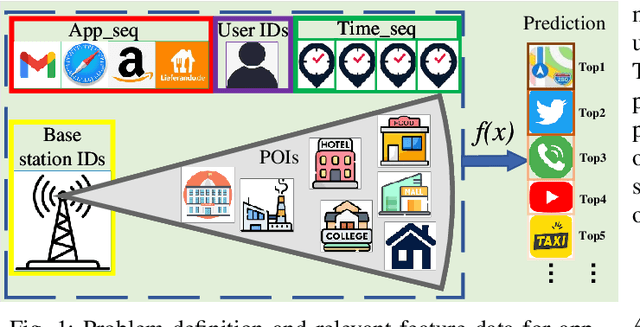
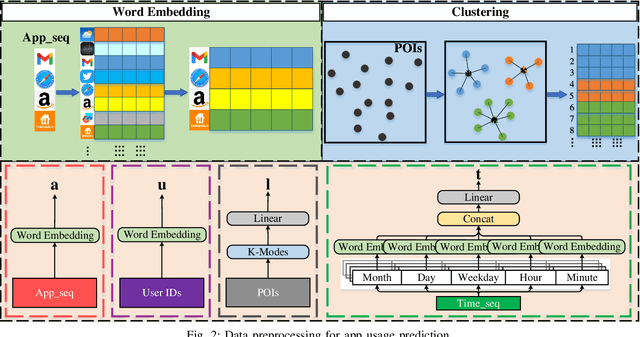
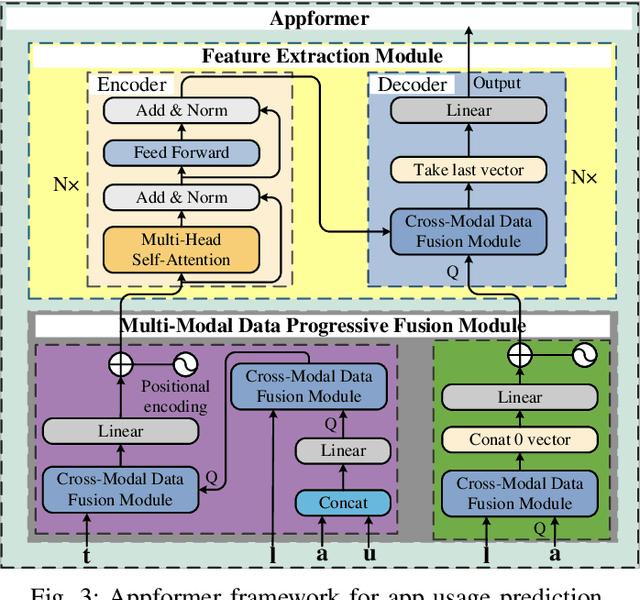
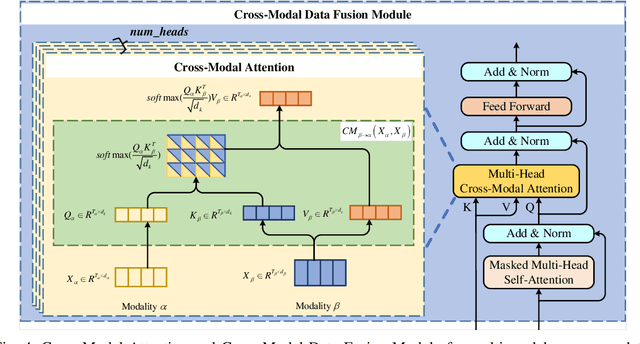
This article presents Appformer, a novel mobile application prediction framework inspired by the efficiency of Transformer-like architectures in processing sequential data through self-attention mechanisms. Combining a Multi-Modal Data Progressive Fusion Module with a sophisticated Feature Extraction Module, Appformer leverages the synergies of multi-modal data fusion and data mining techniques while maintaining user privacy. The framework employs Points of Interest (POIs) associated with base stations, optimizing them through comprehensive comparative experiments to identify the most effective clustering method. These refined inputs are seamlessly integrated into the initial phases of cross-modal data fusion, where temporal units are encoded via word embeddings and subsequently merged in later stages. The Feature Extraction Module, employing Transformer-like architectures specialized for time series analysis, adeptly distils comprehensive features. It meticulously fine-tunes the outputs from the fusion module, facilitating the extraction of high-calibre, multi-modal features, thus guaranteeing a robust and efficient extraction process. Extensive experimental validation confirms Appformer's effectiveness, attaining state-of-the-art (SOTA) metrics in mobile app usage prediction, thereby signifying a notable progression in this field.