 Add to Chrome
 Add to Firefox
 Add to Edge
Inter-Residue Geometry Attention for Antibody-Specific Epitope Prediction
Aug 02, 2026
Antibody-specific epitope prediction aims to identify which antigen residues are recognized by a given antibody, a task that depends on the three-dimensional complementarity between antibody CDRs and the antigen surface. Existing methods usually leverage PLM embeddings and inject structure through additional graph, surface, or point-cloud encoders, where the positional mechanism inside attention remains largely tied to one-dimensional sequence order. For proteins, the analogue of a token offset is not only sequence separation, but also the three-dimensional displacement between residues after folding. This raises a question, can folded residue geometry serve as the positional mechanism of attention itself? We propose Local-Frame 3D Rotary Position Encoding (LF3DRoPE), which expresses inter-residue displacements in backbone-defined local frames and injects them directly into rotary attention. This design preserves continuous directional geometry while ensuring invariance to global $\mathrm{SE}(3)$ transformations. On the AsEP benchmark, LF3DRoPE achieves state-of-the-art $\mathrm{MCC}$ on both ratio and epitope-group splits. Ablations and rigid transformation tests show that local three-dimensional geometry provides information beyond sequence-order attention while preserving invariance to arbitrary global coordinate systems. Mutation ranking results further indicate that LF3DRoPE captures antigen-specific structural compatibility.

Interleaved Tool-Call Reasoning for Protein Function Understanding
Jan 07, 2026Recent advances in large language models (LLMs) have highlighted the effectiveness of chain-of-thought reasoning in symbolic domains such as mathematics and programming. However, our study shows that directly transferring such text-based reasoning paradigms to protein function understanding is ineffective: reinforcement learning mainly amplifies superficial keyword patterns while failing to introduce new biological knowledge, resulting in limited generalization. We argue that protein function prediction is a knowledge-intensive scientific task that fundamentally relies on external biological priors and computational tools rather than purely internal reasoning. To address this gap, we propose PFUA, a tool-augmented protein reasoning agent that unifies problem decomposition, tool invocation, and grounded answer generation. Instead of relying on long unconstrained reasoning traces, PFUA integrates domain-specific tools to produce verifiable intermediate evidence. Experiments on four benchmarks demonstrate that PFUA consistently outperforms text-only reasoning models with an average performance improvement of 103%.
ProtTeX: Structure-In-Context Reasoning and Editing of Proteins with Large Language Models
Mar 13, 2025Large language models have made remarkable progress in the field of molecular science, particularly in understanding and generating functional small molecules. This success is largely attributed to the effectiveness of molecular tokenization strategies. In protein science, the amino acid sequence serves as the sole tokenizer for LLMs. However, many fundamental challenges in protein science are inherently structure-dependent. The absence of structure-aware tokens significantly limits the capabilities of LLMs for comprehensive biomolecular comprehension and multimodal generation. To address these challenges, we introduce a novel framework, ProtTeX, which tokenizes the protein sequences, structures, and textual information into a unified discrete space. This innovative approach enables joint training of the LLM exclusively through the Next-Token Prediction paradigm, facilitating multimodal protein reasoning and generation. ProtTeX enables general LLMs to perceive and process protein structures through sequential text input, leverage structural information as intermediate reasoning components, and generate or manipulate structures via sequential text output. Experiments demonstrate that our model achieves significant improvements in protein function prediction, outperforming the state-of-the-art domain expert model with a twofold increase in accuracy. Our framework enables high-quality conformational generation and customizable protein design. For the first time, we demonstrate that by adopting the standard training and inference pipelines from the LLM domain, ProtTeX empowers decoder-only LLMs to effectively address diverse spectrum of protein-related tasks.
ProTeX: Structure-In-Context Reasoning and Editing of Proteins with Large Language Models
Mar 11, 2025Large language models have made remarkable progress in the field of molecular science, particularly in understanding and generating functional small molecules. This success is largely attributed to the effectiveness of molecular tokenization strategies. In protein science, the amino acid sequence serves as the sole tokenizer for LLMs. However, many fundamental challenges in protein science are inherently structure-dependent. The absence of structure-aware tokens significantly limits the capabilities of LLMs for comprehensive biomolecular comprehension and multimodal generation. To address these challenges, we introduce a novel framework, ProTeX, which tokenizes the protein sequences, structures, and textual information into a unified discrete space. This innovative approach enables joint training of the LLM exclusively through the Next-Token Prediction paradigm, facilitating multimodal protein reasoning and generation. ProTeX enables general LLMs to perceive and process protein structures through sequential text input, leverage structural information as intermediate reasoning components, and generate or manipulate structures via sequential text output. Experiments demonstrate that our model achieves significant improvements in protein function prediction, outperforming the state-of-the-art domain expert model with a twofold increase in accuracy. Our framework enables high-quality conformational generation and customizable protein design. For the first time, we demonstrate that by adopting the standard training and inference pipelines from the LLM domain, ProTeX empowers decoder-only LLMs to effectively address diverse spectrum of protein-related tasks.
ChatMol: A Versatile Molecule Designer Based on the Numerically Enhanced Large Language Model
Feb 27, 2025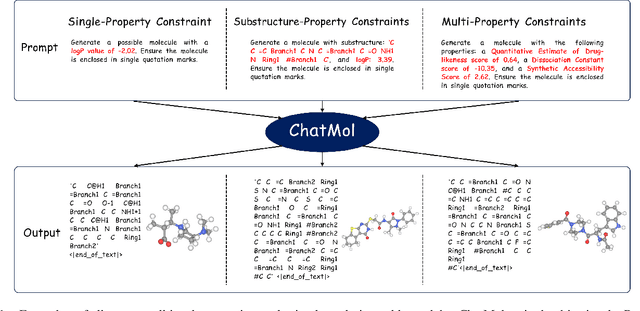
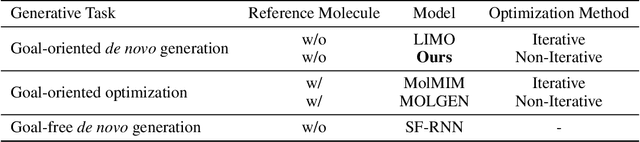
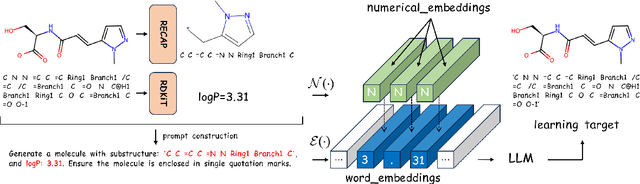
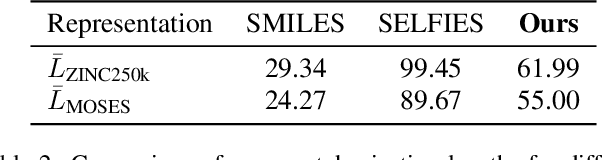
Goal-oriented de novo molecule design, namely generating molecules with specific property or substructure constraints, is a crucial yet challenging task in drug discovery. Existing methods, such as Bayesian optimization and reinforcement learning, often require training multiple property predictors and struggle to incorporate substructure constraints. Inspired by the success of Large Language Models (LLMs) in text generation, we propose ChatMol, a novel approach that leverages LLMs for molecule design across diverse constraint settings. Initially, we crafted a molecule representation compatible with LLMs and validated its efficacy across multiple online LLMs. Afterwards, we developed specific prompts geared towards diverse constrained molecule generation tasks to further fine-tune current LLMs while integrating feedback learning derived from property prediction. Finally, to address the limitations of LLMs in numerical recognition, we referred to the position encoding method and incorporated additional encoding for numerical values within the prompt. Experimental results across single-property, substructure-property, and multi-property constrained tasks demonstrate that ChatMol consistently outperforms state-of-the-art baselines, including VAE and RL-based methods. Notably, in multi-objective binding affinity maximization task, ChatMol achieves a significantly lower KD value of 0.25 for the protein target ESR1, while maintaining the highest overall performance, surpassing previous methods by 4.76%. Meanwhile, with numerical enhancement, the Pearson correlation coefficient between the instructed property values and those of the generated molecules increased by up to 0.49. These findings highlight the potential of LLMs as a versatile framework for molecule generation, offering a promising alternative to traditional latent space and RL-based approaches.